
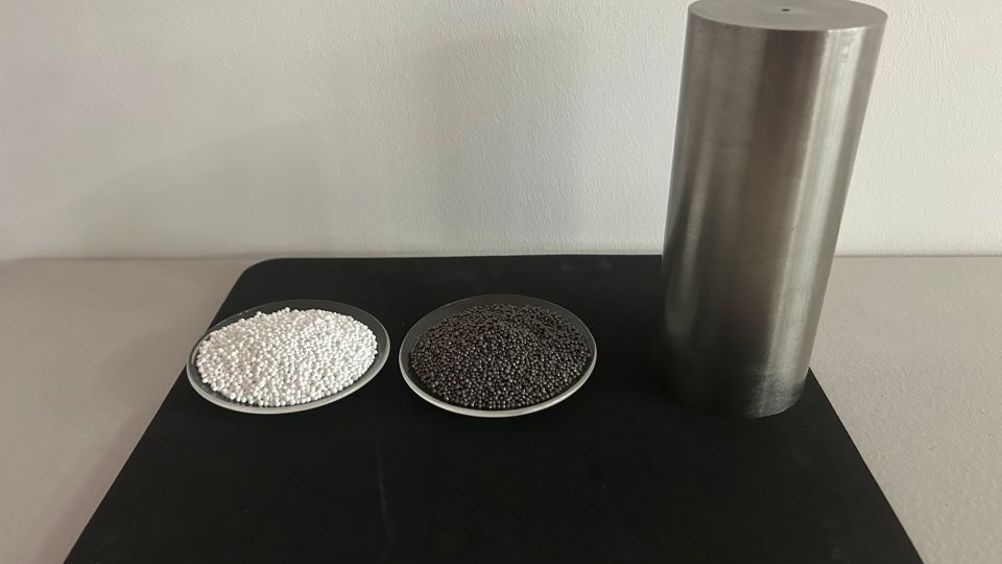
The 24-month programme will focus on advancing the company’s patented Metalysis FFC Process to enable larger-scale, sustainable production of titanium, a material widely used in space and aerospace systems. The initiative is intended to support the development of a more secure and environmentally sustainable supply route for the metal.
The project will be delivered by a consortium led by Metalysis and involves Lucideon, TTP Plc, NCHG Ltd and RHP‑Technology GmbH.
Titanium is a critical engineering material in spacecraft and aerospace structures due to its high strength-to-weight ratio, corrosion resistance and ability to perform at elevated temperatures.
However, most titanium production currently relies on the long-established Kroll process, which involves several processing stages including chemical reduction, melting and thermomechanical treatment.
This conventional production route is associated with high energy consumption and the use of chlorine gas, while also generating hazardous by-products.
Metalysis’ FFC technology takes a different approach by reducing metal oxides through molten salt electrolysis. The process removes oxygen directly from solid metal oxides, producing metallic powders without the multiple melting stages required in the Kroll route.
According to the company, the method can reduce energy requirements and simplify alloy production by allowing direct electrochemical control over composition.
The technology is currently deployed in the company’s GEN-3 and GEN-4 reactor systems, which produce titanium powder for additive manufacturing applications. The new ESA-funded programme aims to extend the process to continuous or quasi-continuous operation, enabling higher production volumes suitable for wider industrial use.
Supply chain considerations have also become more prominent in recent years. Prior to 2022, a large share of titanium sponge used by Western aerospace manufacturers originated from Russia, while China is now estimated to supply the majority of global output. This has increased interest in developing alternative production routes within Europe and allied economies.
In a statement, Metalysis CEO Nitesh Shah said: “The near €1m from ESA to our consortia, led by Metalysis, is further endorsement in our technology and reflects the strategic need across the space, as well as aerospace, defence, hypersonics and wider advanced manufacturing sectors for industrial outputs of critical metals – in this case titanium. Scaling-up our technology to continuous or semi-continuous production will help drive the western supply of sustainable titanium – as the Metalysis FFC process is leaner, greener and cleaner than traditional titanium manufacturing processes”.
In addition to terrestrial manufacturing, the company’s electrolysis technology is also being explored for oxygen extraction from metal oxides in lunar regolith. By using an oxygen-evolving anode rather than carbon, the process releases oxygen gas that can potentially be captured and used for propulsion systems or life-support applications in space environments.
The technology has been selected by the European Space Agency as the basis for several of its oxygen extraction research programmes. The new project is expected to support further development of scalable production methods while addressing the demand for secure supplies of critical metals used across space, aerospace and advanced manufacturing sectors.