
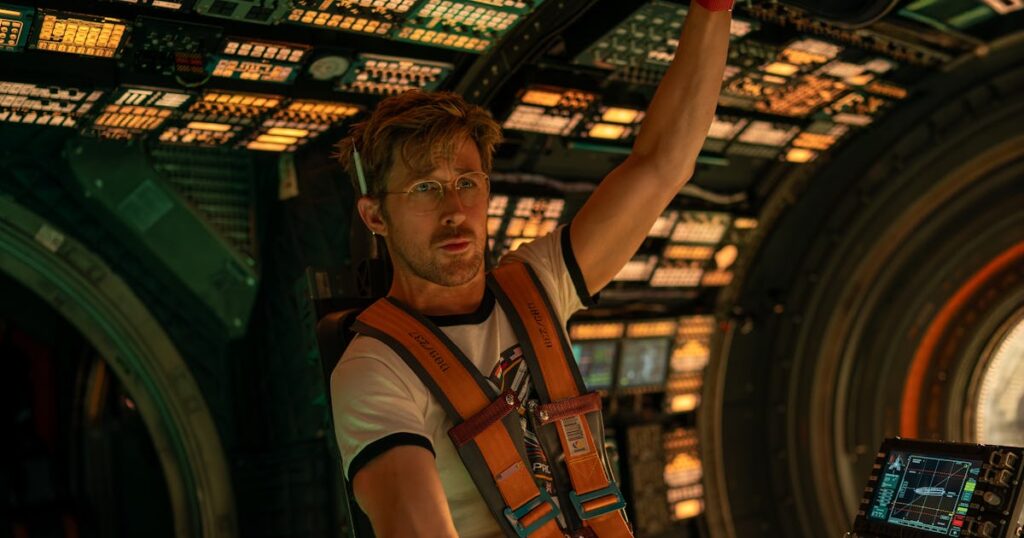
Project Hail Mary kicks off with an intriguing premise: A man wakes up on a spaceship with no memory of who he is or how he got there. But as his memories gradually become untangled, he is suddenly met with another unexpected incident: the arrival of a gigantic alien spaceship.
A first contact story is nothing new — it’s the kind of far-future sci-fi story that has been a staple of the genre for decades — but Andy Weir’s 2021 novel, like his acclaimed 2011 debut The Martian, took great pains to ground the fiction in as much hard science as possible. Weir gave us lengthy descriptions about how gravity works, explained the intricacies of relativity, and mapped out a (somewhat) plausible situation in which the Earth would be plunged into an apocalypse following the discovery of organisms that eat stars. But it also made sure to do this with many, many jokes on hand.
It’s no surprise, then, that directors Phil Lord and Chris Miller gravitated to Project Hail Mary. Its wry approach to the alien first contact story was right up their alley, as the directors who turned 21 Jump Street into a new-gen comedy hit, and who managed to weave complex sci-fi ideas into an earnest coming-of-age story with Into the Spider-Verse. They once again work their magic on Project Hail Mary, a spectacular and spectacularly moving sci-fi blockbuster that occasionally struggles under its big ideas, but is saved by the sheer star power of Ryan Gosling and his adorable alien friend.
Gosling plays a science teacher who somehow ends up in space.
Amazon MGM
Gosling stars as Ryland Grace, a junior high school science teacher who wakes up on board the spaceship Hail Mary lightyears from home, with two dead crewmates and a bad case of retrograde amnesia. His memories gradually return to him in the form of hazy flashbacks: He was a former molecular biologist who had gotten roped into “Project Hail Mary,” an international initiative led by the stern Eva Stratt (Sandra Hüller, lending wonderful depth to an underwritten role) to save the Earth from mysterious alien microorganisms called “Astrophage” that have been steadily consuming the sun. With the dimming sun set to have catastrophic effects on the Earth within 30 years, the world’s nations band together to send a small team of scientists to the Tau Ceti system, the only solar system that seems to be unaffected by the Astrophage. But just as Grace pieces together his mission — and his own doomed fate — his ship suddenly encounters an alien spacecraft housing a spider-like alien that he dubs “Rocky.” As Grace and Rocky get acquainted, they realize they’re on similar quests to save their own solar systems, and decide to work together to solve the mystery of Astrophage.
It’s hard to write about Project Hail Mary without comparing it to Ridley Scott’s adaptation of The Martian, though each is a vastly different film. Both of Weir’s novels possessed a rigid devotion to science, and both have screenwriter Drew Goddard penning the scripts. But where The Martian was the rare gripping, scientifically-minded Hollywood drama that felt like it was made for adults, Project Hail Mary feels like it’s catering to the widest audience possible. This is not entirely a bad thing — like the breezy read that is Weir’s novel, Project Hail Mary barrels along with a gleeful, propulsive energy; clearly inspired by Lord and Miller’s experiences in the animation space. There are times where Gosling even moves like an animated character — one scene where he’s shot in silhouette and throws a triumphant punch in the air feels like it could have been storyboarded for a Spider-Verse movie.
Grace finds recruited to be part of Project Hail Mary by Stratt (Sandra Hüller).
Amazon MGM
But it is quickly very apparent that Lord and Miller have almost zero interest in the science side of the story. Project Hail Mary zips through the complex explanations about Astrophage and molecular biology in the flashbacks, and breezes even more quickly through the early stretches of the film where Grace grapples with his loss of memories and his solitude on board the Hail Mary. The movie seems scared of letting Gosling be truly alone, filling any moments of potential silence with goofy lines where Grace yells “Am I SMART?” or cutting from any particularly interesting discovery to have Gosling do a pratfall. It’s funny, sure, but it feels like a representation of how Gosling’s comedic persona seems to have superseded his dramatic talents since Barbie turned him into our representative cinematic himbo. It’s a bit of a shame — one only needs to look at his performances in First Man, Blade Runner 2049, or Drive to see that he thrives in those nuanced, lonely performances. It’s only in the riveting opening sequence, in which Grace awakens from his medically-induced coma and is horrified to discover that he’s in space, and in the handful of quieter moments when the movie finally allows itself to breathe, that Project Hail Mary lingers on the dread of the cosmos, and of humanity’s extinction.
In the book versus movie analysis, the book is smarter, and its science focus makes everything more believable. But, stylistically, let’s not pretend Weir’s novel is the height of maturity either — his prose has a Redditor-style cadence to it that can begin to grate after a while; a style which Goddard and Lord and Miler wisely streamline into a more accessible quippiness. And while Lord and Miller may not give all that much import to the science, at the very least they nail the emotional beats of the story thanks to the addition of several small, intimate character moments that allow the supporting cast to be more than mouthpieces for technobabble; one original scene in which Hüller’s Eva Stratt shows a surprising vulnerability to the crew by singing a Harry Styles song at karaoke is an affecting standout.
But all criticisms about the movie (and book) quickly fall aside once Rocky enters the picture. A spider-like creature covered in a rock-like carapace, Rocky is an alien who only speaks in musical notes and sees via echolocation, a wildly different creature in every way from Grace, who fumbles his first encounters with him. But they quickly develop a form of communication — thanks to the universal language of map and a handy laptop — and a sweet, endearing friendship that propels the movie through its rockier (pun intended) stretches. Lord and Miller are wise to want to get to Rocky as quickly as possible, as Grace and Rocky’s friendship and Rocky’s endearingly dense personality elevates Project Hail Mary from being a dumbed down Interstellar, and into its own, singular thing. It’s a boy and his alien movie, given an injection of hard science and some spectacular cosmic action beats.
Grace working to communicate with an alien lifeform.
Amazon MGM
Lord and Miller’s propulsive, near-hyperactive pacing is complemented by the gorgeous cinematography by Dune director of photography Greig Fraser, who lends an otherworldly beauty to the film, both on Earth and in the cosmos. Project Hail Mary was shot for IMAX, and it earns every inch of it, thanks to Lord and Miller’s prioritizing of big action beats in the latter half of the film. If the film’s thrilling, breathtakingly tense setpieces — in which Lord and Miller flex the action chutzpah that we might have seen in their aborted Han Solo movie — came at the cost of some of the intricacies of the science, then it was worth the tradeoff.
Project Hail Mary was never going to be a cerebral sci-fi movie, as many first-contact stories are, or even as many past Gosling sci-fi movies have been. But it is just content to be a crowdpleaser, and thankfully, it’s very good at that. All it takes to make the movie sing is Gosling befriending a little alien rock and being a little silly about it.
Project Hail Mary opens in theaters on March 20. Early screenings for Amazon Prime members begin on March 16. Limited 70mm screenings begin on March 13.