AXIS (the Advanced X-ray Imaging Satellite), the successor to Chandra X-Ray Observatory, will not be reviewed because the lost personnel at NASA Goddard and government shutdown impacted the schedule and budget
AXIS (the Advanced X-ray Imaging Satellite), the successor to Chandra X-Ray Observatory, will not be reviewed because the lost personnel at NASA Goddard and government shutdown impacted the schedule and budget
Astronomer here- to be clear this is a giant blow to science, as the earliest a high resolution x-ray mission can now launch is the 2050s. The TL; DR is the mission (which people have worked on for a decade so far) was rejected without review not because of the science or technology but because of all the cuts at NASA Goddard in personnel meant they couldn’t submit some documents in time (which were from the president but rejected by Congress).
I have not found a source for this other than the email the team lead sent out yesterday; if you can’t read it via the link I’ve copy/ pasted it here.
===========
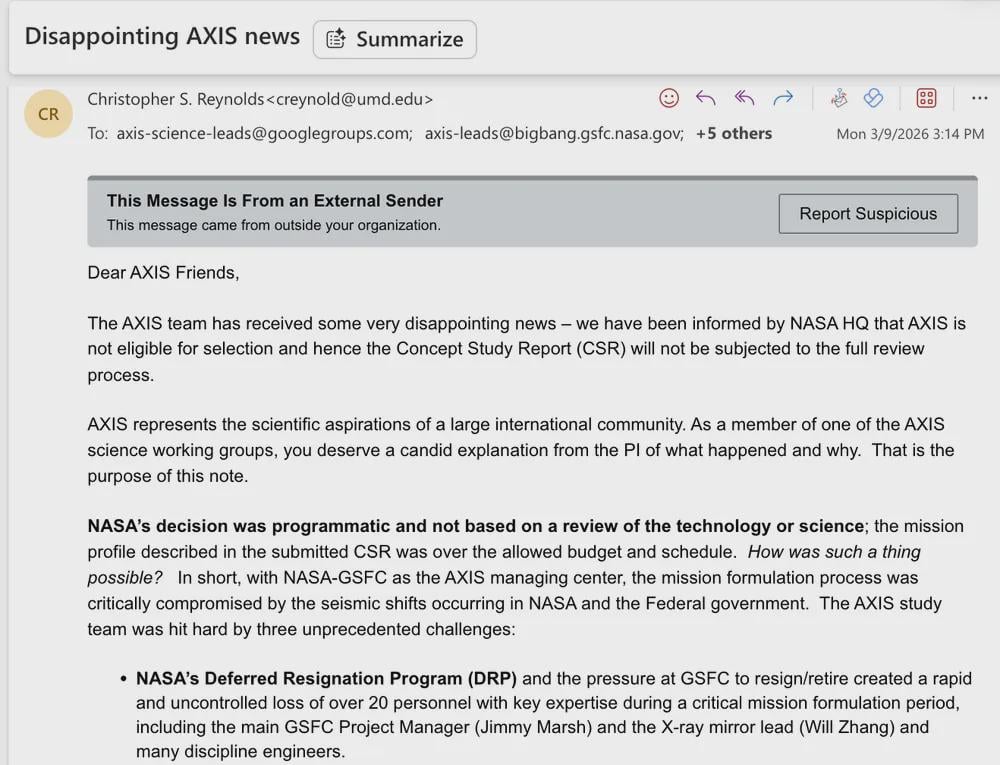
Dear AXIS Friends,
The AXIS team has received some very disappointing news – we have been informed by NASA HQ that AXIS is not eligible for selection and hence the Concept Study Report (CSR) will not be subjected to the full review process.
AXIS represents the scientific aspirations of a large international community. As a member of one of the AXIS science working groups, you deserve a candid explanation from the PI of what happened and why. That is the purpose of this note.
NASA’s decision was programmatic and not based on a review of the technology or science; the mission profile described in the submitted CSR was over the allowed budget and schedule. How was such a thing possible? In short, with NASA-GSFC as the AXIS managing center, the mission formulation process was critically compromised by the seismic shifts occurring in NASA and the Federal government. The AXIS study team was hit hard by three unprecedented challenges:
NASA’s Deferred Resignation Program (DRP) and the pressure at GSFC to resign/retire created a rapid and uncontrolled loss of over 20 personnel with key expertise during a critical mission formulation period, including the main GSFC Project Manager (Jimmy Marsh) and the X-ray mirror lead (Will Zhang) and many discipline engineers.
GSFC priorities rapidly realigned to the FY2026 President’s Budget Request (PBR) that eliminated the Probe program, further reducing the availability of GSFC engineering and mission formulation personnel (incl. cost analysts and schedulers) over the critical Summer and Fall months.
Key work was halted for almost seven weeks when the core GSFC AXIS study team, dominated by NASA civil servants, was furloughed during the government shutdown. NASA HQ’s extension to the CSR submission deadline (from 18-Dec-2025 to 29-Jan-2026) was inadequate compensation for the disruption and lost time.
Taken together, these factors disrupted the basic grass-roots costing process (which requires extensive “reach back” to the discipline engineers to assess labor requirements) as well as the cost-design iteration process that is central to the formulation of a cost-capped and schedule-constrained mission. While the mission design was finalized in April, our initial grass-roots costing (which was ~10% over budget) could only be completed in September due to the lack of assigned resources. With the subsequent government shutdown and then “pens down” in early-December forced by the GSFC Executive Review process, there was no opportunity to work through the set of cost/schedule savings that had already been identified by the AXIS team.
Ultimately, the GSFC executive council gave AXIS leadership the choice of submitting a CSR with a non-compliant schedule and cost, or not submitting a CSR at all. We of course proceeded with the submission, including a narrative that we understood the path to a cost-compliant profile (that we would have discussed with the review panels during the Site Visit). NASA HQ has ruled this stance to be unacceptable.
It is important to stress that NASA’s programmatic decision was before any technical review had been conducted. The decision was NOT due to any concerns about AXIS technology. Indeed, the AXIS Phase A work had major successes with furthering the key technologies. GSFC’s Next Generation X-ray Optics (NGXO) team successfully demonstrated iridium-coated, stress-compensated mirror segments that meet AXIS baseline requirements (i.e. segment-level performance at sub-arcsecond level). NGXO also built the first AXIS demonstrator mirror module, learning critical lessons about mirror alignment, mounting and bonding. On the detector side, MIT quickly moved to fabricate AXIS-like CCDs and, working with our colleagues at Stanford, recently demonstrated that they achieve the required readout rate and spectral resolution.
Similarly, NASA’s decision was NOT a judgment of the importance of AXIS science. The AXIS science case was rated excellent in the Step 1 review, and it only became stronger during our Phase A study. The AXIS Community Science Book, which many of you contributed to, is an extremely powerful demonstration of the relevance and importance of high-resolution X-ray observations to all areas of astrophysics. The Science Book is one of the most important legacies of the AXIS Phase A study and, I believe, will help define future mission concepts for many years to come. I thank you all from the bottom of my heart for all of your work on this.
AXIS has been a long journey; we started under the leadership of Richard Mushotzky more than nine years ago. During that time, it’s been an enormous privilege to work with amazing people; the AXIS science team, the incredible/brilliant GSFC and Northrop Grumman engineers, and the wider astrophysics community. I am, quite frankly, livid that AXIS ultimately fell victim to the programmatic chaos of 2025. The astronomical community deserves better. I hope that NASA leadership, especially at GSFC and HQ, can have an honest discussion about how to better support and protect programs during extraordinary times.
For now, as a community, we must look forward. There is still one excellent mission under consideration for the Probe program, PRIMA, and we wish them a smooth and speedy path to selection and flight. In X-ray astronomy, the SMEX and MidEX programs represent concrete pathways for focused, high-impact missions, and the scientific case we built for AXIS provides a strong foundation for those concepts. The technologies we advanced in Step 1 and Phase A, particularly the NGXO mirror work and the MIT/Stanford detector demonstrations, can anchor the next generation of proposals. Most importantly, the AXIS Community Science Book, representing more than 500 scientists across, is a living document and a powerful signal to NASA leadership that this community is organized, serious, and not going anywhere. I encourage everyone to use it actively, as a resource for future concept development, for Astro2030 engagement, and for building the next mission that will deliver high angular resolution X-ray imaging to address the fundamental questions about black hole growth, galaxy evolution, and the hot universe that motivated AXIS from the beginning. This community built something remarkable over nine years and that doesn’t end here.
Thank you again for your support of AXIS over these times.
Best
Chris and the AXIS leadership team
Strange_Flatworm1144 on
They wanted to cancel the whole Probe-class of astrophysics missions all along and I’m not convinced that PRIMA will move forward now.

2 Comments
Astronomer here- to be clear this is a giant blow to science, as the earliest a high resolution x-ray mission can now launch is the 2050s. The TL; DR is the mission (which people have worked on for a decade so far) was rejected without review not because of the science or technology but because of all the cuts at NASA Goddard in personnel meant they couldn’t submit some documents in time (which were from the president but rejected by Congress).
I have not found a source for this other than the email the team lead sent out yesterday; if you can’t read it via the link I’ve copy/ pasted it here.
===========
Dear AXIS Friends,
The AXIS team has received some very disappointing news – we have been informed by NASA HQ that AXIS is not eligible for selection and hence the Concept Study Report (CSR) will not be subjected to the full review process.
AXIS represents the scientific aspirations of a large international community. As a member of one of the AXIS science working groups, you deserve a candid explanation from the PI of what happened and why. That is the purpose of this note.
NASA’s decision was programmatic and not based on a review of the technology or science; the mission profile described in the submitted CSR was over the allowed budget and schedule. How was such a thing possible? In short, with NASA-GSFC as the AXIS managing center, the mission formulation process was critically compromised by the seismic shifts occurring in NASA and the Federal government. The AXIS study team was hit hard by three unprecedented challenges:
NASA’s Deferred Resignation Program (DRP) and the pressure at GSFC to resign/retire created a rapid and uncontrolled loss of over 20 personnel with key expertise during a critical mission formulation period, including the main GSFC Project Manager (Jimmy Marsh) and the X-ray mirror lead (Will Zhang) and many discipline engineers.
GSFC priorities rapidly realigned to the FY2026 President’s Budget Request (PBR) that eliminated the Probe program, further reducing the availability of GSFC engineering and mission formulation personnel (incl. cost analysts and schedulers) over the critical Summer and Fall months.
Key work was halted for almost seven weeks when the core GSFC AXIS study team, dominated by NASA civil servants, was furloughed during the government shutdown. NASA HQ’s extension to the CSR submission deadline (from 18-Dec-2025 to 29-Jan-2026) was inadequate compensation for the disruption and lost time.
Taken together, these factors disrupted the basic grass-roots costing process (which requires extensive “reach back” to the discipline engineers to assess labor requirements) as well as the cost-design iteration process that is central to the formulation of a cost-capped and schedule-constrained mission. While the mission design was finalized in April, our initial grass-roots costing (which was ~10% over budget) could only be completed in September due to the lack of assigned resources. With the subsequent government shutdown and then “pens down” in early-December forced by the GSFC Executive Review process, there was no opportunity to work through the set of cost/schedule savings that had already been identified by the AXIS team.
Ultimately, the GSFC executive council gave AXIS leadership the choice of submitting a CSR with a non-compliant schedule and cost, or not submitting a CSR at all. We of course proceeded with the submission, including a narrative that we understood the path to a cost-compliant profile (that we would have discussed with the review panels during the Site Visit). NASA HQ has ruled this stance to be unacceptable.
It is important to stress that NASA’s programmatic decision was before any technical review had been conducted. The decision was NOT due to any concerns about AXIS technology. Indeed, the AXIS Phase A work had major successes with furthering the key technologies. GSFC’s Next Generation X-ray Optics (NGXO) team successfully demonstrated iridium-coated, stress-compensated mirror segments that meet AXIS baseline requirements (i.e. segment-level performance at sub-arcsecond level). NGXO also built the first AXIS demonstrator mirror module, learning critical lessons about mirror alignment, mounting and bonding. On the detector side, MIT quickly moved to fabricate AXIS-like CCDs and, working with our colleagues at Stanford, recently demonstrated that they achieve the required readout rate and spectral resolution.
Similarly, NASA’s decision was NOT a judgment of the importance of AXIS science. The AXIS science case was rated excellent in the Step 1 review, and it only became stronger during our Phase A study. The AXIS Community Science Book, which many of you contributed to, is an extremely powerful demonstration of the relevance and importance of high-resolution X-ray observations to all areas of astrophysics. The Science Book is one of the most important legacies of the AXIS Phase A study and, I believe, will help define future mission concepts for many years to come. I thank you all from the bottom of my heart for all of your work on this.
AXIS has been a long journey; we started under the leadership of Richard Mushotzky more than nine years ago. During that time, it’s been an enormous privilege to work with amazing people; the AXIS science team, the incredible/brilliant GSFC and Northrop Grumman engineers, and the wider astrophysics community. I am, quite frankly, livid that AXIS ultimately fell victim to the programmatic chaos of 2025. The astronomical community deserves better. I hope that NASA leadership, especially at GSFC and HQ, can have an honest discussion about how to better support and protect programs during extraordinary times.
For now, as a community, we must look forward. There is still one excellent mission under consideration for the Probe program, PRIMA, and we wish them a smooth and speedy path to selection and flight. In X-ray astronomy, the SMEX and MidEX programs represent concrete pathways for focused, high-impact missions, and the scientific case we built for AXIS provides a strong foundation for those concepts. The technologies we advanced in Step 1 and Phase A, particularly the NGXO mirror work and the MIT/Stanford detector demonstrations, can anchor the next generation of proposals. Most importantly, the AXIS Community Science Book, representing more than 500 scientists across, is a living document and a powerful signal to NASA leadership that this community is organized, serious, and not going anywhere. I encourage everyone to use it actively, as a resource for future concept development, for Astro2030 engagement, and for building the next mission that will deliver high angular resolution X-ray imaging to address the fundamental questions about black hole growth, galaxy evolution, and the hot universe that motivated AXIS from the beginning. This community built something remarkable over nine years and that doesn’t end here.
Thank you again for your support of AXIS over these times.
Best
Chris and the AXIS leadership team
They wanted to cancel the whole Probe-class of astrophysics missions all along and I’m not convinced that PRIMA will move forward now.