
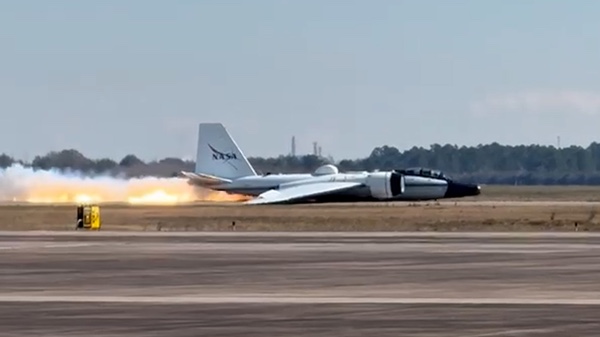
One of NASA’s three WB-57 high-altitude research aircraft made a gears-up landing in late January. The aircraft were developed during the Cold War to perform intelligence missions. (credit: KHOU)
by Dwayne A. Day
Monday, March 9, 2026
On January 27, 2026, NASA 927, a big-winged WB-57F with an elegant white and blue paint scheme, performed a gear-up landing at Ellington Field Joint Reserve Base, trailing sparks and smoke as it slid down the runway, making a horrible sound until it slid to a stop. The WB-57F is not the easiest aircraft to land, because its wings generate so much lift that it wants to be in the air, not on the ground, but fortunately both crew members onboard survived with no injuries. The aircraft, N927NA, sustained significant damage and remains grounded. NASA operates three WB-57Fs, high-altitude scientific research aircraft that have long had many connections to the agency’s space programs. The planes are the legacy of a mysterious Cold War era program that in some ways owed its existence to the U-2 spyplane.
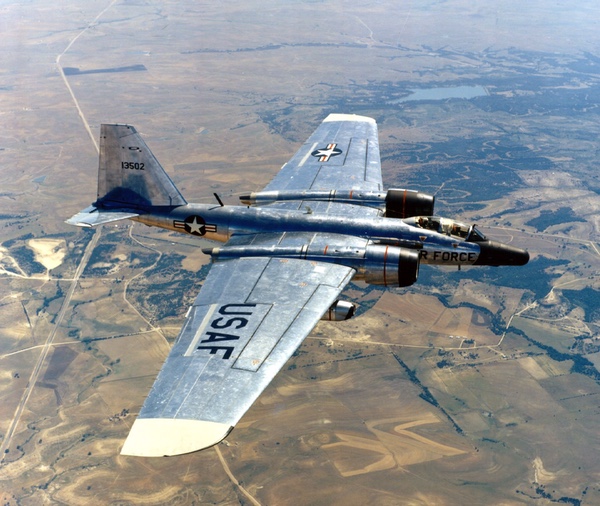
The Martin RB-57F was developed in the early 1960s due to a requirement for a high-altitude intelligence aircraft with greater payload than the U-2. Twenty-one RB-57Fs were remanufactured from existing B-57B aircraft. By 1972, three aircraft had been transferred to NASA and the remaining aircraft were retired to long-term storage. (credit: USAF)
The Canberra
In the late 1940s, the English Electric Corporation developed the jet-powered Canberra medium bomber. The Canberra proved to be a highly successful aircraft for the company, which produced dozens of variants and exported them to multiple countries, with some continuing in operation into the 2000s. English Electric manufactured 900 Canberras, with another 49 license-built in Australia. In 1950, the Martin Aircraft Corporation in the United States licensed the Canberra to produce a version for the US Air Force designated the B-57. Martin made several modifications to its early models, notably changing the awkward cockpit and the bomb bay, and eventually built 400 of them.
The planes are the legacy of a mysterious Cold War era program that in some ways owed its existence to the U-2 spyplane.
Throughout the 1950s and into the 1960s, Martin introduced numerous updated versions of the B-57. The B-57B, C, and E models all saw service in Vietnam. Another aircraft, the enigmatic B-57G, with an unusual sensor mounted under its nose and the designation Tropic Light III, also flew in Vietnam during Operation Shed Light, and remained mysterious for years after the war. The sensor equipment consisted of low light level and infrared detection equipment for night bombing missions.
In 1954, the Air Force was developing the twin-engine X-16 high-altitude reconnaissance aircraft when the CIA was authorized to develop the U-2. The X-16 was canceled, and the CIA performed high-altitude reconnaissance missions for the remainder of the decade. The Air Force still sought its own high altitude reconnaissance aircraft and contracted Martin to develop a large-wing version of the B-57. The RB-57D (“R” for “Reconnaissance”) was able to fly higher than most existing aircraft, but not as high as the U-2. Only 20 were produced, and they were used for high-altitude photo-reconnaissance, high-altitude signals interception, and radar mapping. Some of them were employed by the US Air Force with Taiwanese pilots to conduct reconnaissance missions over mainland China, where one aircraft was shot down in 1959. RB-57Ds operated from 1956 until 1964, when they were retired due to fatigue problems with their large wings. The Air Force began flying its own U-2s by 1957, but the U-2 was a flimsy aircraft that could not do all the high-altitude missions the Air Force needed to do.
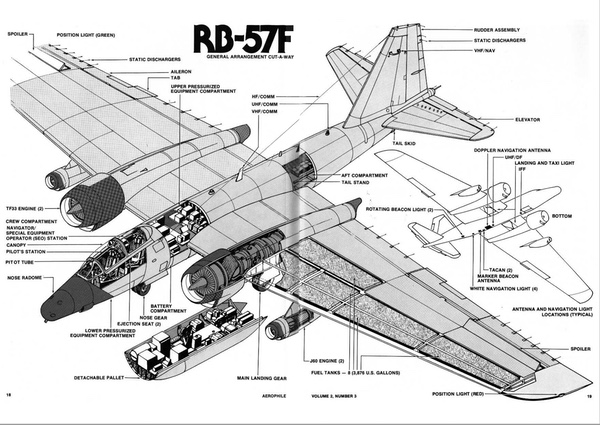
Cutaway of the RB-57F in Air Force service. (credit: Aerophile magazine)
In 1963, due to a requirement for higher-altitude reconnaissance missions, the Air Force contracted Martin to produce a version with an even larger wing, this time designated the RB-57F. The aircraft was capable of sustained flight up to 80,000 feet (24,400 meters), although with a payload it generally operated at around 50,000 feet (15,200 meters). Twenty-one RB-57Fs were produced, remanufactured from B-57Bs. Because they were so heavily modified, the Air Force gave them entirely new serial numbers. The aircraft was capable of carrying signals intelligence sensors and cameras. A primary requirement was the ability to fly high-altitude air sampling missions, carrying equipment that contained filters that trapped radioactive particles blown high into the atmosphere during nuclear weapons tests. The aircraft were operated by the US Air Force’s 9th Weather Reconnaissance Wing, Air Weather Service, Military Air Transport Service (MATS), headquartered at McClellan Air Force Base, California, with four squadrons deployed to California, Japan, Australia, and New Mexico. Aircraft designated Rivet Slice were used for reconnaissance missions, and two-word code names starting with “Rivet” were used to designate specific modifications.
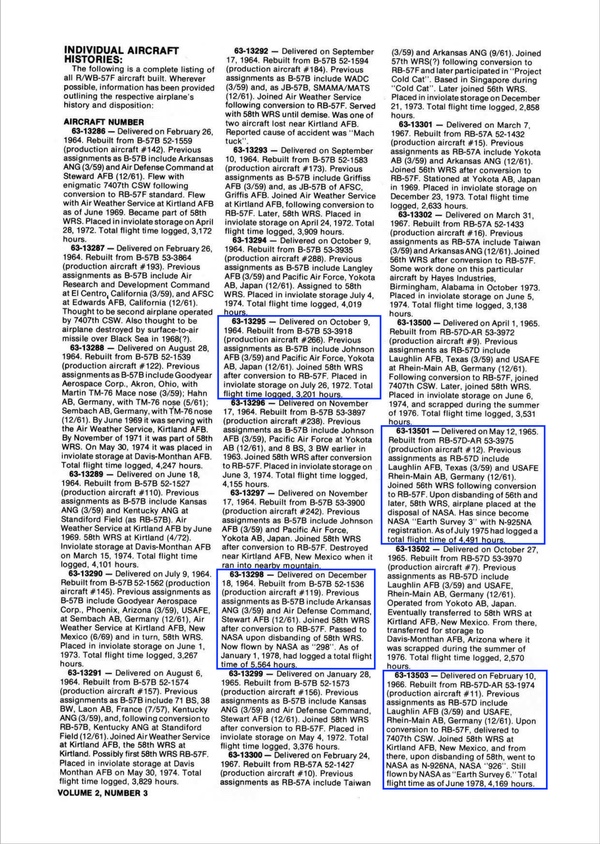 Twenty-one RB-57F aircraft were built and four flew for NASA. This list was compiled by aviation historian Jay Miller in 1980 for the now-defunct Aerophile magazine. (larger version) (credit: Aerophile magazine)
The RB-57Fs flew many different missions with names like Cold Car, Cold Cone, Sold Sand, Cross Check, Paddlewheel, Rough Rider, Slurry, Spinnaker Bravo and Storm Fury. Some of these were in support of civilian missions, including NASA’s Apollo spacecraft recoveries as well as NOAA cyclone monitoring operations. In 1968, the Air Force redesignated the aircraft as WB-57F.
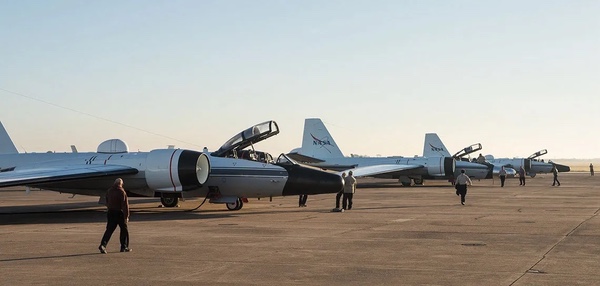
From 1982 to 2012 NASA operated two WB-57s. A third aircraft was taken out of long-term storage and returned to flight due to increased demand. The aircraft have had many different paint schemes over the years. (credit: NASA)
NASA’s WB-57Fs
Starting in the late 1950s, NASA’s predecessor NACA operated an RB-57B with the standard wing for flight testing purposes. The plane then became a NASA aircraft when the agency was formed in 1958. The Air Force serial number was 52-1576 (indicating the aircraft was originally ordered in 1952) and initially designated NASA 237 when it was transferred to the agency. It was also designated N637N, N516NA, and finally NASA 809. The aircraft was used for flight testing and as an atmospheric research aircraft. In the late 1950s it was used to test hydrogen fuel at high altitude with a special wing modification. In the mid-1970s it was used to validate the Viking Mars lander parachutes. It was also used for turbulence tests in the mid-1970s and again a decade later. It was retired in 1987 and put on display at Edwards Air Force Base.
In 1968, the Air Force loaned NASA a WB-57F to support the agency’s Earth Resources Satellite Program. This mission consisted of carrying sensors to high altitude to correlate their data with data collected by a satellite. A modified WB-57F given the NASA tail number 925 and known as the Earth Survey Aircraft flew missions in 1968 and 1969.
During the 2000s, NASA was apparently considering retiring at least one of the WB-57Fs due to lack of users. However, several factors intervened to increase the demand for the aircrafts’ capabilities.
Because the aircraft was on loan to NASA, the Air Force required that no permanent modifications be made, and its sensor package had to be easily removed so that the aircraft could be returned to its national security mission. General Dynamics developed aerodynamically faired plug-in pallets that could carry both NASA and Air Force equipment. The pallets were mounted in the bomb bay and connected to existing cooling and electrical outlets. The back seat was fitted with removable operating consoles.
In 1972, the Air Force decommissioned its weather reconnaissance squadron and its fleet of WB-57Fs. The Air Force sent most of them to the 309th Aerospace Maintenance and Regeneration Group (AMARG) at Davis-Monthan Air Force Base in Arizona. It is better known as “the boneyard,” a sprawling facility covered with hundreds of aircraft, most used for spare parts until they are scrapped, but some eventually returned to American or foreign service. It also permanently transferred the airplane on loan to NASA as well as two additional WB-57Fs, where they were part of the NASA High Altitude Research Project. The two new aircraft were given tail numbers NASA 926 and NASA 928.
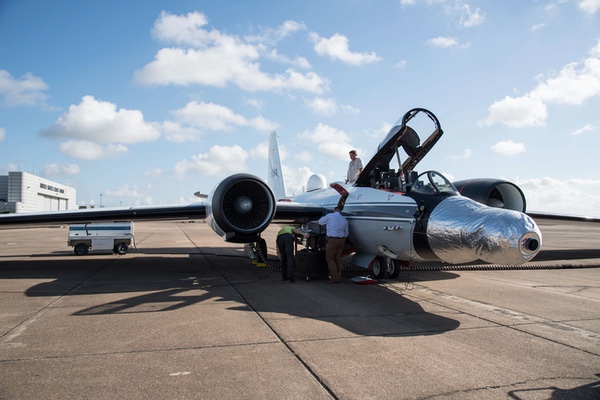
The WB-57s were used to observe both the 2017 and 2024 eclipses. Here one of the aircraft is seen modified for observing the 2017 eclipse. (credit: NASA)
NASA 925 was retired in 1982, leaving the agency with two operational aircraft for the next several decades. Throughout the 1980s, 1990s, and into the 2000s, NASA’s two WB-57s performed various Earth science missions. NASA operated a fleet of Earth sciences aircraft throughout this time. The fleet included two ER-2 aircraft—essentially later versions of the U-2 developed in the mid-1950s—a DC-8, which proved to be a major Earth science workhorse, and multiple other aircraft, including a P-3 Orion and several Gulfstream variants. The planes carried science sensors for atmospheric as well as ground observations. Collectively, this fleet of aircraft is part of NASA’s Airborne Science Program. This diverse and capable Earth science aircraft fleet was, and remains, unmatched, and NASA is an attractive international partner in airborne science because of its range of capabilities.

NASA operates an extensive fleet of aircraft for research purposes. These are scientific aircraft, not flight test aircraft. NASA’s extensive capabilities make it an attractive international partner. (credit: NASA)
NASA sources about the planes’ maximum altitude are inconsistent, but it appears that the WB-57Fs can fly up to 63,000 feet (19,200 meters), but with most payloads they fly lower than this. They can carry a 2,700-kilogram sensor pallet in the former bomb bay underneath the center fuselage. The pallet can carry various cameras and other instruments. They have multiple payload location options besides the pallet bay, including the nose, wing pods, wing hatches, aft fuselage, and tail cone. For some research projects, multiple instruments are carried at many payload locations, missions only include a few or only one instrument.
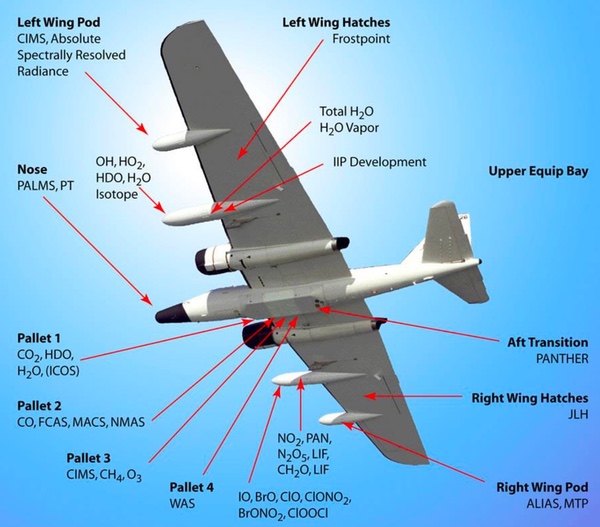
The WB-57 is a versatile aircraft capable of mounting many instruments in multiple locations. This illustration shows one configuration for a research mission. (credit: NASA)
Although NASA’s ER-2s can fly higher than the WB-57Fs, up to 70,000 feet (21,300 meters), the WB-57Fs can carry a bigger payload. NASA even flew an Earth sciences campaign over Central America that involved multiple aircraft simultaneously flying the same path at different altitudes: an aircraft at lower altitude, the DC-8 at medium altitude, a WB-57 above it at approximately 50,000 feet, and a ER-2 above them all at 70,000 feet. Scientists could take readings at multiple altitudes, measuring a vertical slice of the atmosphere. The aircraft have flown many unique missions over the decades.
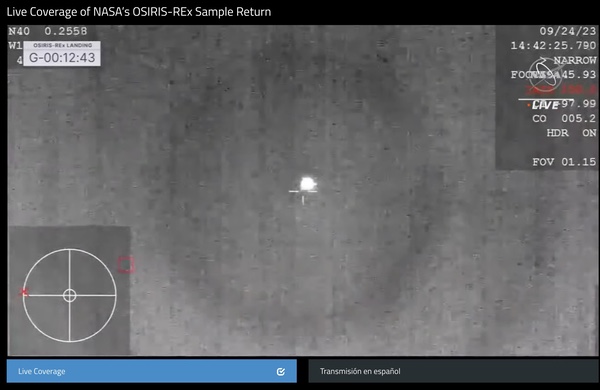
WB-57s have been used to track spacecraft reentries, such as the returning sample canister from the OSIRIS-REx spacecraft. (credit: NASA)
In 2005, a NASA WB-57 flew four missions out of Mildenhall in the United Kingdom as part of the Cosmic Dust Collector (CDC) mission. The aircraft was equipped with two small metallic rectangular boxes carried under each wing that collected interplanetary dust particles on an adhesive strip.
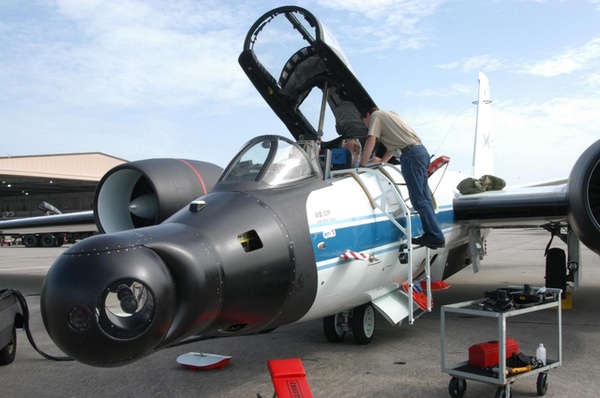
In the early 2000s, the WB-57s were not heavily utilized. Several new missions, including the need to track space shuttle launches using a nose-mounted camera seen here, increased demand for them. (credit: NASA)
The 21st century and a new lease on life
During the 2000s, NASA was apparently considering retiring at least one of the WB-57Fs due to lack of users. However, several factors intervened to increase the demand for the aircrafts’ capabilities. The Columbia accident in early 2003 highlighted NASA’s need for better tracking of space shuttle launches. The aircraft were equipped with a special high-definition tracking camera and other sensors in a specially adapted gimbal-mounted ball turret mounted in the nose. This was known as the WB-57F Ascent Video Experiment (WAVE). The turret was used throughout the remainder of the shuttle program and continues to be used for monitoring various launch and some reentry events. For example, it has been used to monitor Starship launches from Texas, and also monitored the Artemis 1 launch in 2022. It is not unusual for a WB-57 to land at Kennedy Space Center during a launch monitoring period.
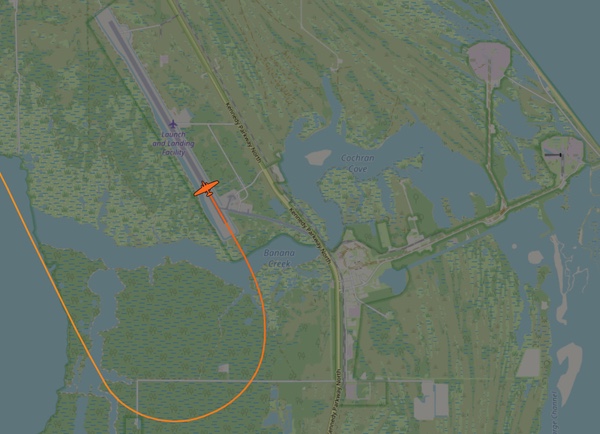
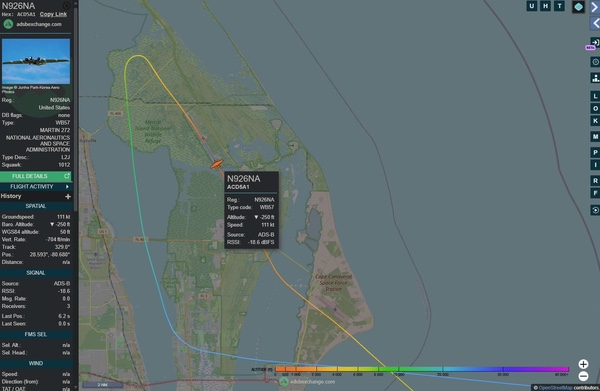
When WB-57s are assigned to track rocket launches from Florida, they occasionally land at Kennedy Space Center. (credit: adsbexchange.com)
The 2001 US invasion of Afghanistan also led to a new demand for the aircraft. One problem experienced by US forces deployed into valleys was the inability to transmit or receive communications because they could be out of view of a satellite. Starting in 2006, NASA WB-57s were deployed to Afghanistan carrying BACN (Battlefield Airborne Communications Node) payloads, which acted as communications relays. Both aircraft were separately deployed to Afghanistan. During these deployments, their NASA logos were removed and they were probably operated by military pilots. There was little information released about these operations. Later, the Department of Defense acknowledged that the WB-57s were sometimes used as technology testbeds so that military aircraft were free to be deployed operationally.
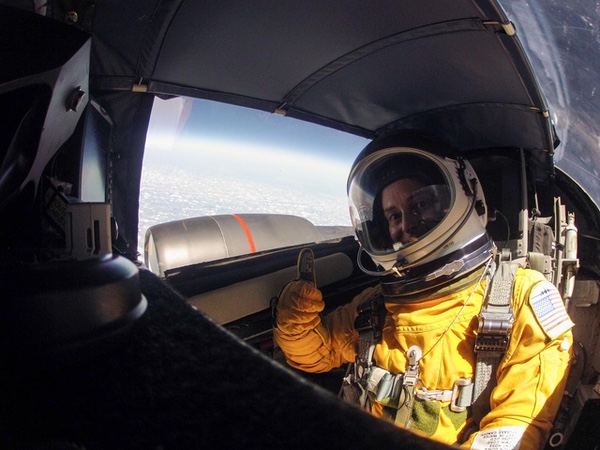
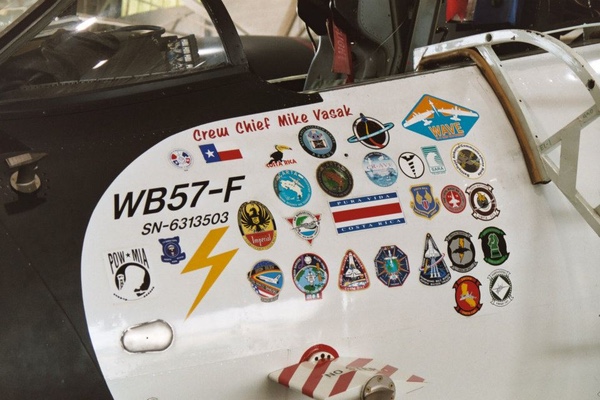
For many years it was common to put mission stickers on the side of the aircraft. The planes have had several different paint schemes over the decades. (Note the aircraft designation is misspelled in this 2006 photograph.) (credit: Dwayne Day)
The NASA aircraft also performed geophysical and remote sensing surveys in 2007 as part of the US aid to the Afghan reconstruction effort. During 28 missions, the WB-57 collected data that was used for resource assessment purposes. From November 2010 to August 2011, a WB-57 was deployed to Afghanistan with the High-Altitude Lidar Operational Experiment (HALOE) payload. These missions ended in the early 2010s as the DoD acquired its own assets for performing them. Two WB-57s were used to observe the August 2017 and the April 2024 solar eclipses.
WB-57s have been used to track spacecraft reentries, such as the returning sample canister from the OSIRIS-REx spacecraft. (credit: NASA)
Operating an old aircraft presents many challenges. One of them was that the agency began running out of tires and no new tires were being made. Fortunately, the F-15 had the same size tire, but the WB-57 landing gear had to be modified to accommodate it. The aircraft cockpits are a mix of old “steam gauges” and modern electronics like navigation systems.
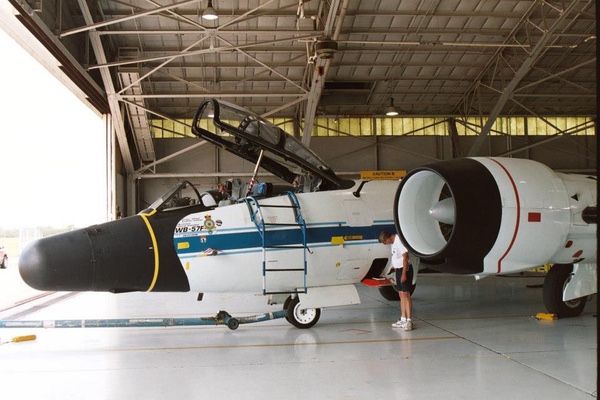
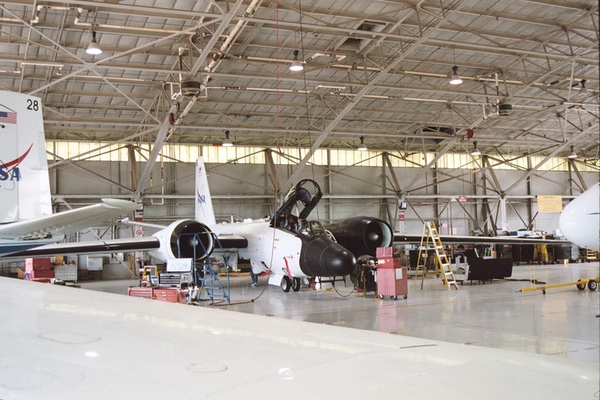
The aircraft are kept at a hangar facility only a short distance north of Johnson Space Center. Here the two aircraft in service in 2006 are seen being prepared for flight. (credit: Dwayne Day)
The increased demand for the NASA aircraft in the 21st century resulted in an unusual development. In May 2011, WB-57F 63-13295, which had been retired in June 1972 and placed in long-term storage at AMARG at Davis-Monthan Air Force Base in Arizona, was removed from storage and trucked to Colorado. At Centennial Airport, Sierra Nevada Corporation refurbished the aircraft to flying condition. On August 9, 2013, it was flown to Ellington Air Force Base north of Johnson Space Center in Texas and turned over to NASA. It was re-designated as NASA 927. The aircraft had spent 41 years in storage, the longest that a military aircraft had been stored before returning to service. It was this aircraft—the newest in NASA’s fleet—that suffered the mishap in January.
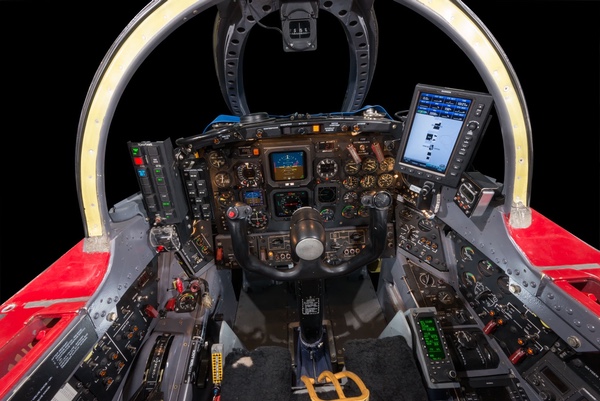
The WB-57 cockpit is a mix of 1960s and modern instruments. Keeping such old aircraft maintained is not easy. (credit: NASA)
NASA frequently does not include the “F” in the aircraft designation. As the only operational Canberras in the world, it is not necessary.
Whether NASA 927 is repaired and reenters service will depend upon the extent of the damage, the cost of repairing it, and the projected need for the aircraft. There are several WB-57F airframes still in storage at Davis-Monthan Air Force Base to support future NASA WB-57 requirements. The big-winged bird may still rejoin its flock.
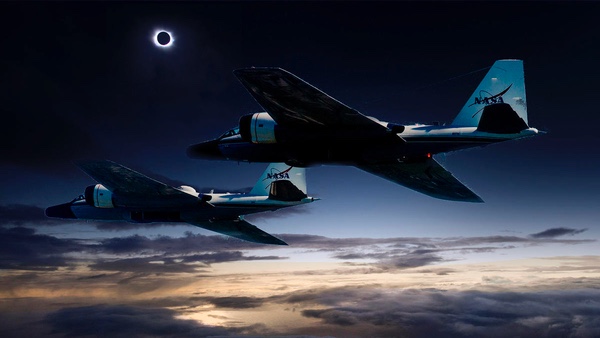
Artwork produced for the 2024 eclipse, which used specialty instruments deployed on two WB-57s. (credit: NASA)
NASA WB-57F aircraft:
N925NA (NASA 925), AF s/n 63-13501 (Rivet Slice 3 and Rivet Rap), retired September 15, 1982.
N926NA (NASA 926), AF s/n 63-13503 (Rivet Slice 2).
N927NA (NASA 927), AF s/n 63-13295 (Rivet Chip 8).
N928NA (NASA 928), AF s/n 63-13298 (Rivet Chip 11).
Further reading:
Paul Bradley, Martin B-57 and English Electric Canberra, Volume 2, Phoenix Scale Publications, 2023.
Aeroplane Illustrated: Canberra – Britain’s First Jet Bomber.
Andrew Brookes, RAF Canberra Units of the Cold War, Combat Aircraft 105, Osprey, 2014.
T.E. Bell, B-57 Canberra Units of the Vietnam War, Combat Aircraft 85, Osprey, 2011.
Guy Warner, The Last Canberra – PR9XH131, December 2010.
Glenn Sands and Gary Madgwick, On Target, Profile 11, Canberra Part 2, The Aviation Workshop, 2005.
Kev Darling, Martin B-57 Canberra, Warpaint Series No. 45, Guideline Publications, 2004.
Robert C. Mikesh, “B-57 Canberra in Vietnam,” Wings of Fame, Volume 19, 2000, pp. 14-31.
Robert C. Mikesh, Martin B-57 Canberra: The Complete Record, Schiffer Military History, 1997.
Roland Beamont and Arthur Reed, English Electric Canberra, Ian Allan Ltd., 1984.
Jay Miller, “Martin/General Dynamics RB-57F,” Aerophile, Volume 2, Number 3, April 1980, pp, 11-43.
Note: we are now moderating comments. There will be a delay in posting comments and no guarantee that all submitted comments will be posted.