
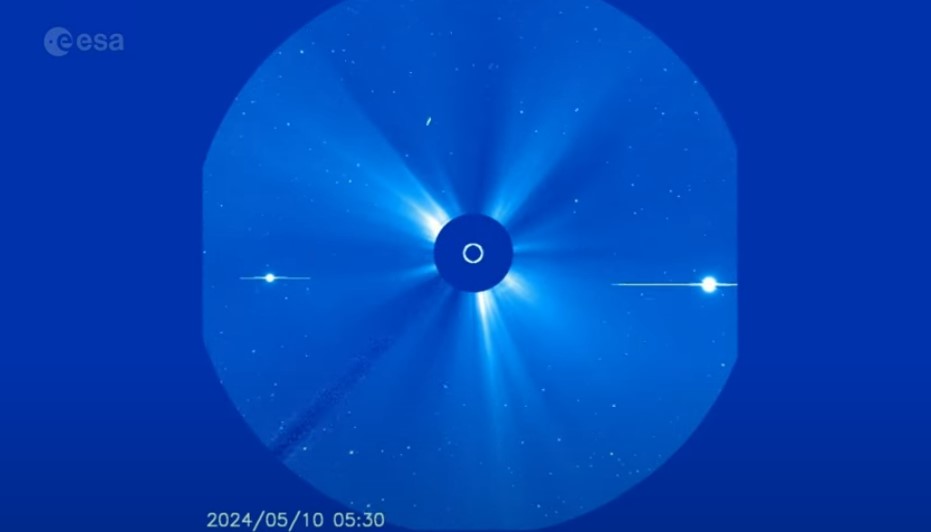
In May 2024, the most powerful solar storm in more than 20 years lit up Earth’s skies with rare auroras visible far beyond the polar regions. But Earth was not the only planet affected. The same storm also slammed into Mars.
Fortunately, two ESA spacecraft, Mars Express and the ExoMars Trace Gas Orbiter (TGO), were in the right place at the right time to observe the event. Their instruments recorded a sudden surge of radiation and unusual changes in Mars’s upper atmosphere.
A new study published in Nature Communications now reveals in detail how this solar superstorm affected the Red Planet.
Mars’s Atmosphere Flooded with Electrons
One of the most striking effects of the storm was a dramatic increase in electrons in Mars’s upper atmosphere.
Two atmospheric layers, located about 110 km and 130 km above the surface, experienced sharp jumps in electron numbers. In these regions, electron levels rose by 45% and an astonishing 278%, the highest concentrations ever measured there.
“The impact was remarkable: Mars’s upper atmosphere was flooded by electrons,” said Jacob Parrott, ESA Research Fellow and lead author of the study. “It was the biggest response to a solar storm we’ve ever seen at Mars.”
Spacecraft Also Felt the Storm
The storm not only affected Mars itself, but it also briefly disrupted the spacecraft observing it. Highly energetic particles from the Sun triggered computer errors on both orbiters, a common risk during strong space weather events. Such particles can interfere with electronics in space.
Fortunately, both spacecraft were designed to withstand these conditions. Their systems include radiation-resistant components and built-in software that can detect and correct errors automatically. As a result, the orbiters quickly recovered and continued their observations.
A New Way to Study Mars’s Atmosphere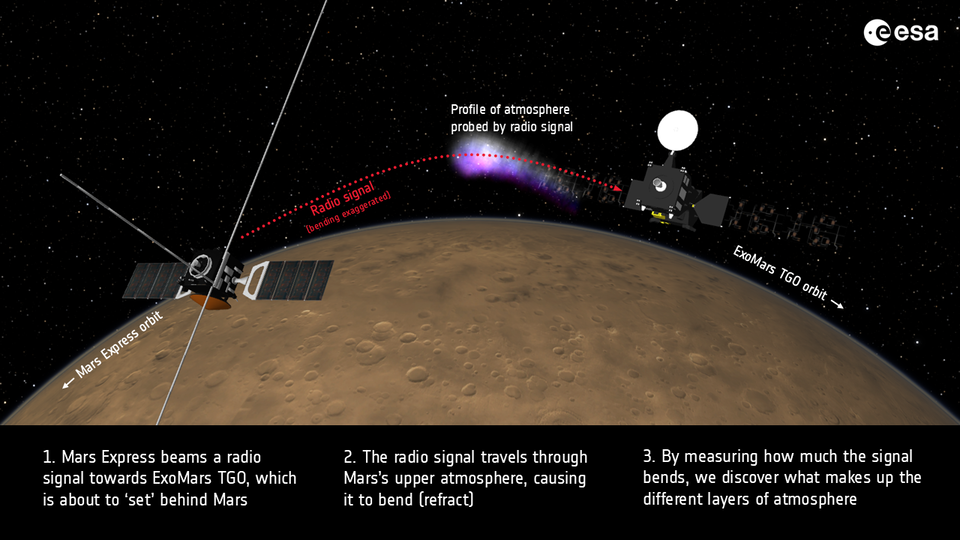 A new investigation technique. Credit: ESA
To better understand what happened during the storm, scientists used a technique called radio occultation.
During the observation, Mars Express sent a radio signal to the Trace Gas Orbiter just as TGO was disappearing behind the Martian horizon. As the signal passed through Mars’s atmosphere, it was slightly bent by different atmospheric layers.
By analysing how the signal changed, researchers were able to measure the structure of the atmosphere and determine how many electrons were present. To confirm their findings, the team also used data from NASA’s MAVEN spacecraft, which studies the Martian atmosphere.
A Technique with New Applications
The method itself is not entirely new. For decades, scientists have used radio signals sent from spacecraft back to Earth to study planetary atmospheres.
However, using signals sent directly between two spacecraft at Mars is a much more recent development.
“It’s only in the past five years or so that we’ve started using this technique between spacecraft like Mars Express and TGO,” explained Colin Wilson, ESA project scientist for the two missions and co-author of the study.
Normally, these radio systems are used to transmit scientific data between spacecraft and Mars rovers. Now they are also helping scientists study the planet’s atmosphere in greater detail.
ESA already uses similar orbiter-to-orbiter measurements around Earth and plans to apply them more widely in future planetary missions.
A Rare Moment of Perfect Timing
Observing space weather is often difficult because solar eruptions happen unpredictably. Scientists rarely know exactly when or where a solar storm will strike.
In this case, however, the timing was exceptionally lucky.
Researchers were able to start their radio occultation measurements just 10 minutes after a powerful solar flare hit Mars. Since such observations currently take place only twice a week, catching the event so quickly was a rare opportunity.
Three Solar Events Hit Mars
The team observed the effects of three different solar eruptions, all part of the same storm.
These included:
a burst of radiation from a solar flare,a stream of high-energy particles,and a massive cloud of solar material known as a coronal mass ejection (CME).
Together, these events sent fast-moving plasma and X-rays toward Mars. When this energetic wave reached the planet, it collided with atoms in the upper atmosphere and knocked electrons free, filling the region with charged particles.
Why These Observations MatterSOHO’s view of the 11 May 2024 solar storm. Credit: ESA
Understanding how solar storms affect Mars is important for several reasons.
According to ESA scientist Colin Wilson, the findings help researchers understand how energy and particles from the Sun interact with the Martian atmosphere.
This is particularly significant because scientists believe Mars has lost much of its atmosphere and water over billions of years, likely due to the constant stream of particles flowing from the Sun.
Studying events like this superstorm helps scientists better understand that long-term process — and how space weather continues to shape planets across the Solar System.