
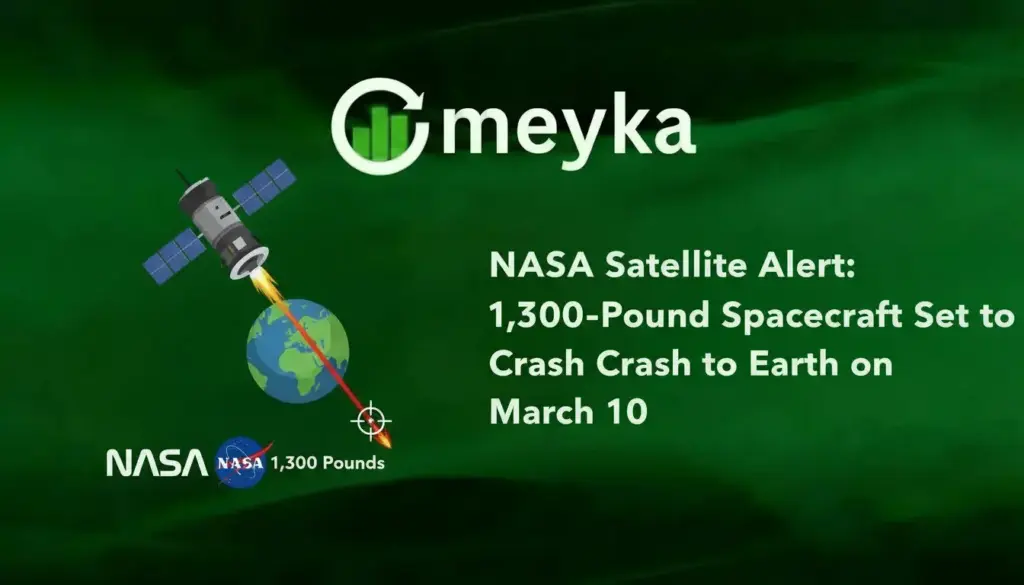
A major space development has captured global attention as a 1,300 pound spacecraft is expected to reenter Earth’s atmosphere on March 10. Scientists and monitoring agencies are carefully tracking the object’s descent, analyzing its trajectory, breakup pattern, and potential landing zones. The event highlights the growing challenges connected to space debris and aging satellites orbiting our planet.
The spacecraft, originally launched for scientific observation, has completed its operational life. As gravity gradually pulled it closer to Earth, atmospheric drag accelerated its descent. According to aerospace monitoring data, the object is now entering the final stage of orbital decay.
This situation has renewed interest in how NASA and international space agencies manage spacecraft disposal and protect populated areas from risks associated with uncontrolled reentry.
Why the Spacecraft Is Falling Back to Earth
Satellites do not stay in orbit forever. Over time, tiny atmospheric particles create resistance that slows spacecraft speed. Once velocity drops below a critical level, Earth’s gravity pulls the object downward. Key reasons behind the reentry include:
Mission completion and fuel depletion.
Gradual orbital decay caused by atmospheric drag.
Lack of propulsion for controlled repositioning.
Increased solar activity expanding Earth’s upper atmosphere.
Experts explain that most satellites burn up completely during reentry due to extreme heat generated by friction. Temperatures can exceed 1,500 degrees Celsius, causing structural materials to melt and disintegrate before reaching the ground.
However, denser components such as fuel tanks or titanium structures may survive partially.
How Scientists Track Reentry Paths
Space agencies rely on advanced tracking systems to predict landing risks. Observatories and radar networks continuously monitor altitude changes and velocity patterns.
Tracking involves:
Ground based radar monitoring.
Optical telescopes observing orbital movement.
Atmospheric density modeling.
Artificial intelligence simulations used in aerospace forecasting.
Modern predictive tools, similar to technologies influencing AI stocks and advanced computational systems, allow scientists to refine impact estimates hours before reentry. These tools analyze millions of trajectory variables to improve accuracy.
Organizations like the European Space Agency and the U.S. Space Surveillance Network collaborate globally to ensure public safety.
Risk Assessment and Public Safety Measures
Despite alarming headlines, experts emphasize that the probability of injury remains extremely low. Statistically, the chance of a person being struck by space debris is less than one in several billion.
Several factors reduce danger:
Most debris burns during atmospheric entry.
Oceans cover more than 70 percent of Earth’s surface.
Uninhabited regions dominate predicted reentry corridors.
Continuous updates allow authorities to issue warnings if necessary.
Governments coordinate with aviation agencies to temporarily adjust flight paths if required. Maritime alerts may also be issued for ships traveling near projected debris zones.
We observe that safety planning has improved dramatically over the past decade due to advancements in aerospace analytics and global data sharing.
The Growing Problem of Space Debris
The upcoming event reflects a larger issue facing modern space exploration. Thousands of inactive satellites currently orbit Earth. As commercial launches increase, orbital congestion becomes a serious concern. Space debris includes:
Defunct satellites.
Rocket fragments.
Collision remnants.
Microscopic particles traveling at high speeds.
Even small debris can damage operational spacecraft. This risk has sparked discussions within the stock market about investment opportunities in satellite servicing companies, debris removal technology firms, and aerospace innovation startups.
Investors conducting stock research increasingly monitor companies developing autonomous cleanup systems and orbital management technologies. The intersection of aerospace engineering and artificial intelligence is shaping future investment narratives.
How Reentry Actually Happens
When the spacecraft enters denser atmospheric layers, several stages occur rapidly.
Initial friction heating begins above 120 kilometers altitude.
External panels detach as structural stress increases.
Internal systems fail due to extreme temperatures.
The spacecraft fragments into smaller pieces.
Remaining debris slows dramatically before reaching Earth.
Witnesses in certain regions may observe bright streaks resembling meteors. These visual effects occur when metal surfaces ionize surrounding air molecules. Scientists stress that these glowing trails are normal and not explosions.
Environmental Impact of Falling Spacecraft
Environmental effects from reentry are generally minimal. Most materials vaporize into tiny particles dispersed across the atmosphere. Studies conducted by aerospace researchers show limited long term ecological impact from isolated satellite reentries. However, experts continue evaluating:
Aluminum oxide particle accumulation.
Potential chemical residue from propulsion systems.
Atmospheric heating effects from frequent reentries.
Research collaborations between global universities and agencies aim to ensure sustainable space activity as satellite launches increase worldwide.
Why This Event Matters for Future Space Missions
The March 10 reentry demonstrates the importance of designing spacecraft with controlled disposal systems. Modern missions increasingly include deorbit plans to guide satellites safely into remote ocean regions. Future spacecraft development focuses on:
Self deorbiting propulsion systems.
Burn up optimized materials.
Autonomous navigation adjustments.
AI assisted orbital management.
Such innovations reduce uncertainty and support safer long term space operations.
The NASA approach to mission lifecycle management now prioritizes sustainability alongside scientific discovery. Engineers integrate disposal planning at the design stage rather than treating it as an afterthought.
Public Reaction and Global Interest
News of a falling spacecraft often spreads quickly across social media, creating anxiety and speculation. While public curiosity is understandable, scientific assessments consistently show minimal danger.
Astronomy communities encourage people to follow verified updates from official agencies rather than viral rumors. Educational outreach surrounding this event also helps raise awareness about how space technology works.
We see growing public engagement with astronomy, space exploration, and satellite technology. This interest indirectly influences innovation sectors tied to aerospace, data analytics, and emerging AI technologies.
The Role of International Cooperation
Space safety is no longer managed by a single country. Monitoring networks operate across continents, sharing real time data to improve prediction accuracy. Key collaborative actions include:
Data exchange between space agencies.
Shared debris tracking systems.
Coordinated emergency response planning.
Joint research into sustainable orbital practices.
International cooperation ensures that reentry events remain controlled, transparent, and scientifically managed. The involvement of NASA alongside global partners highlights how space exploration has evolved into a cooperative scientific effort rather than a competitive race alone.
What Observers Can Expect on March 10
As the spacecraft approaches final descent, prediction windows will narrow significantly. Scientists expect updated forecasts within hours of atmospheric entry. Possible public observations include:
Bright fireball streaks in twilight skies.
Brief sonic phenomena if fragments survive longer.
Temporary aviation notices in select regions.
Authorities will release updates through official aerospace channels as tracking precision improves.
Conclusion
The anticipated reentry of a 1,300 pound spacecraft serves as a reminder of humanity’s expanding presence in space and the responsibilities that accompany it. Advanced monitoring systems, international coordination, and evolving aerospace technology ensure that such events remain safe and scientifically valuable.
While headlines may sound dramatic, the reality reflects careful planning, strong engineering principles, and decades of accumulated expertise. Events like this deepen our understanding of orbital mechanics and guide safer future missions.
As global interest in space continues to grow, innovations connected to satellite management, artificial intelligence, and aerospace engineering will shape both exploration and investment landscapes. The ongoing work by NASA and partner agencies demonstrates how science, safety, and technology combine to manage even the most complex challenges beyond Earth’s atmosphere.
FAQs
Is the falling spacecraft dangerous to people on Earth?
No. Most of the spacecraft will burn up during reentry. The chance of injury is extremely low according to aerospace safety statistics.
Can people see the spacecraft during reentry?
Yes. In some regions, observers may see a bright streak across the sky similar to a meteor if atmospheric conditions are clear.
Why do satellites fall back to Earth instead of staying in orbit forever?
Atmospheric drag gradually slows satellites over time. Without propulsion adjustments, gravity eventually pulls them back toward Earth.
Disclaimer:
The content shared by Meyka AI PTY LTD is solely for research and informational purposes. Meyka is not a financial advisory service, and the information provided should not be considered investment or trading advice.