
Located in Southampton, the Southampton Space Institute aims to strengthen the UK’s £17 billion-a-year space industry and contribute to government plans for sector advancement.
The institute is part of the University of Southampton and draws on more than six decades of expertise in space science, aeronautics and astronautics.
READ MORE: Southampton students build world-first ‘blockchain black box’ for drones
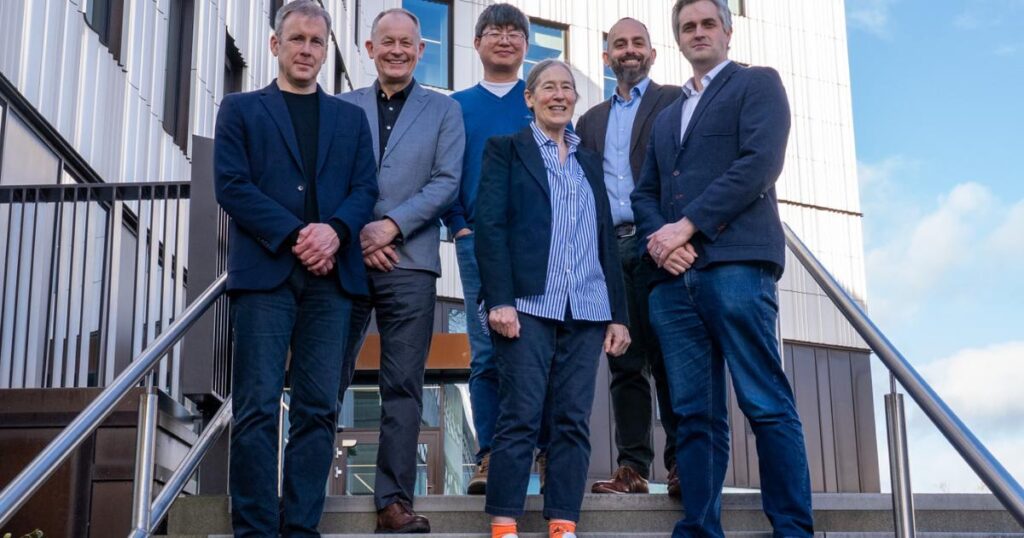
Professor Mark Sullivan, Professor David Parker, Professor Minkwan Kim, Frances Clarke, Professor Andrea Cammarano and Institute director Professor Matt Middleton. (Image: University of Southampton)
Professor Matt Middleton, its inaugural director, said: “Southampton already has an established heritage in space research, with a university that has taught thousands of students about aircraft and satellite design since 1959.
“The UK space industry is now supporting around 50,000 jobs and contributing billions to our economy.
“It needs the expertise of a university like Southampton to train the next generation, create new jobs and companies, and ensure that space is sustainable in the long term.
“We will be drawing on our expertise in electronics, fundamental science, astronautics, artificial intelligence and many others, to enrich the UK space industry and support the national space strategy.”
The institute will bring together research groups and facilities from across the university and serve as a hub for collaboration with government and industry on technology, policy and sustainability.
READ MORE: AI conference set to be held in Hedge End
Southampton Space Institute’s inaugural director Professor Matt Middleton (Image: University of Southampton)
Professor David Parker, a UK space policy expert, Southampton alumnus and former director of exploration at the European Space Agency, said: “Our vision is to drive sustainable, local and national economic growth by becoming one of the top UK universities for space education, novel space science, technology, and applications of space data here on Earth.
“The university has some unique strengths, and we are working on exciting initiatives that will come to fruition across the next few years – watch this space.”
Recent funding of more than £1 million from the UK Space Agency’s national space innovation programme will support university scientists in developing a plasma torch system to replicate spacecraft re-entry conditions and a water-based propulsion system for satellites.
The institute is working with Space South Central, the UK’s largest regional space cluster, which connects the university with 130 space-related businesses across Hampshire, Surrey and the Isle of Wight.