
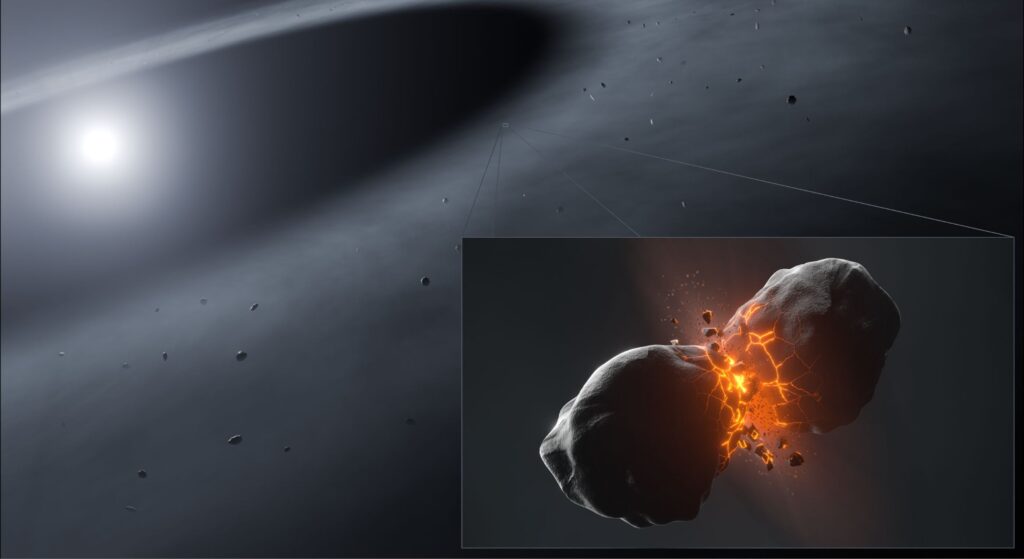
Dust clouds masquerading as exoplanets
Fomalhaut, located within the southern constellation Piscis Austrinus, is 16 times more luminous than our sun and one of the brightest stars in the sky. After Kalas began observing it with HST in 2004, he discovered a large belt of dusty debris at a distance of 133 astronomical units (AU) from the star, more than three times the distance from the star as the Kuiper Belt is from the sun in our solar system. An AU is the average distance between the Earth and the sun, or 93 million miles.
The belt’s sharp inner edge suggested that it had been sculpted by planets. After a second observation in 2006, Kalas concluded that a bright spot in the outer belt visible in both the 2004 and 2006 images was, in fact, a planet. He acknowledged at the time that it could be a very bright dust cloud caused by a collision in the disk, but the likelihood of that seemed very low.
Kalas was able to schedule four follow-up HST observations of Fomalhaut, in 2010, 2012, 2013 and 2014. In the last, however, Fomalhaut b was nowhere to be seen. Nine years later, after three failed attempts to image Fomalhaut with HST, he obtained a new image that revealed another bright spot not far from the first, now referred to as Fomalhaut cs1 for circumstellar source 1. Based on its location, however, the new spot, Fomalhaut cs2, could not be a reappearance of Fomalhaut cs1. Because of the nine-year hiatus between 2014 and 2023, it’s unclear when Fomalhaut cs2 appeared.