
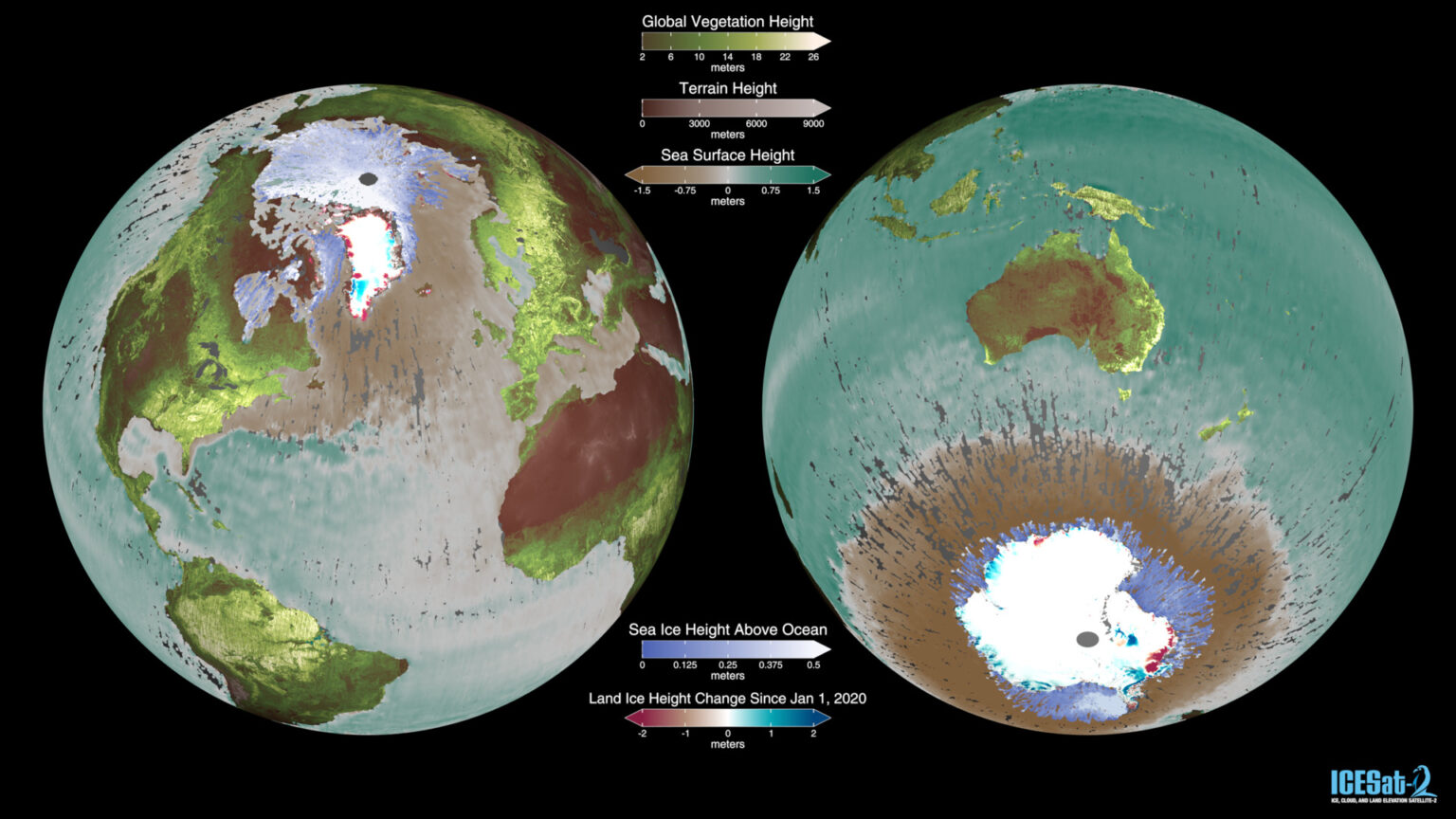
NASA’s Ice, Cloud, and land Elevation Satellite-2 (ICESat-2) is an Earth-observing laser altimeter mission designed to measure the elevation of ice sheets, glaciers, sea ice, forests, and other surfaces with remarkable precision and accuracy. Launched on September 15, 2018, from Vandenberg Air Force Base aboard a United Launch Alliance Delta II rocket, ICESat-2 carries a single instrument: the Advanced Topographic Laser Altimeter System (ATLAS), which was designed and built by NASA’s Goddard Space Flight Center (GSFC) with contributions from industry partners. Satellite laser altimetry is the only technique with sufficient canopy penetration and vertical accuracy to map the 3D structure of Earth’s terrestrial ecosystems and ice surface topography. ATLAS uses a green-wavelength (532 nm) photon-counting laser that splits its pulses into six beams arranged in three pairs. The satellite’s near-polar orbit enables it to take measurements across nearly the entire globe. ICESat-2 is a follow-on to the original ICESat mission (2003–2009) and continues NASA’s long-term record of cryospheric and surface elevation change, at higher spatial coverage. With multi-beam sampling, ICESat-2 has improved coverage across key ecosystems and cryosphere zones, enabling process detection and modeling at higher spatial resolutions and mapping change over time.
ICESat-2 is a multifunction instrument that produces a range of science data products to serve diverse research communities and applications. For land ice, ICESat-2 measures the surface elevation of ice sheets and glaciers, enabling scientists to track mass loss and contributions to global sea level rise. For sea ice, the mission provides estimates of freeboard – the height of ice floes above the waterline – which is used to derive sea ice thickness and volume across the Arctic and Antarctic. For sea surface height, the mission captures open-water elevation in leads and polynyas between sea ice floes, offering valuable data for oceanographic and geodetic studies. For land and canopy elevation, ICESat-2 maps bare ground topography as well as the height and vertical structure of forest canopies, supporting ecology and carbon stock assessments. Finally, for cloud fraction, ICESat-2’s photon-counting lidar detects the presence and vertical distribution of clouds and aerosols in the atmosphere, providing data products that characterize cloud occurrence and optical properties along the satellite’s ground track.
For more information about ICESat-2, see: https://icesat-2.gsfc.nasa.gov/