
Back to Article List
Today in the history of astronomy, an international armada homes in on Halley.

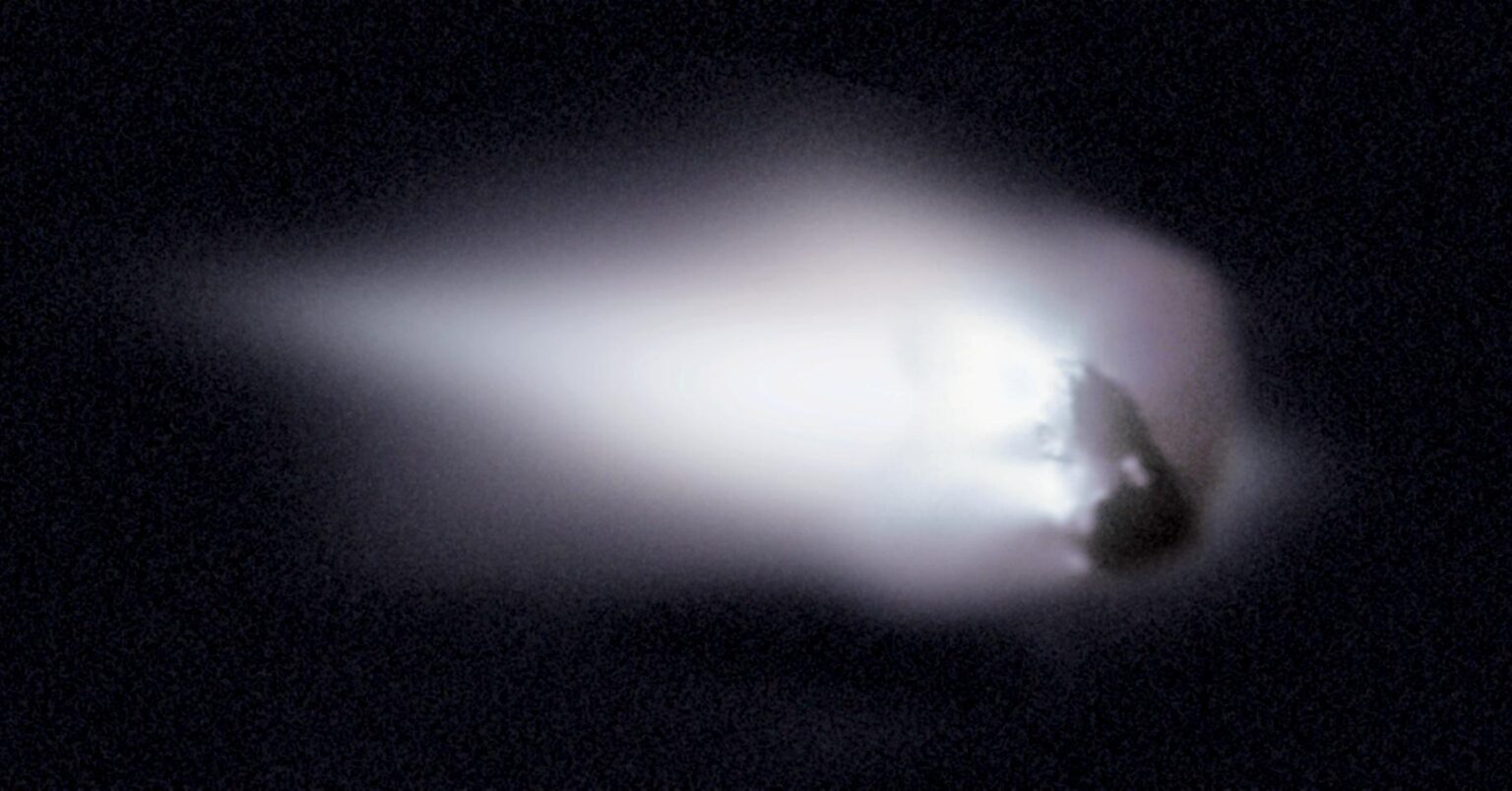
The European Space Agency’s Giotto probe captured this image of Halley’s nucleus on March 14, 1986. From March 6-11, two Soviet and two Japanese spacecraft had also flown by the comet as part of the “Halley Armada.” Credit: NASA/ESA/Giotto Project
It’s often said that nonastronomers recognize three celestial objects: the Moon, the rings of Saturn, and Halley’s Comet. History’s first identified periodic comet, 1P/Halley, returned to the night sky in 1986 for its most-observed appearance on record. And that’s saying something, because it’s been observed at least as far back as 240 B.C.E.
Unfortunately, during that recent appearance, celestial geometry wasn’t on our side: Perihelion occurred Feb. 9, 1986, when Halley was on the opposite side of the Sun from Earth. Still, it peaked at magnitude 2.4 in early March, putting on a decent show for those in the Southern Hemisphere. And an international “armada” of space-based probes observed the comet: Soviet Vega 1 making its closest approach on March 6, Japan’s Suisei on March 8, Soviet Vega 2 on March 9, and Japan’s Sakigake on March 11. Finally, on the 14th, ESA’s Giotto made the closest-ever flyby of the comet.
Halley’s Comet is named for English astronomer Edmond Halley, but he didn’t discover it. In 1705, he published a paper in which he wrote that the comets seen in 1531, 1607, and 1682 were all the same object. He further predicted that this comet would return to Earth’s skies in 1758. And although Halley died in 1742 before he could see the outcome for himself, his prediction came true when observers sighted the comet on Christmas night 1758. Comet Halley’s next perihelion will occur July 28, 2061. At that time, it is predicted to glow at magnitude –0.3, 12 times as bright as its peak in 1986.