
Not every Netflix or Prime Video streaming session needs to involve watching the same episodes of an old sitcom time after time! Space documentaries form a relatively big niche within many streaming platforms and this means that viewers can make a point of learning something.
These documentaries can be incredibly creative. Some explore the past while others explore the present or even the future… Special effects have continued to improve. Many of the documentaries can catch the eye as well as provide mind blowing facts and mental stimulation.
Our Universe (Netflix)
Our Universe is one of those rare science documentaries that tries to do something genuinely ambitious, and largely pulls it off. Produced by BBC Studios’ Science Unit and narrated by Academy Award-winner and modern icon Morgan Freeman, the six-part series sets out to tell a story that stretches back 13.8 billion years. It still feels immediate and personal.
It links the birth of stars to the lives of animals alive today, creating what showrunner Mike Davis described as cosmic “Just So” stories.
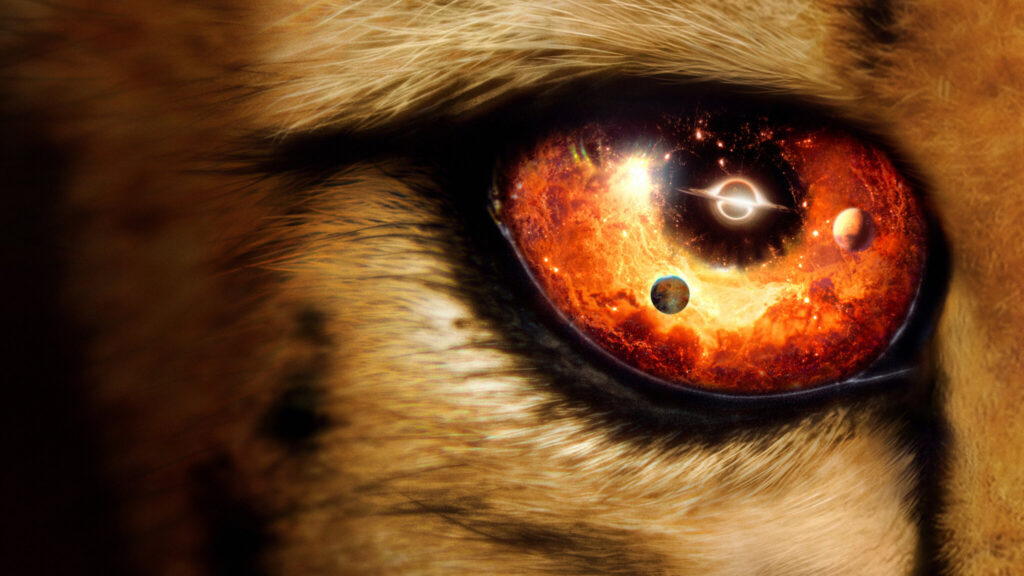
Each episode follows a “hero” animal. Namely: a cheetah, chimpanzee, brown bear, elephant, sea turtle, or king penguin. It traces how cosmic events shaped the conditions that make their lives possible. The death of ancient stars leads to the creation of heavy elements. The formation of the Sun governs seasonal rhythms. Supernovas and planetary collisions are woven into survival stories unfolding on Earth right now.
What sets Our Universe apart is the seamless blending of large-scale cosmology with blue-chip natural history filmmaking. Wildlife footage, often shot with anamorphic lenses to give it an almost cinematic feel, sits alongside striking CGI sequences created to visualise events inside stars. The effect is bold without feeling gimmicky.
The sound design deserves particular mention. Rather than treating space and wildlife as separate worlds, the production team carefully merged them. The Dolby Atmos mix enhances the scale. The show is also made in HDR where explosions of light and colour feel immersive rather than abstract.
The documentary is both comfortable and fascinating to watch. The smooth tones of Morgan Freeman guide us through an impressive cosmic journey.
Black Holes: The Edge of All We Know (Netflix)
Black Holes: The Edge of All We Know is one of the most compelling space documentaries you can stream. Directed by Peter Galison, the 2020 film follows two parallel scientific journeys: the race to capture the first-ever image of a black hole and the theoretical battle to resolve one of physics’ deepest mysteries, the black hole information paradox.
The documentary places us inside the Event Horizon Telescope (EHT) collaboration, the global network of observatories that combined data from radio telescopes around the world to image the supermassive black hole at the centre of galaxy M87.
From the Large Millimeter Telescope in Mexico to sites across multiple continents, scientists work against weather and extreme logistical challenges. Over five days, the team gathers staggering amounts of data. It equates to around 1.5 petabytes per day, which must then be painstakingly processed. To avoid bias, analysis teams work independently before comparing results. The now-famous orange ring image is finally revealed on April 10, 2019.
Running alongside this story is a more intimate narrative involving Stephen Hawking and collaborators Andrew Strominger, Malcolm Perry, and Sasha Haco. They grapple with the black hole information paradox. This is the question of whether information swallowed by a black hole is truly lost.
Their proposed solution, involving “soft hair” on the event horizon, suggests black holes may encode information in subtle quantum structures. The film captures Hawking at work before his passing. It offers a rare glimpse of one of the most iconic scientists of modern times engaged in active research.
The film mixes observational footage with black-and-white animation and graphic-novel-inspired sequences. It’s less about simplified explanations and more about the human process of discovery.
Black Holes: The Edge of All We Know reminds viewers that breakthroughs aren’t lightning bolts from lone geniuses. They’re the result of collaborative effort at the very edge of understanding.
Alien Worlds (Netflix)
Netflix’s Alien Worlds occupies a fascinating space between science fact and speculative imagination. It has a lot of fictional elements and delivers one of the most visually engaging explorations of what extraterrestrial life could look like. Narrated by Sophie Okonedo, the four-part docuseries doesn’t spin tales of cartoon aliens or Hollywood battles. It anchors its creativity in real scientific principles drawn from human knowledge of the universe.
Alien Worlds asks a deceptively simple question and uses stunning graphics to answer: If life exists elsewhere in the universe, what might it actually look like? To explore this, the series combines expert interviews with cutting-edge CGI and carefully constructed hypothetical ecosystems on four distinct exoplanets.
It avoids the trope of humanoid life. It also extrapolates from conditions such as gravity, atmosphere, temperature, and stellar radiation (all of which shape evolution on Earth) to craft alien biospheres that feel logical. This keeps it away from a lot of the boring sci-fi stereotypes.
The show takes cues from recent scientific discoveries. Thousands of exoplanets have now been identified using telescopes like Kepler and TESS, and researchers know that many orbit stars very different from our Sun. Some worlds may be tidally locked or bathed in intense radiation. These extremes lead the series’ creative team to plausible but wildly diverse life forms. For example, heavier gravity might produce squat and powerful organisms and a planet with a thicker atmosphere could give rise to floating or gliding species.
Alien Worlds provides something different for viewers. There are very few other “sci-fi meets science” shows. Its consistent grounding in real research. Astrobiologists, ecologists, and astronomers explain the fundamental rules of life before the visuals bring those extrapolations to vivid life. The result feels like a series of educated hypotheses that are never disconnected from what scientists know about Earth’s own living systems. No more portrayals of little green guys with big black eyes.
The documentary also sparks curiosity about our place in the universe. By highlighting the diversity of planetary conditions already observed, it hints that life elsewhere could be more varied and surprising than most sci-fi often allows. Without any of the tropes.
Cosmic Dawn (NASA+ / YouTube)
If Black Holes: The Edge of All We Know captures the moment of scientific revelation, Cosmic Dawn: The Untold Story of the James Webb Space Telescope documents the years of ambition and even near-catastrophe that made such revelations possible.
Released by NASA+ for free on YouTube, the film focuses on the long and fragile path that led to the launch of the James Webb Space Telescope (JWST). It is the story of the most powerful space observatory ever built.
The documentary shows engineering under extreme pressure. Webb was designed to detect infrared light from the first galaxies formed after the Big Bang, effectively allowing astronomers to look more than 13 billion years into the past. To do that, the telescope had to unfold perfectly in space after launch. This led to a high-stakes ballet of sunshields and deployment mechanisms with no possibility of repair. One failure would have meant the loss of a $10 billion mission decades in the making.
The documentary follows the telescope from its early development at NASA’s Goddard Space Flight Center through assembly, testing and transport to French Guiana for launch aboard an Ariane 5 rocket.
Scientifically, the stakes are enormous. Webb is designed to study “cosmic dawn” – the name given to the era when the first stars ignited and galaxies assembled. By observing redshifted infrared light, it can peer deeper into time than Hubble ever could. The film makes clear that Webb is not just another telescope; it is a machine built to answer fundamental questions about how structure emerged from the early universe. The documentary is so interesting due to the telescope’s undeniable importance.
Sally (National Geographic / Disney+ / Hulu)
Sally is more than a space documentary. It’s a portrait of courage lived in public and private. A warning that if you’re not really interested in the people involved in space, that this will probably not be for you.
Directed by Cristina Costantini, the 2025 film revisits the life of influential figure Sally Ride, the first American woman to travel into space. It examines the deeper story that remained largely unspoken during her lifetime.
Ride made history in 1983 aboard Space Shuttle Challenger. At just 32, she became a symbol of scientific excellence and progress, inspiring generations of young women to pursue careers in STEM. But as the documentary carefully explores, that public image came with intense scrutiny. Media coverage at the time frequently focused less on her scientific expertise and more on superficial questions about her appearance or emotions.
What makes Sally particularly powerful is its exploration of Ride’s long-term relationship with Tam O’Shaughnessy, her partner of nearly three decades. Their relationship was kept private during Ride’s life, reflecting the cultural and political climate of the time.
Archival footage of Ride’s missions, press conferences and training sessions sit alongside intimate interviews with family members and former colleagues.
Premiering at Sundance in January 2025 before airing on National Geographic and streaming on Disney+ and Hulu, Sally has been widely praised for its layered storytelling. Scientifically, Ride’s legacy remains monumental. Her story is worth a watch.
Built for Mars: The Perseverance Rover is a focused, behind-the-scenes look at one of NASA’s most ambitious robotic missions. It doesn’t dwell on dramatic launch footage or glossy images of the Red Planet, this documentary pulls viewers into the workshops and clean rooms of NASA’s Jet Propulsion Laboratory (JPL), where engineers and scientists raced to prepare the Perseverance rover for its 2020 launch window.
The team must push through technical failures, last-minute design challenges, and the sudden disruption of the COVID-19 pandemic. Clean-room protocols become even stricter. Schedules tighten. Every delay risks missing a narrow launch window that only opens every 26 months when Earth and Mars align correctly.
Mars: One Day on the Red Planet (Disney+)
Mars: One Day on the Red Planet is an immersive and visually rich documentary that compresses billions of years of Martian history into a single cinematic day and takes viewers from sunrise to sunset on our nearby (relatively) world. Streaming on Disney+, the film blends real spacecraft data with high-end visual effects to create what feels like the most complete tour of Mars yet attempted.
Rather than presenting Mars as a static desert, the documentary reconstructs the planet using actual data gathered by orbiters and rovers. Towering volcanoes like Olympus Mons rise into view. Vast canyon systems stretch across the surface. Ancient lakebeds and dried river deltas potentially hint at a wetter past. Even the scattered remains of crashed landers are explored…
The structure of the film follows a fictional Mars mission across a single Martian day. It uses that framework to explore both science and speculation. It walks viewers through the brutal physics of landing in Mars’ thin atmosphere and the challenges of surviving dust storms. It even asks questions of the complex engineering required to establish a human habitat.
At its core, the documentary asks the enduring question: Is there – or was there ever – life on Mars?
Challenger: The Final Flight (Netflix)
Few space documentaries hit as hard as Challenger: The Final Flight. Released on Netflix in 2020 and developed by Glen Zipper and Steven Leckart, this four-part docuseries revisits the 1986 Space Shuttle Challenger disaster with a level of intimacy and clarity that is both devastating and necessary.
Rather than simply recounting the explosion that killed seven astronauts, the series carefully reconstructs the pressure and warning signs that led up to it. Episode by episode, it charts NASA’s transformation during the Space Shuttle era, from President Nixon’s push for a reusable spacecraft to the ambitious promise that space would soon be accessible to everyone. The “Teacher in Space” program becomes a powerful emotional thread. The mission resonated with the public.
What makes this documentary especially gripping is its focus on decision-making. Interviews with Morton Thiokol engineers reveal mounting concerns about O-ring erosion in the solid rocket boosters. The now-infamous teleconference before launch — where engineers warned against flying in freezing temperatures — is reconstructed in painful detail. When Richard Feynman later demonstrates live on television that O-rings lose resiliency in cold water, the consequences of those ignored warnings become starkly clear.
The series doesn’t sensationalise the tragedy. It humanises it. Former NASA officials, family members, and engineers speak candidly about the demands and flawed management culture that contributed to what the Rogers Commission ultimately called a “fatally flawed” decision-making process.
Visually restrained but emotionally powerful, Challenger: The Final Flight avoids spectacle and focuses on accountability.
For anyone interested in the history of NASA and the human side of ambition in space exploration, this docuseries is essential viewing.
Apollo 13: Survival (Netflix)
Apollo 13: Survival is a modern retelling of one of the most famous space emergencies ever recorded, and even if the ending is already known, the documentary still manages to feel tense and remarkably immediate. Rather than simply repeating the story made famous by the 1995 Hollywood film (also worth a watch) this Netflix documentary leans into archival material plus mission audio and firsthand accounts to reconstruct how a routine lunar mission suddenly became a global survival drama.
The documentary follows the Apollo 13 crew. Namely, that means Jim Lovell, Fred Haise, and Jack Swigert, as their 1970 mission to the Moon turns catastrophic after an oxygen tank explodes mid-flight. What makes this version especially engaging is the way it highlights the engineering improvisation that followed. The astronauts and mission control weren’t just battling physics; they were inventing solutions in real time with remarkably limited resources.
Rather than focusing purely on technical jargon, Apollo 13: Survival emphasises the teamwork and emotional strain involved. Viewers see how engineers on the ground recreated spacecraft conditions using spare parts, while the crew inside the command module worked calmly under impossible pressure. The documentary’s pacing mirrors the mission itself. A tense and relentless countdown toward re-entry.
Critics and viewers have noted that the film relies heavily on original footage and real communications, which gives it a documentary authenticity that scripted recreations can’t fully capture.
Good Night Oppy (Amazon Prime Video)
Good Night Oppy is one of those rare space documentaries that can be unexpectedly emotional. Directed by Ryan White and narrated by Angela Bassett, the 2022 film tells the story of NASA’s Mars rover Opportunity (affectionately nicknamed “Oppy”) which was originally designed to operate for just 90 Martian days but ultimately survived for nearly 15 years. That underdog narrative becomes the heart of the film.
Using a mix of real NASA archival footage plus interviews with engineers and scientists, and cinematic recreations built with visual effects from Industrial Light & Magic, the documentary traces Oppy’s journey from launch in 2003 to its long exploration across the Martian surface. The film captures the excitement of discovery as the rover searches for evidence that water once existed on Mars, helping reshape our understanding of the planet’s history.
The film frames the rover as a character without losing scientific credibility. The engineers at NASA’s Jet Propulsion Laboratory describe Oppy almost like a member of the family as they celebrate its successes. The team worry and panic during dust storms, and grieve when contact is finally lost.
Many critics felt it earned its emotive tone by highlighting the years of dedication behind the mission. It also does a good job of making fairly complex planetary science feel personal and easy to follow.
The soundtrack features upbeat classics like “Here Comes the Sun” and “Walking on Sunshine”. This adds warmth and optimism, reinforcing the idea that exploration is as much about perseverance as technology.
Ultimately, Good Night Oppy works because it celebrates curiosity and resilience. Even viewers who don’t usually watch space documentaries tend to connect with it. Much of that is down to the emotional focus on the humans behind the mission and the quiet wonder of a small robot that kept going long after anyone expected.
This list provides a great jumping-off point for some documentary bingeing. There is a growing selection out there, with Disney Plus and Netflix providing fairly regular new documentary releases.