
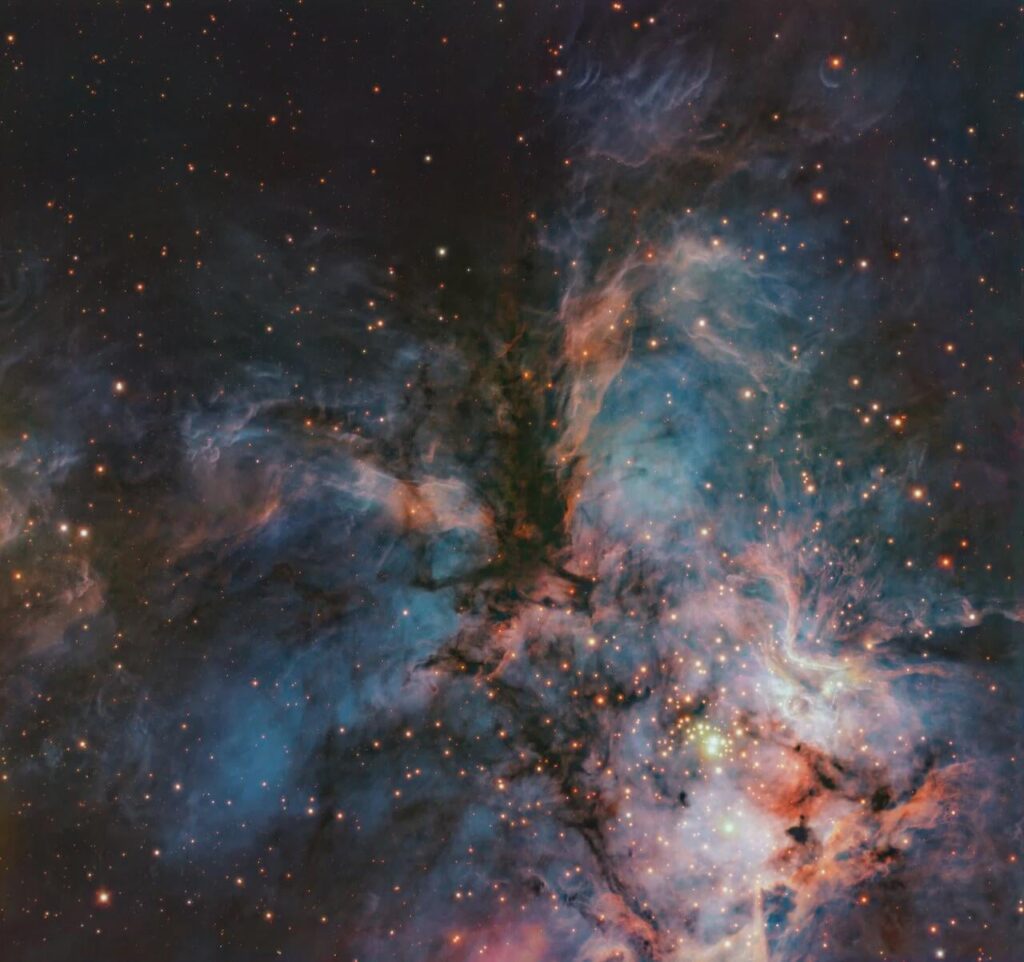
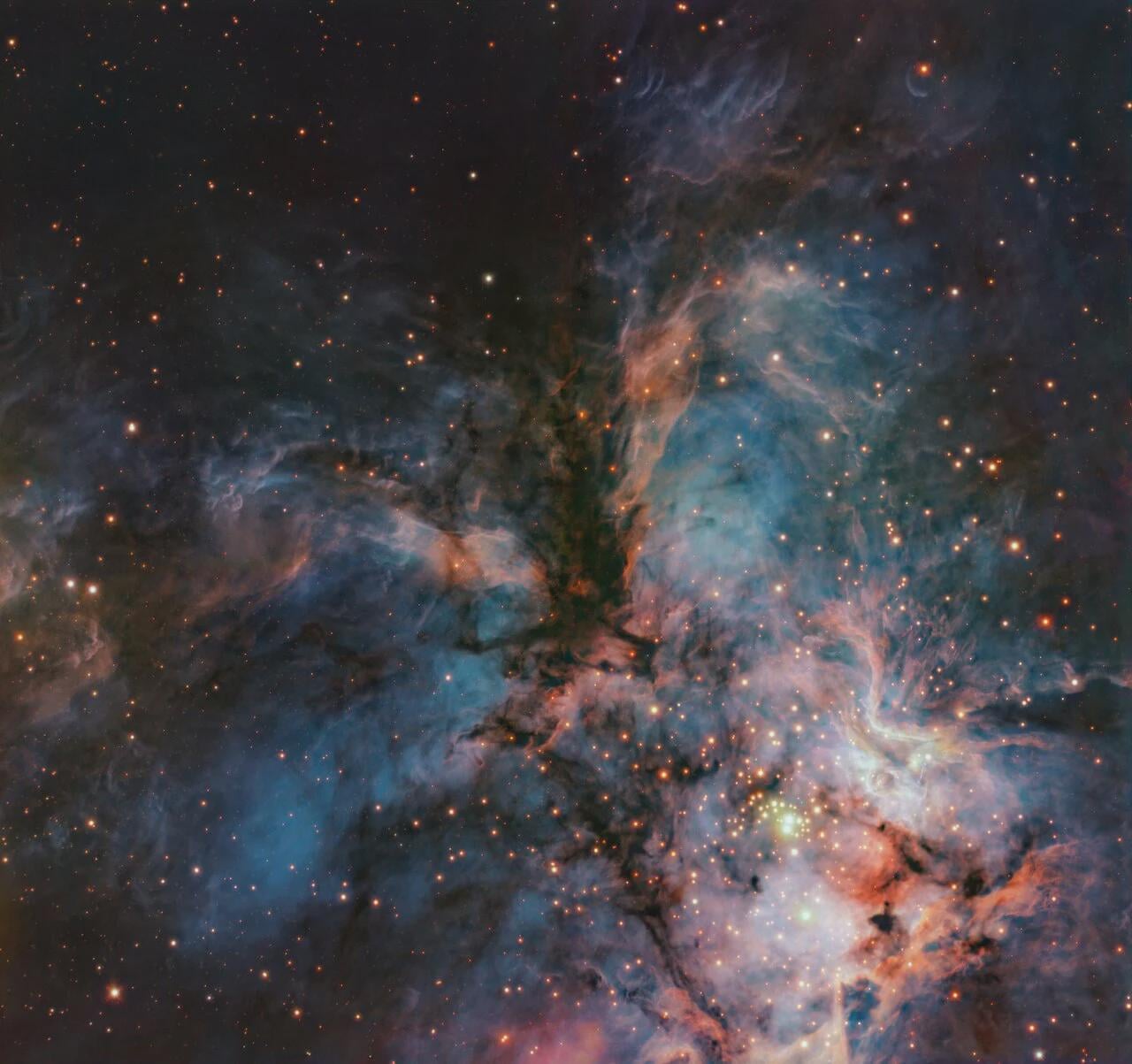
This image, acquired by the Very Large Telescope (VLT) in Chile, shows the RCW 36 nebula, located about 2,300 light-years away in the Vela Constellation. But to observers, it looks like a cosmic hawk spreading its wings: the dark clouds at the center resembling the hawk's head and body, and the filaments extending to the right and left serving as the wings. And in a nice twist, the image itself was acquired by the High Acuity Wide-field K-band Imager-1 (HAWK-1) instrument on the VLT.
This high-performance, near-infrared imager is designed to capture deep, high-resolution images that allow it to penetrate the clouds of dust and gas that obscure dimmer objects, such as newly forming stars. Several new stars are visible beneath the hawk in the image, nestled amid clouds of nebula gas and dust. The intense radiation from these massive young stars illuminates the nebula, causing it to glow blue, red, and white. However, it is the population of faint brown dwarfs that was of interest to the astronomers taking this image.
by Professor_Moraiarkar
1 Comment
I see cat 😺