
Back to Article List
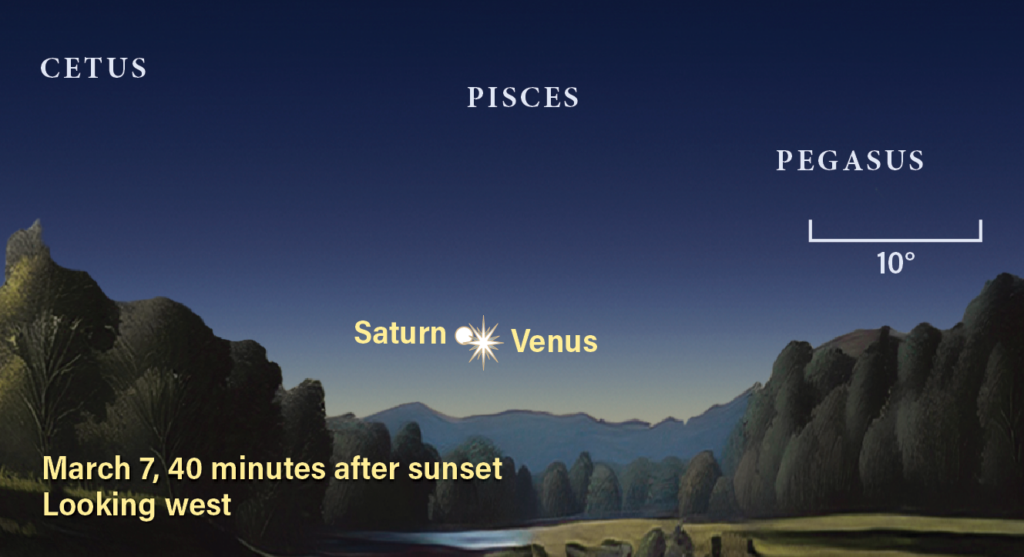
Two planets meet in the evening sky after sunset. Use bright Venus to easily find your way to fainter, more distant Saturn.
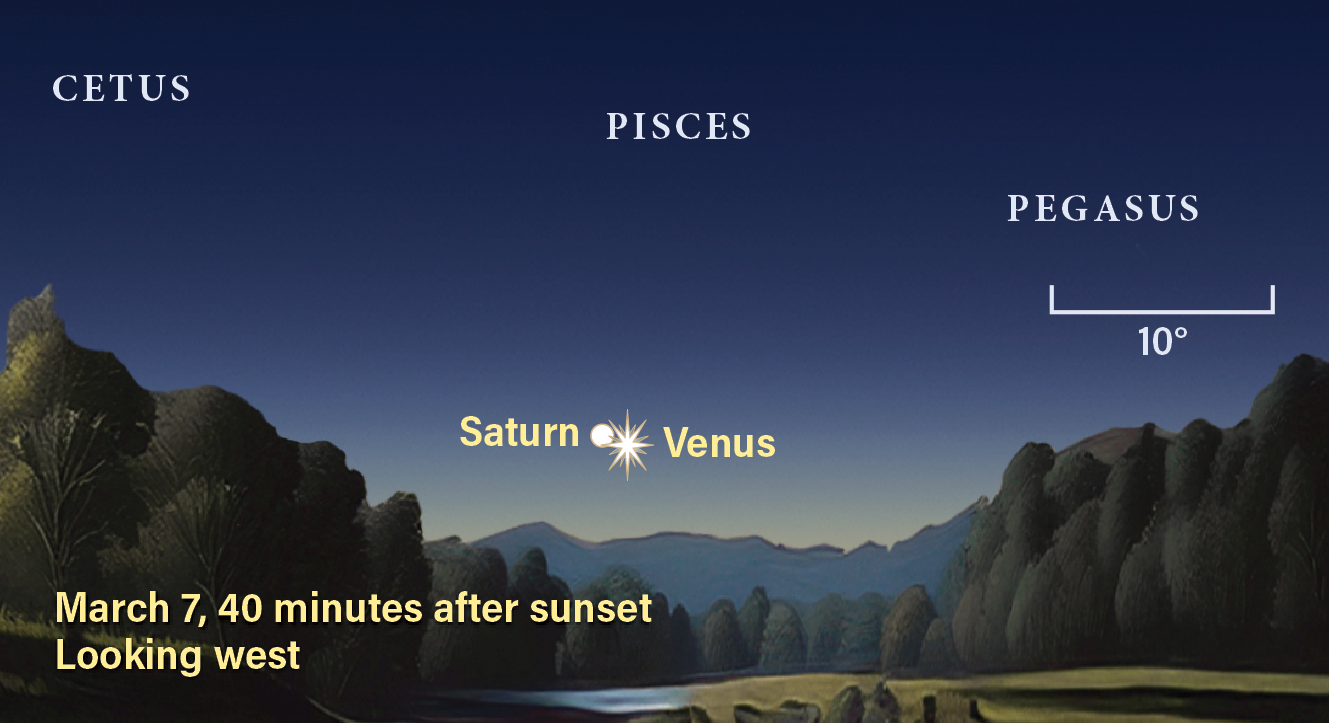
After sunset on the 7th, use bright Venus to guide you to fainter Saturn. If you can’t see the ringed planet by eye, try using binoculars. Credit: Astronomy: Roen Kelly
Looking for a sky event this week? Check out our full Sky This Week column.
March 6: Io’s turn to transit
Today our focus is on the evening sky as Venus and Saturn sit close together in the west. About 30 minutes after sunset, brilliant Venus should be visible some 7° above the horizon. Tonight, 1st-magnitude Saturn lies to its upper left — use binoculars or any telescope to look roughly 1° southeast of Venus to find the ringed planet.
With the two worlds so close, it’s easy to compare them. Venus’ disk spans 10” and has just a sliver in shadow, showing off a 97-percent-lit gibbous. Saturn, though much farther from Earth, is physically much larger than Venus and spans 16”, with rings that stretch some 36” from end to end. It appears fully illuminated, with the southern face of the rings now visible to us.
The pair will set some 70 minutes after the Sun. You can come back and observe them again tomorrow, when the two worlds are still the same distance apart, but now with Saturn south of Venus in the sky, appearing to Venus’ lower left.
Sunrise: 6:24 A.M.
Sunset: 5:59 P.M.
Moonrise: 10:43 P.M.
Moonset: 8:02 A.M.
Moon Phase: Waning gibbous (79%)
*Times for sunrise, sunset, moonrise, and moonset are given in local time from 40° N 90° W. The Moon’s illumination is given at 10 P.M. local time from the same location.