
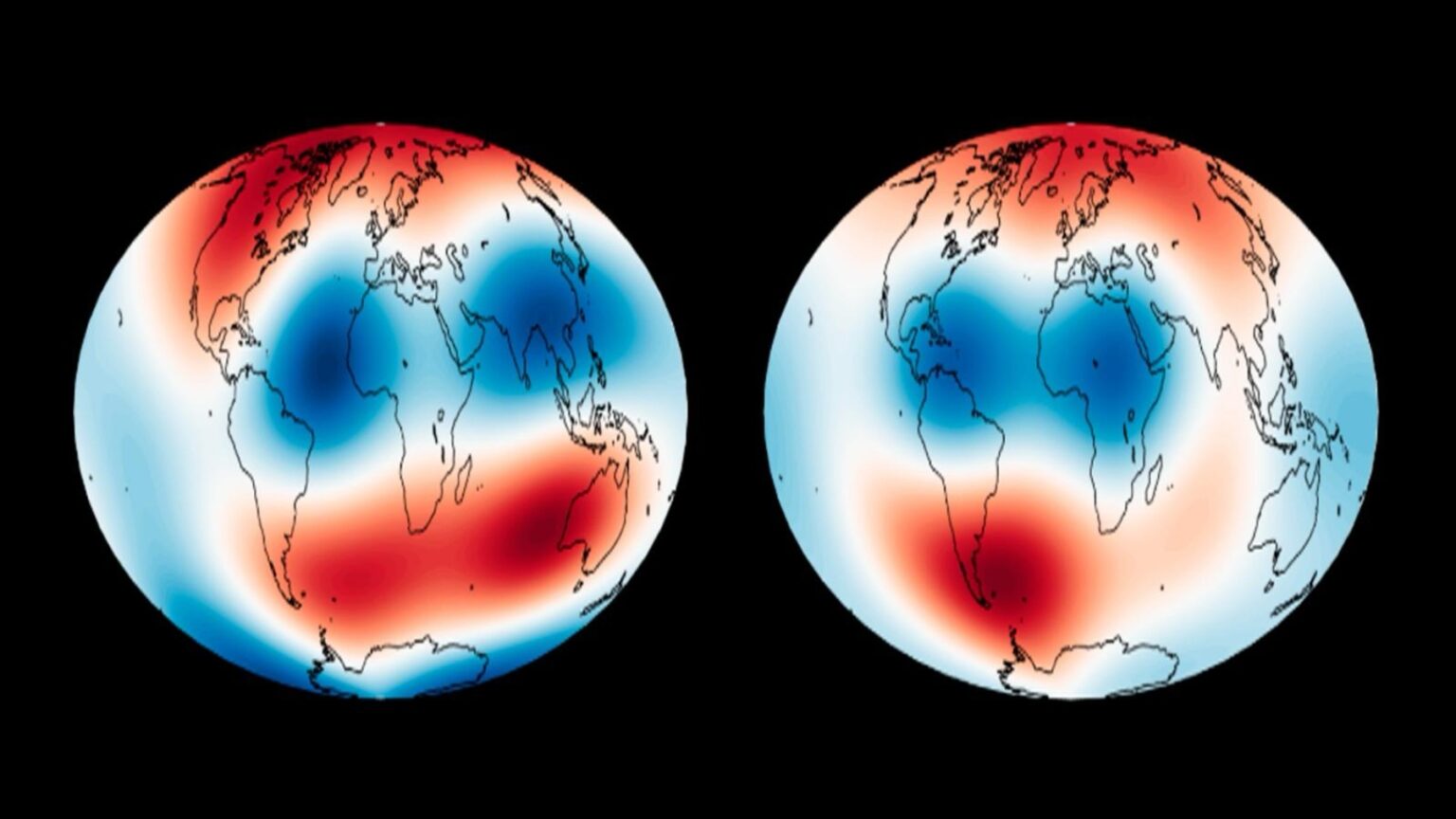
Scientists have noticed a massive gravity hole dragging Antarctica downwards.
Gravity affects nearly every factor of life on the third rock from the sun. And as science progresses, we are learning new and amazing details about how the mass of the universe influences our one and only home in the cosmos.
How can a gravity hole develop in the icy continent of Antarctica?
How our understanding of gravity has changed over history
The ancient Greeks believed in a theory developed by Aristotle that noted that objects fell downwards to seek their “natural place” at the center of the cosmos.
The apple myth we all learned about at school stated that Isaac Newton “discovered” his theory of how gravity works by an apple hitting him on the head, but in reality, historians think he likely saw an apple dropping from a tree at a distance.
Science has taught us that gravity and weight are two very different things.
Your mass stays at a constant level, but gravity influences your weight as the invisible force can pull and alter your weight depending on where you are. But the ultimate explanation of how gravity operates in the universe came from the mind of Albert Einstein.
Technology has forever altered our knowledge of the universe and Earth
The sensory upgrade that technology has provided us is amazing.
New immensely sensitive detectors in space have revealed that 95% of the universe is made up of Dark Matter, an unknown substance that dominates the emptiness of the cosmos.
Our technological progress has mostly been driven by our military needs, as new “weapons” are developed with astonishing implications.
Our technology has also enabled us to search the universe for our next habitable planet. The “daily updates” from the network of satellites and huge telescopes like the Hubble and Webb innovations have gazed into the vastness of space, revealing a treasure trove of new information.
The Arctic ice of the most mysterious continent on our planet holds many secrets of how the Earth moves and reshapes itself on a regular basis.
A new study, “Cenozoic evolution of Earth’s strongest geoid low illuminates mantle dynamics beneath Antarctica”, published in Nature, has revealed that a “gravity hole” exists in the iconically freezing continent.
Scientists find a massive “hole” underneath Antarctica. The question is what caused it
As we know, gravity is different depending on where on Earth you are.
Tectonic plates are constantly shifting beneath us, revealing the activities under the ground and oceans. This new study finds that the Antarctic Geoid Low, or AGL, is acting as a significant “gravity hole” in the continent.
This means that mantle convection, ancient sinking tectonic plates, and rising boiling materials create a weaker than normal gravitational pull.
While organizations like NASA spend their time gazing up at the inky darkness of the night sky, this study has opted to focus on the gravitational pull on Earth and how the massive “gravity hole” was created.
A 70-million-year-old anomaly that has changed the way we think about gravity and Earth
The study has suggested that the 70-million-year-old anomaly grew significantly stronger roughly 50 million years ago, possibly influencing the creation of the Antarctica continent.
The team analyzed earthquake data to understand how the region had such weaker gravity than other regions around the world.
This is the first study to explain the long-term history of the strange phenomenon that has baffled the minds of the best and brightest. Deep-Earth density variations can play a part in the gravitational forces that dominate the laws of physics, the study finds.
The secrets of our planet and its oceans and continents have become a little bit easier to unravel, thanks to the astonishing technological progress we have made.