
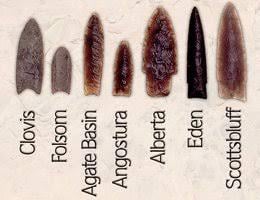
Clovis points have a distinctive flute channel and socket-like base designed to fit into a prepared socket on the shaft rather than being tied into notches—a radical departure from all other point traditions. This socket attachment allows the point to separate under lateral pressure, exactly like toggle harpoon heads used by Arctic hunters, where sideways forces lock the point inside an animal rather than yanking it free. This design makes no sense for land hunting, which requires maximum retention, but it's perfect for marine hunting: thrown harpoons for distance strikes where the point stays embedded, and close-range gaff strikes to haul large fish aboard a vessel. Both require a point that functions while separated from the shaft. The fact that Clovis points are optimized for socket attachment—not notched retention—is a feature that doesn't fit the orthodox land-hunting explanation, raising the question archaeology hasn't adequately addressed: how much of Clovis distribution actually aligns with coastal zones and waterways rather than inland megafauna hunting?
by C_B_Doyle
3 Comments
What makes you think you think clovis points separate when impacting something?
Properly lashed clovis points won’t do this when impacting flesh, and if they do they will just completely separate from the spear when it is pulled back.
Why would you waste a precious toolstone resource when a bone or wooden fishing spear works fine or better?
# Clovis Points: A Maritime Hunting Tool
**What Makes Clovis Different**
Clovis points have a distinctive feature that no other point tradition shares: a flute—a long, shallow channel ground into the flat face running from base to tip. Combined with a concave, socket-like base, this creates geometry designed to fit into a prepared socket on the shaft rather than being tied into notches. This socket attachment is the key. Unlike land-hunting points (which use notches to grip the wood and maximize retention in tissue), a Clovis point can separate from its shaft under lateral pressure. This is the opposite of what land hunting requires.
**The Toggle Harpoon Connection**
Arctic and Pacific hunters developed toggle harpoon heads that work on exactly this principle: the point penetrates, then when the shaft pulls away or the animal twists, the head rotates perpendicular to the wound and locks inside—impossible to pull back out the way it entered. A Clovis point’s socket geometry could function identically. The sideways forces that would rip a land-hunting point out actually lock a toggle harpoon in place. This design optimization makes no sense for hunting terrestrial megafauna, but it makes perfect sense for hunting marine animals that dive and fight in water.
**Two Maritime Uses, One Point**
The Clovis design likely served two related marine hunting scenarios: thrown harpoons for distance strikes at fish and sea mammals (where the point stays embedded while the shaft recovers), and close-range gaff-style securing strikes to haul large fish aboard a vessel. A 5-foot tuna alongside a reed boat can’t be lifted by line alone—you drive a Clovis point deep and use the shaft as a lever. Both uses require a point that functions effectively while separated from the shaft. This is the design logic Clovis embodies, and it’s fundamentally orthogonal to land hunting. The question archaeology hasn’t answered: how much of Clovis distribution actually aligns with coastal zones and waterways rather than inland megafauna hunting?
Except they are found in many locations far from coastlines.