
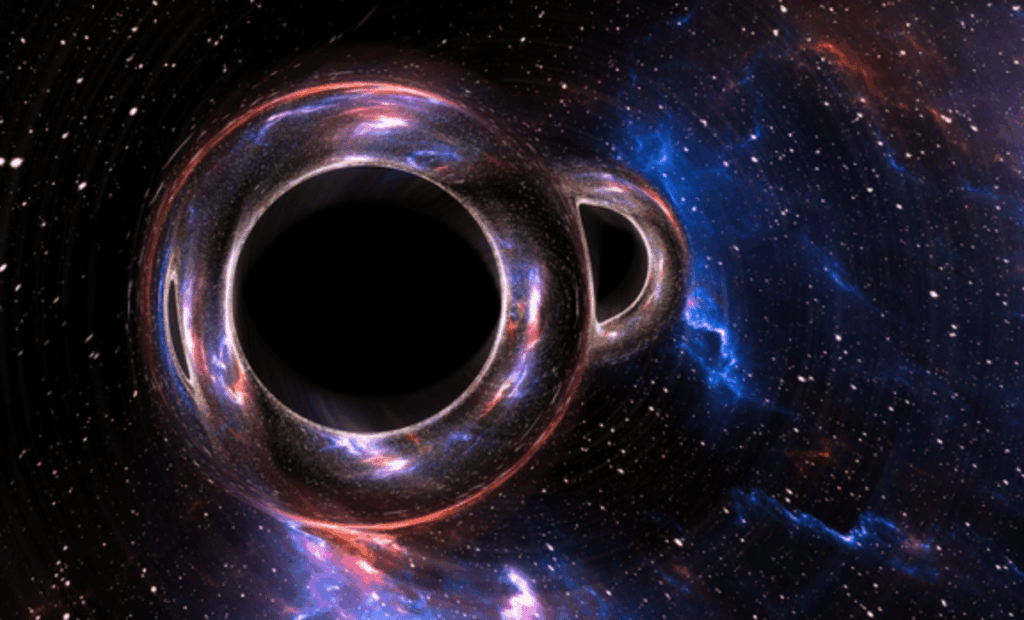
In the depths of the universe, where black holes collide and neutron stars crash, invisible ripples in spacetime are sent across the cosmos, carrying with them secrets about the most extreme events in the universe. These cosmic echoes, known as gravitational waves, have only recently become detectable, opening a window into the universe’s most mysterious and violent phenomena. What once seemed like a distant dream is now a reality, with astronomers detecting hundreds of these elusive waves, each one a snapshot of a cataclysmic event that unfolded billions of years ago.
The latest developments in this field, published in Astrophysical Journal Letters, reveal the most substantial breakthrough in gravitational-wave astronomy yet. With the release of the Gravitational-Wave Transient Catalog 4.0 (GWTC-4), researchers from the LIGO-Virgo-KAGRA (LVK) collaboration have more than doubled the number of detected gravitational-wave candidates, adding 128 new signals to the catalog. This new data is pushing the boundaries of our understanding, opening up new avenues to explore black hole formation, the expansion of the universe, and the very fabric of space and time itself.
Advancements in Detection Technology Fuel New Gravitational-Wave Insights
In the quest to better understand the cosmos, gravitational waves have emerged as one of the most profound tools in modern astrophysics. The ability to detect these tiny ripples in spacetime caused by the collision of massive objects, like black holes and neutron stars, has been made possible by advanced instruments such as LIGO and Virgo. According to Nergis Mavalvala, LVK member and Dean of MIT’s School of Science, “The beautiful science that we are able to do with this catalog is enabled by significant improvements in the sensitivity of the gravitational-wave detectors as well as more powerful analysis techniques.” These improvements have enabled the detection of previously elusive cosmic events, revealing a wealth of new information that would have been impossible to gather just a few years ago.
The latest catalog, known as Gravitational-Wave Transient Catalog 4.0 (GWTC-4), represents a significant leap in our understanding of gravitational-wave astronomy. As Stephen Fairhurst, a spokesperson for the LIGO Scientific Collaboration, explains, “In the past decade, gravitational wave astronomy has progressed from the first detection to the observation of hundreds of black hole mergers.” This expanded catalog of 128 new gravitational-wave candidates provides invaluable data that will help researchers explore how black holes form from the collapse of massive stars, probe the evolution of the universe, and offer even stronger confirmations of Einstein’s theory of general relativity.
Pushing the Boundaries of Black Hole Research: A New Frontier
The latest catalog reveals a variety of new discoveries that expand our knowledge of black hole binaries and their formation. Daniel Williams, a researcher at the University of Glasgow, points out that “The message from this catalog is: We are expanding into new parts of what we call ‘parameter space’ and a whole new variety of black holes.” This includes black hole binaries with more massive, rapidly spinning black holes, some of which are unlike anything seen before. These rare and unusual black hole systems present exciting opportunities for further investigation, helping scientists explore the extreme limits of astrophysical physics.
One of the most remarkable findings from the latest run is the discovery of a black hole binary with a previously unseen combination of characteristics. “One of the striking things about our collection of black holes is their broad range of properties,” says LVK member Jack Heinzel. “Some of them are over 100 times the mass of our sun, others are as small as only a few times the mass of the sun. Some black holes are rapidly spinning, others have no measurable spin.” This diversity in black hole characteristics opens up new avenues for research, allowing scientists to probe the underlying processes that govern black hole formation and evolution.
The Cosmic Dance of Merging Black Holes: A Chaotic Symphony
The collisions that produce gravitational waves occur when dense objects, such as black holes or neutron stars, spiral toward each other and merge. This “dance” of cosmic bodies generates ripples in spacetime, allowing scientists to observe these violent events from across vast distances. The chaotic nature of these mergers means that gravitational-wave detections are unpredictable, with some days seeing multiple detections and others having long dry spells. As Amanda Baylor, a graduate student at the University of Wisconsin, notes, “You can’t ever predict when a gravitational wave is going to come into your detector. We could have five detections in one day, or one detection every 20 days. The universe is just so random.”
Despite the unpredictable nature of these events, the frequency of detections has been steadily increasing, thanks to advancements in both hardware and data analysis. With each detection, scientists gain new insights into the behavior of black holes and the nature of spacetime itself. The most recent data, with its rich variety of black hole mergers, is a testament to the extraordinary potential of gravitational-wave astronomy to uncover the mysteries of the universe.
Gravitational Waves and General Relativity: Testing Einstein’s Theories
The study of gravitational waves also offers a unique opportunity to test Albert Einstein’s theory of general relativity. According to Aaron Zimmerman, an LVK member and associate professor of physics at the University of Texas, “Black holes are one of the most iconic and mind-bending predictions of general relativity.” When these dense objects collide, they create disturbances in spacetime that can be measured from Earth. By studying these disturbances, scientists can test the limits of Einstein’s theory, particularly in extreme conditions like black hole mergers.
One of the most “loud” gravitational-wave signals ever observed was GW230814_230901, a particularly clear signal that allowed researchers to test general relativity with unprecedented precision. Although the theory passed most tests with flying colors, the analysis also highlighted some of the challenges faced when trying to measure these extreme events. As Zimmerman points out, “When testing our physical theories, it’s good to look at the most extreme situations we can, since this is where our theories are most likely to break down, and where we have the best chance of discovery.”
Gravitational Waves and the Hubble Constant: Measuring the Universe’s Expansion
In addition to deepening our understanding of black holes, gravitational waves have the potential to resolve one of cosmology’s biggest questions: the rate at which the universe is expanding. By analyzing the signals from merging black holes, researchers can estimate how far these events took place, providing an alternative way to measure the Hubble constant, which has been a subject of debate among scientists. As Rachel Gray, an LVK member and lecturer at the University of Glasgow, explains, “Merging black holes have a really unique property: We can tell how far away they are from Earth just from analyzing their signals.”
This method offers a more direct way to measure the expansion of the universe, potentially resolving conflicting measurements obtained from other astrophysical sources. As more gravitational waves are detected, the precision of this measurement will improve, allowing scientists to refine their understanding of the universe’s evolution.
Unlocking the Universe’s Secrets: The Future of Gravitational-Wave Astronomy
Each new gravitational-wave detection brings us one step closer to solving the universe’s biggest mysteries. As Lucy Thomas, a postdoc at the Caltech LIGO Lab, says, “Each new gravitational-wave detection allows us to unlock another piece of the universe’s puzzle in ways we couldn’t just a decade ago.” With each new discovery, scientists gain more insights into the fundamental nature of spacetime, the origins of black holes, and the very fabric of the cosmos itself. The future of gravitational-wave astronomy is filled with exciting possibilities, and as more observing runs unfold, the surprises are sure to continue.