

Astronomers in Italy and Germany have turned to some of the oldest stars in the Milky Way to estimate the true age of the Universe, and finally address the long-standing mystery known as the Hubble tension.
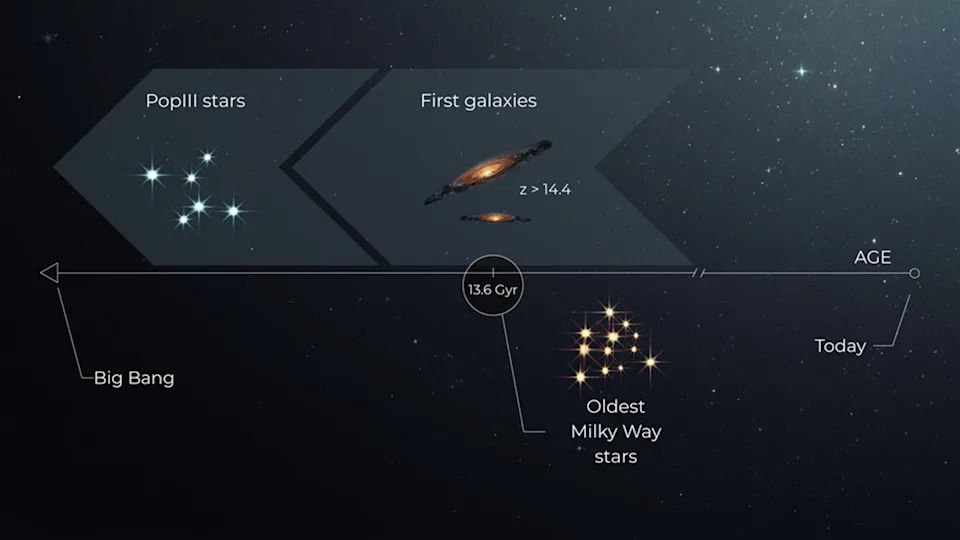
Researchers from the University of Bologna in Italy, and the Leibniz Institute for Astrophysics Potsdam (AIP), used precise stellar data to determine that the Milky Way Galaxy, which includes the Solar System, is likely 13.6 billion years old.
Even though this age contradicts the younger Universe proposed by Cepheid and supernova measurements, it agrees with the older age estimated from the cosmic microwave background. It adds a new perspective to the Hubble tension debate.
“This project beautifully shows how combining expertise from different fields can open new windows on fundamental questions,” Elena Tomasetti, a PhD student at the University of Bologna and lead author of the study said.
A new cosmic approach
The Hubble constant, which measures how fast the Universe is expanding today, is one of the most debated questions in modern cosmology. While estimated at roughly 68 kilometers per second per megaparsec (km/s/Mpc), its exact value is still disputed.
Meanwhile, different measurement methods have produced conflicting results throughout the years. Observations based on nearby cosmic objects like Cepheid variable stars and supernovae suggest a faster expansion rate. This corresponds to a younger Universe of roughly 13 billion years.
In contrast, measurements based on the cosmic microwave background, the faint afterglow of the Big Bang, indicate a slower expansion, as well as a slightly older Universe of about 14 billion years.
 The value of the Hubble constant is one of the most debated questions in modern cosmology.
Credit: Elena Tomasetti
“Measuring the age of stars is, in itself, a complex challenge, but we now live in an era in which the quantity and quality of available data allow us to achieve unprecedented precision and, for the first time, statistically significant results,” Tomasetti said.
To address the challenge, the research team placed their focus on the ages of the oldest stars in the galaxy. Because the Universe cannot be younger than the stars it contains, accurately measuring the ages of the oldest stars in the Milky Way can provide a robust lower limit on the age of the Universe.
Clues from ancient stars
For the project, the team utilized an existing catalogue of stellar ages developed at AIP, which contains age estimates for over 200,000 stars in the Milky Way. Data from the European Space Agency’s Gaia mission provided precise measurements of stellar distances and spectra.
This information made it possible for the scientists to determine stellar properties with unprecedented accuracy. The team utilized the dataset to select a carefully vetted sample of the oldest stars with the most reliable age measurements.
They prioritized quality over quantity, and filtered out objects that might distort the results. The final sample included about 100 ancient stars, whose ages were determined using the StarHorse computational framework.
Cristina Chiappini, PhD, a senior scientist at AIP, noted that the Gaia mission has effectively turned the Milky Way into a near-field cosmology lab. “We can now estimate stellar ages with unprecedented precision,” Chiappini said.
“The next breakthrough will be accuracy, anchoring the Galactic timeline with far greater certainty,” she concluded in a press release. “The HAYDN mission concept, with AIP participation, aims to provide that decisive step.”
Future data releases from Gaia are expected to further improve age estimates and could refine measurements of both the Universe’s age and the Hubble constant.
The study has been published in the journal Astronomy & Astrophysics.