
Your support helps us to tell the story
From reproductive rights to climate change to Big Tech, The Independent is on the ground when the story is developing. Whether it’s investigating the financials of Elon Musk’s pro-Trump PAC or producing our latest documentary, ‘The A Word’, which shines a light on the American women fighting for reproductive rights, we know how important it is to parse out the facts from the messaging.
At such a critical moment in US history, we need reporters on the ground. Your donation allows us to keep sending journalists to speak to both sides of the story.
The Independent is trusted by Americans across the entire political spectrum. And unlike many other quality news outlets, we choose not to lock Americans out of our reporting and analysis with paywalls. We believe quality journalism should be available to everyone, paid for by those who can afford it.
Your support makes all the difference.Read more
An asteroid, previously used by NASA for a planetary defence test, has been successfully shifted onto a slightly altered path around the sun, scientists reported on Friday. This landmark achievement could pave the way for diverting potentially hazardous space rocks in the future.
The deliberate alteration marks the first instance of a celestial body’s solar orbit being intentionally changed. Crucially, the asteroid impacted by NASA’s DART spacecraft never posed a threat to Earth.
An international research team highlighted the significance, stating in Science Advances: “This study marks a notable step forward in our ability to prevent future asteroid impacts on Earth.” The orbital adjustments were minor, amounting to reductions of just one-tenth of a second and 720 metres over a two-year solar journey spanning hundreds of millions of miles.
“Even though this seems small, a tiny deflection … can add up over decades and make the difference between a potentially hazardous asteroid hitting or missing the Earth in the future,” lead author Rahil Makadia, of the University of Illinois Urbana-Champaign, said in an email.
For any save-the-planet tests, “the key isn’t delivering a huge shove at the last minute. The key is delivering a tiny shove many years in advance,” he added.
Launched in 2021 on the world’s first planetary defense exercise, the Dart spacecraft deliberately plowed into Dimorphos, which orbits a bigger asteroid, Didymos, as they circle the sun together. The space agency quickly determined that the 2022 strike trimmed the smaller asteroid’s orbit around its bigger companion.
But it took until now for scientists to confirm, based on observations from around the world, that the impact cut the duo’s travel time around the sun by 0.15 seconds. With each solar orbit lasting 769 days, that’s a real-time slowdown of just over 10 micrometers per second, shrinking the asteroids’ 300-million-mile (480-million-kilometer) orbit by 2,360 feet (720 meters).
open image in gallery
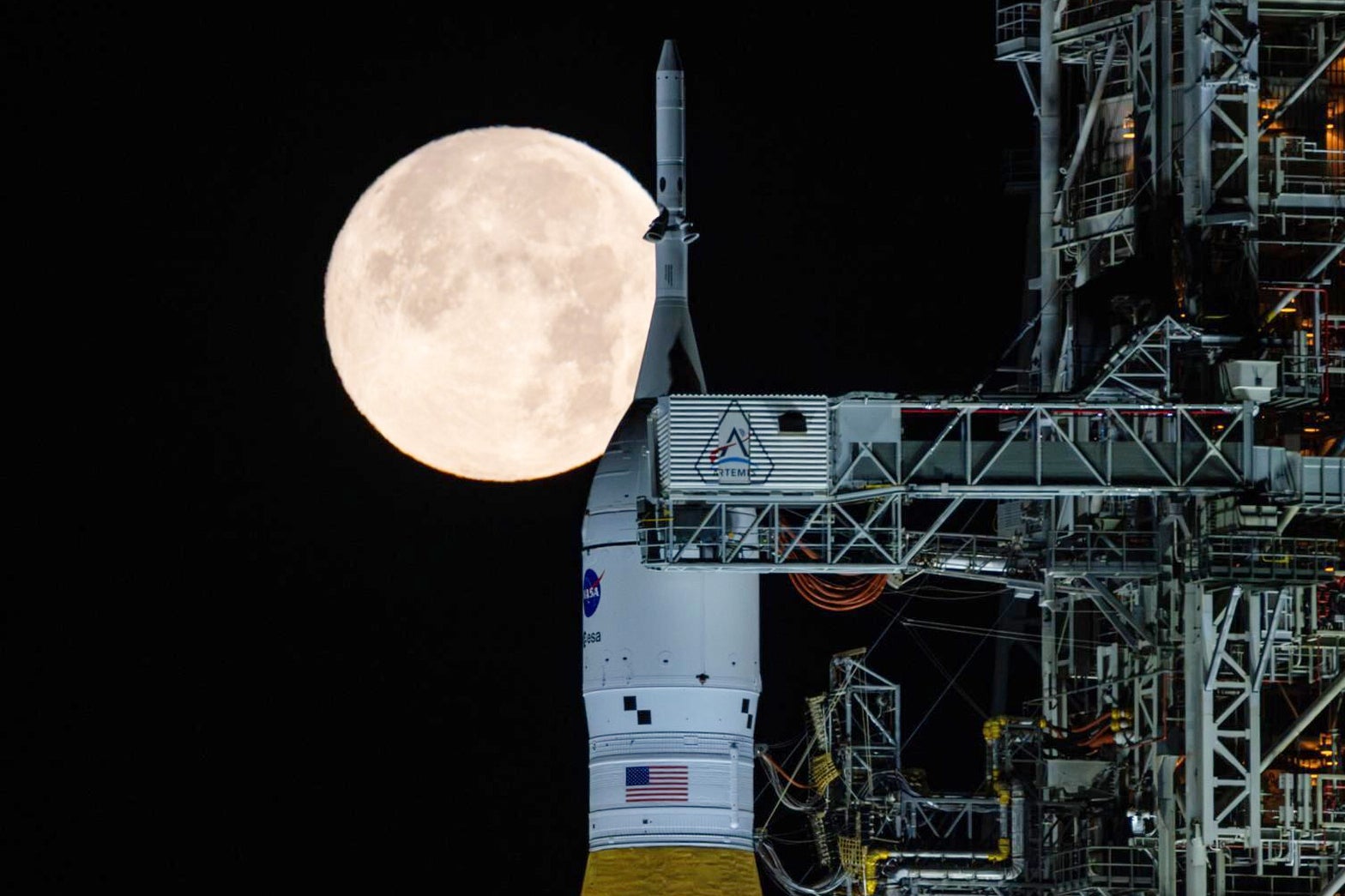
FILE – A full moon is seen shining over NASA’s SLS (Space Launch System) and Orion spacecraft, atop the mobile launcher in the early hours of Sunday, Feb. 1, 2026, at NASA’s Kennedy Space Center in Florida. (Sam Lott/NASA via AP, File)
The researchers said all the boulders and other debris flung off Dimorphos in the crash provided as much push to Dimorphos as the spacecraft itself — a doubling of momentum. Last summer, a U.S.-Italian team estimated that 35 million pounds (16 million kilograms) of rock and dust were ejected.
The good news is that even with the change in the asteroids’ course, Earth remains safely out of their way for the foreseeable future. That’s why this rubble-packed system was picked for the mission, said Steven Chesley of NASA’s Jet Propulsion Laboratory, who took part in the study.
“While it is just a single experiment, it is nonetheless an important data point that will be relevant to any future asteroid deflection missions,” Chesley said in an email.
Scientists expect to learn even more about the impact’s aftermath when the European Space Agency’s Hera spacecraft reaches the asteroids in November. Dimorphos is 525 feet (160 meters) in diameter. Fast-spinning Didymos is 2,560 feet (780 meters) across with, according to the latest study, 200 times more mass than its sidekick.
Unlike Dart, Hera will not strike but will tag along for months of surveying. A pair of small experimental probes will peel away and attempt to land.