
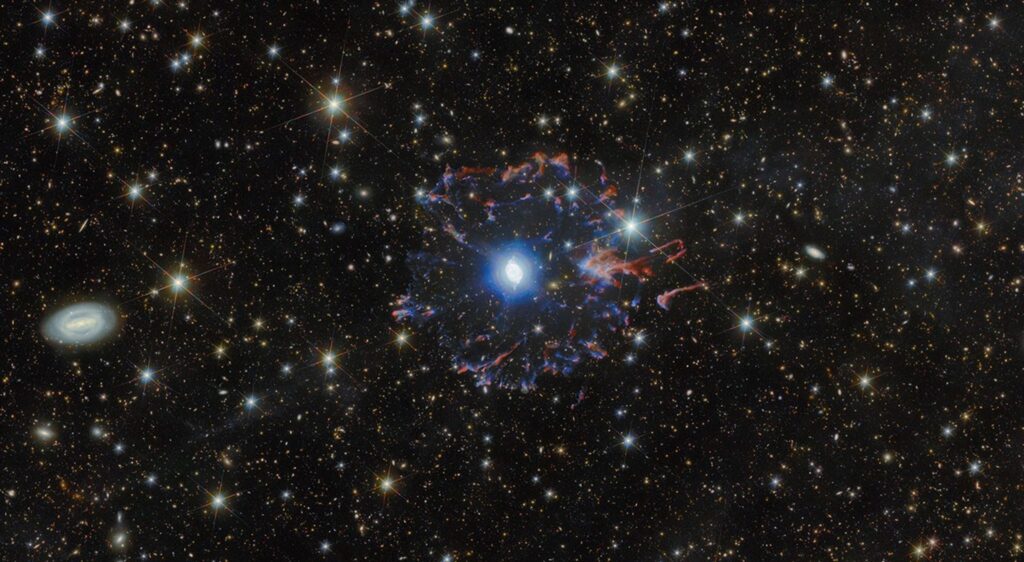
Two of the world’s most powerful space telescopes have joined forces to produce a stunning new image of the Cat’s Eye Nebula, one of the most visually complex objects in the known universe.
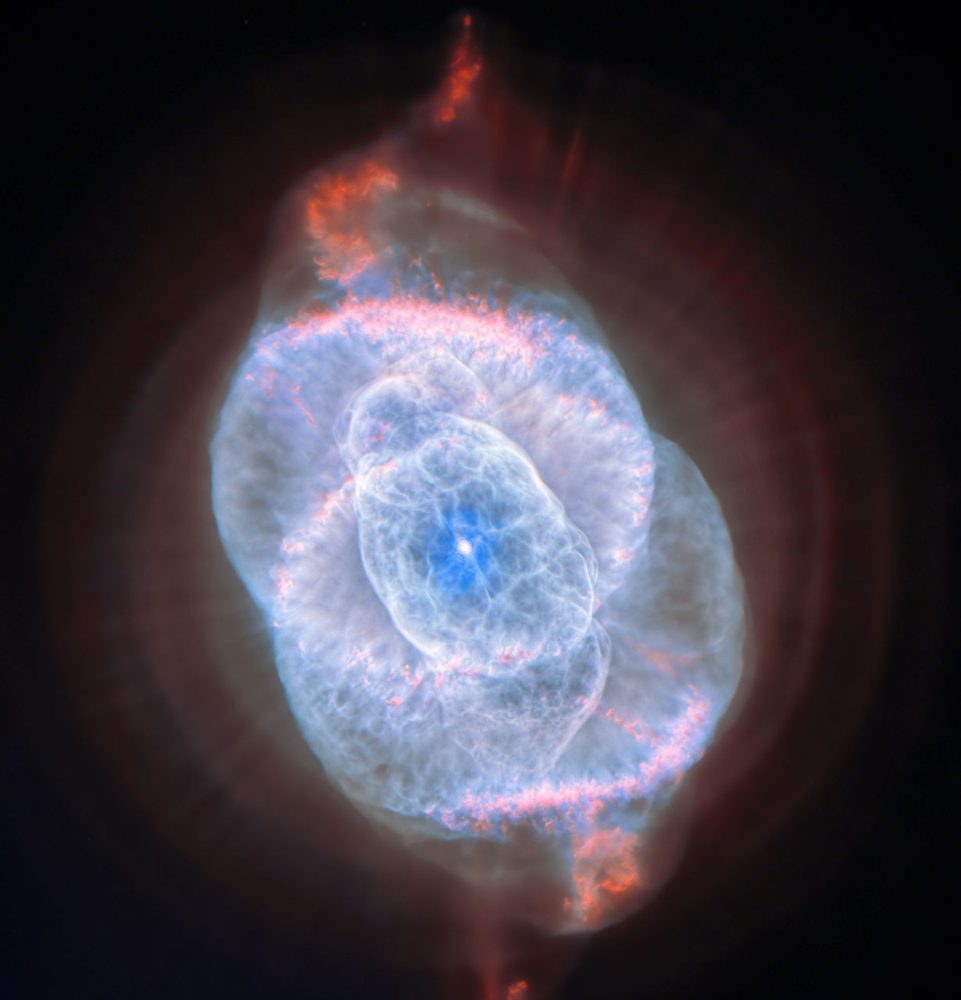
The NASA/ESA Hubble Space Telescope and ESA’s Euclid space telescope combined their distinct capabilities to produce a composite image of NGC 6543. The nebula sits approximately 4,400 light-years from Earth in the constellation Draco.
What is a planetary nebula?
Planetary nebulae take their name from their round, planet-like appearance when viewed through early telescopes. In reality, they are expanding shells of gas that a dying star sheds during the final stages of its life.
The Cat’s Eye Nebula holds a special place in scientific history. In 1864, astronomers examining the spectrum of its light confirmed for the first time that planetary nebulae consist of gas rather than stars or galaxies. That single discovery reshaped how scientists understood stellar death across the entire universe.
A record from two instruments
Hubble trained its Advanced Camera for Surveys on the nebula’s innermost core, revealing high-resolution details of concentric shells, high-speed gas jets, and dense gas knots sculpted by shock interactions. The result is a tapestry of structure that researchers describe as almost surreal in its intricacy.
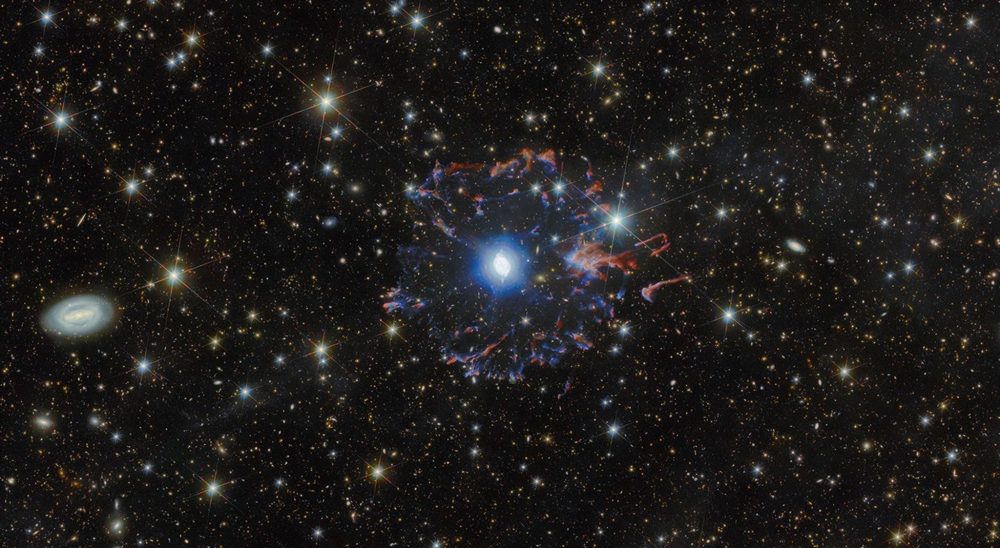
Euclid, built to map dark matter and dark energy across cosmic scales, contributed a sweeping, wide-field view in both near-infrared and visible light. Its contribution placed the nebula within a far larger context, surrounded by a halo of colorful gas fragments and thousands of distant background galaxies.
A stellar fossil record
The concentric shells Hubble detected carry a significant scientific message. Scientists believe these structures record a series of mass-loss episodes from the dying star at the nebula’s center, forming what researchers describe as a cosmic “fossil record” of its final evolutionary stages.
According to Earth.com, planetary nebulae such as the Jewel Bug Nebula and the Egg Nebula have shown astronomers how Sun-like stars behave in their dying phases, helping scientists predict the eventual fate of our own Sun.
An outer ring visible in Euclid’s wide-field image tells a separate story. That ring formed before the bright central nebula, suggesting the star expelled material in multiple distinct phases over a long timeline.
Gaia pinned down the distance
ESA’s Gaia mission provided the precise distance measurement of approximately 4,400 light-years that anchors the entire observation. That figure, combined with Hubble’s structural detail and Euclid’s panoramic sweep, gives researchers a more complete picture of NGC 6543 than any previous study could offer.
Why this image matters
Every shell, jet, and filament in NGC 6543 encodes information about how stars age, shed their outer layers, and enrich surrounding galaxies with elements such as carbon and oxygen. Just as Earth.com has reported for other remarkable nebulae like the Red Spider Nebula and the Spirograph Nebula, each new observation brings scientists closer to answering fundamental questions about stellar life cycles and the chemical history of the cosmos.
The ESA/Hubble team selected this combined image as its Picture of the Month for March 2026. As Euclid continues its deep imaging surveys of the sky, spectacular nearby objects like the Cat’s Eye Nebula will continue to appear as remarkable bonuses alongside its primary mission to probe the nature of dark matter and dark energy.
The full image release is available on the ESA/Hubble website.