
image:
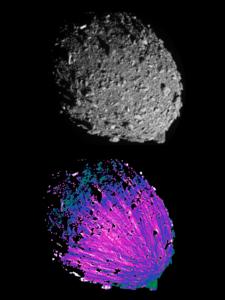
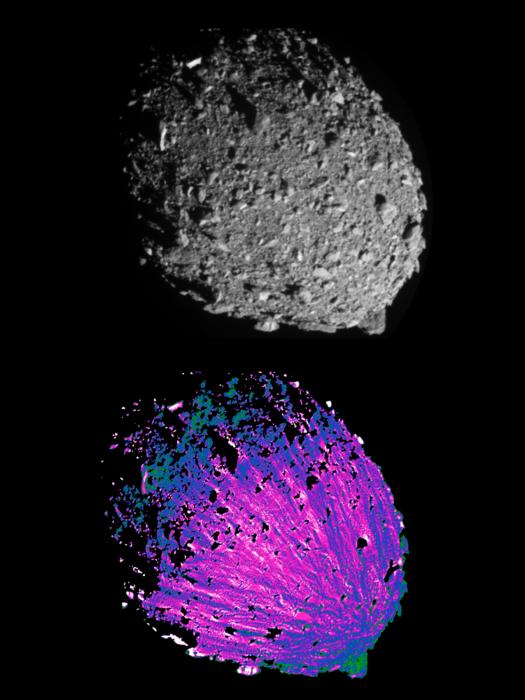
[Top] The boulder-covered moon Dimorphos as seen 8.55 seconds before the impact of the DART space craft. [Bottom] The same image after correcting for lighting conditions across the surface and shadows cast by boulders, revealing a fan-shaped pattern of streaks (highlighted in color for emphasis).
Credit: Credit: NASA/JHU-APL/UMD.
About 15% of asteroids near Earth have small moons orbiting them, making binary asteroid systems common in our cosmic neighborhood.
Now, a team of astronomers led by the University of Maryland discovered that these binary asteroid systems are far more dynamic than anyone realized—actively exchanging rocks and dust in gentle, slow-motion collisions that reshape them over millions of years.
After analyzing images taken by NASA’s Double Asteroid Redirection Test (DART) spacecraft in 2022, just before its deliberate collision with asteroid moon Dimorphos, the team identified bright, fan-shaped streaks across the moon’s surface—the first direct visual evidence of material naturally traveling from one asteroid to another. The researchers’ findings, published in The Planetary Science Journal on March 6, 2026, have significant implications for understanding asteroids that could potentially threaten Earth.
“At first, we thought something was wrong with the camera, and then we thought it could’ve been something wrong with our image processing,” said the paper’s lead author Jessica Sunshine, a professor with joint appointments in the Department of Astronomy and Department of Geological, Environmental, and Planetary Sciences at UMD. “But after we cleaned things up, we realized the patterns we were seeing were very consistent with low velocity impacts, like throwing ‘cosmic snowballs.’ We had the first direct proof for recent material transport in a binary asteroid system.”
The team’s findings also provided the first visual confirmation of the Yarkovsky-O’Keefe-Radzievskii-Paddak (YORP) effect, in which sunlight makes small asteroids spin faster until material flies off their surfaces, sometimes creating moons. Sunshine noted that this was likely the case for Didymos and its smaller moon Dimorphos, as evidenced by the traces of ‘cosmic snowballs’ left on Dimorphos’ surface.
Finding these traces required months of detective work. The fan-shaped streaks were invisible in the DART spacecraft’s original images, but UMD astronomy research scientist Tony Farnham and former postdoctoral researcher Juan Rizos helped develop sophisticated techniques to remove boulder shadows and lightning effects from the pictures, revealing the surprising streaks that ‘cosmic snowballs’ left behind.
“We ended up seeing these rays that wrapped around Dimorphos, something nobody’s ever seen before,” Farnham said. “We couldn’t believe it at first because it was subtle and unique.”
For the researchers, the DART mission’s trajectory created an unusual challenge. The spacecraft hurtled straight toward its target with barely any change in lighting or perspective, making it difficult to distinguish real features from possible lighting artifacts. To prove the legitimacy of the streaks, the team mapped them back to their origin in a single region near Dimorphos’ edge—distinctly offset from where the sun was directly overhead. By taking this approach, the team concluded that the marks left by ‘cosmic snowballs’ weren’t just a trick of the lighting after all.
“As we refined our 3D model of the moon the fan-shaped streaks became clearer, not fainter,” Farnham said. “It confirmed to us that we were working with something real.”
Previously, scientists observed indirect evidence that sunlight makes small asteroids spin faster, causing material to fly off their surfaces. But the UMD team’s newly refined models of the asteroid moon Dimorphos provide the first visual confirmation of this phenomenon and identify exactly where shed material from its primary asteroid, Didymos, landed. Further calculations led by UMD alum Harrison Agrusa (M.S. ’19, Ph.D. ’22, astronomy) also showed that the material left Didymos at 30.7 centimeters per second—slower than the average human walking speed.
“That would explain the distinctive fan-shaped marks,” Sunshine said. “Instead of even spreading, these slow-moving impacts would create a deposit rather than a crater. And they are centered on the equator as predicted from modeling material spun off the primary.”
To test their theories, the researchers led by former UMD postdoctoral associate Esteban Wright performed a series of laboratory experiments at UMD’s Institute for Physical Science and Technology. They dropped marbles into sand scattered with painted gravel to simulate boulders on Dimorphos. High-speed cameras captured the experiment, revealing that boulders blocked some material while letting other particles stream between them—creating ray-like patterns matching those on Dimorphos.
Computer simulations of impacts of loose clumps of dust carried out at Lawrence Livermore National Laboratory confirmed the results. Whether the impactor was a compact rock, like the marble, or a looser clump of material, boulders on the asteroid’s surface naturally sculpted the ‘cosmic snowballs’ into fan-like rays on the ground.
“We could see these marks on Dimorphos from that footage captured by the DART spacecraft right before the big collision, proof that there was material exchange between it and Didymos,” Sunshine said. “The fan line deposit should extend to side of the moon we did not hit, and there is a possibility it was not destroyed by the impact.”
The European Space Agency’s Hera mission, set to arrive at Didymos in December 2026, may reveal whether these features survived DART’s collision. Sunshine and her team predict Hera might also observe new ray patterns created by boulders that the DART spacecraft knocked loose, shedding new light on asteroids that could pose a threat to Earth.
“These new details emerging from this research are crucial to our understanding of near-Earth asteroids and how they evolve,” Sunshine said. “We now know that they’re far more dynamic than previously believed, which will help us improve our models and our planetary defense measures.”
###
This research was supported by NASA (Contract No. 80MSFC20D0004), the U.S. Department of Energy (Contracts DE-AC52-07NA27344 and LLNL-JRNL2002294) and the French National Research Agency (Project ANR-15-IDEX-01).
The paper, “Evidence of Recent Material Transport within a Binary Asteroid System,” was published on March 6, 2026 in The Planetary Science Journal.
Journal
The Planetary Science Journal
Article Title
Evidence of Recent Material Transport within a Binary Asteroid System
Article Publication Date
6-Mar-2026
Disclaimer: AAAS and EurekAlert! are not responsible for the accuracy of news releases posted to EurekAlert! by contributing institutions or for the use of any information through the EurekAlert system.