
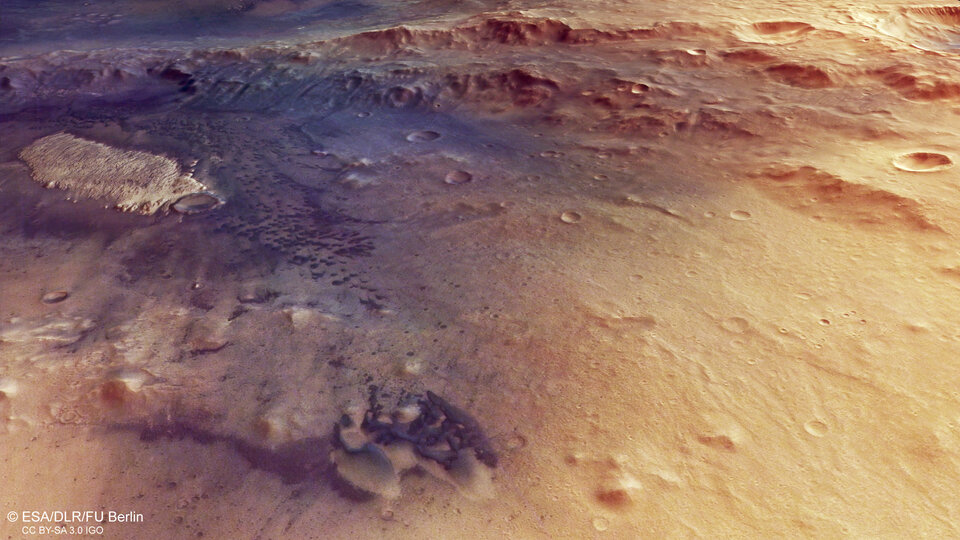
The European Space Agency (ESA) has released striking new images from its Mars Express orbiter. The views offer a detailed look at one of the Red Planet’s most ancient and heavily cratered regions. They reveal a dramatic slice of Arabia Terra, a vast Martian plain shaped by billions of years of asteroid impacts, wind activity, and geological change.
One of the Oldest Regions on Mars
The sheer number of craters visible in the region comes as no surprise to planetary scientists. Arabia Terra is among the oldest terrains on Mars, dating back roughly 3.7-4.1 billion years. Over that immense span of time, the surface has accumulated countless impact scars.
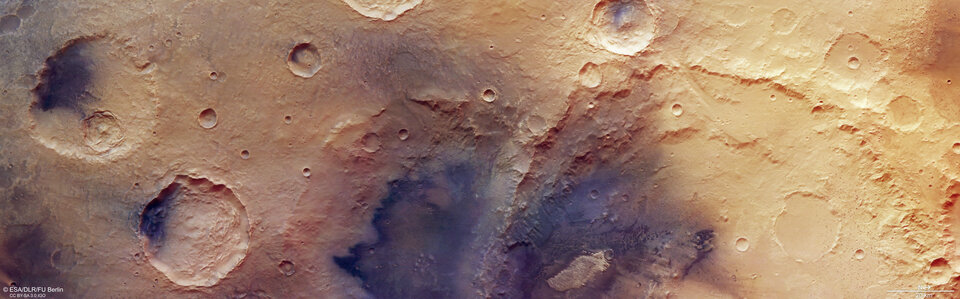 A patch of Arabia Terra. Credit: ESA
The newly released image captures just a small portion of this battered landscape. Some craters contain dark rocky deposits. The others are filled with lighter sands and wind-shaped dunes. Many show eroded rims and collapsing walls that reveal their great age.
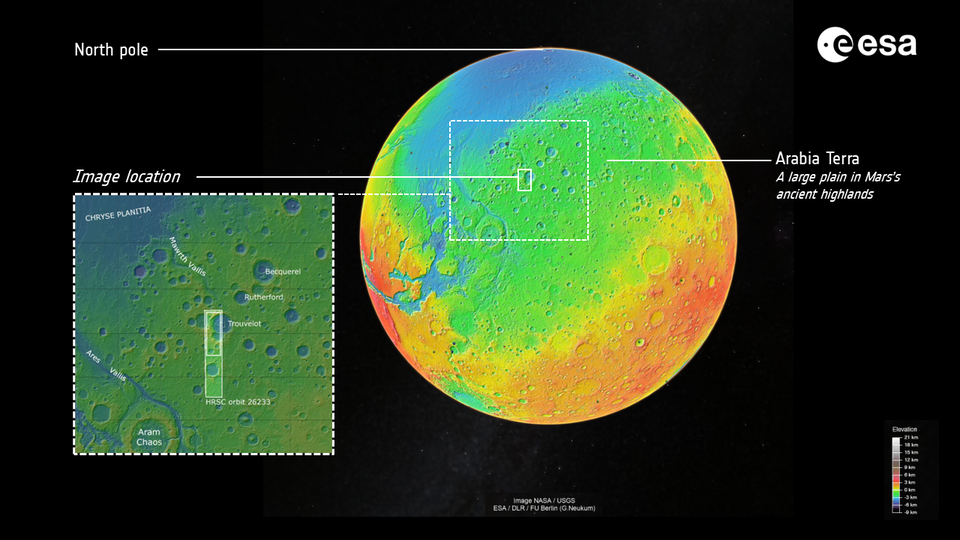 The location of the image within the broader Arabia Terra region. Credit: ESATrouvelot Crater Dominates the Landscape
Among the standout features in the newly released imagery is the Trouvelot Crater. It is a massive impact structure roughly 130 kilometres wide. The imagery reveals a complex landscape where dark volcanic rocks, wind-sculpted dunes and lighter mineral deposits coexist. It provides scientists with valuable clues about Mars’ long geological history.
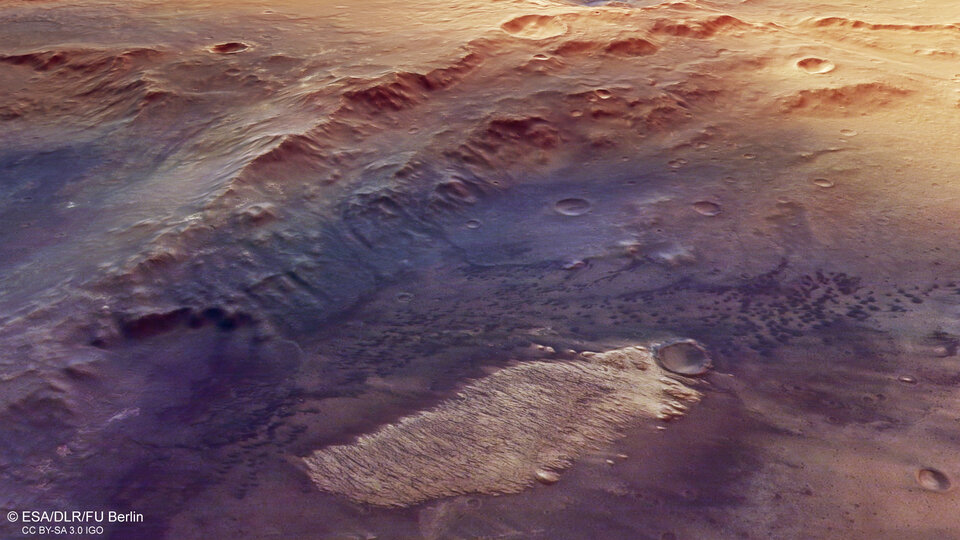 Close-up image showing the dark rock covering the floor of Trouvelot Crater and its ancient companion, with even darker barchan dunes visible at the centre-left of the image. Credit: ESAWind-Shaped Dunes on the Crater Floor
Inside Trouvelot Crater, dark material has been sculpted by wind into rippling barchan dunes. These crescent-shaped formations form when winds blow predominantly in one direction, gradually pushing sand into curved ridges.
Mars Express has observed similar dunes in other parts of the planet. These include the north polar region and around the massive Tharsis volcanic province.
Evidence of an Even Older Impact
To the left of Trouvelot Crater lies another basin that appears even older and more eroded. Its rim is almost completely worn away. Because Trouvelot cuts across it, scientists believe this heavily degraded crater formed earlier.
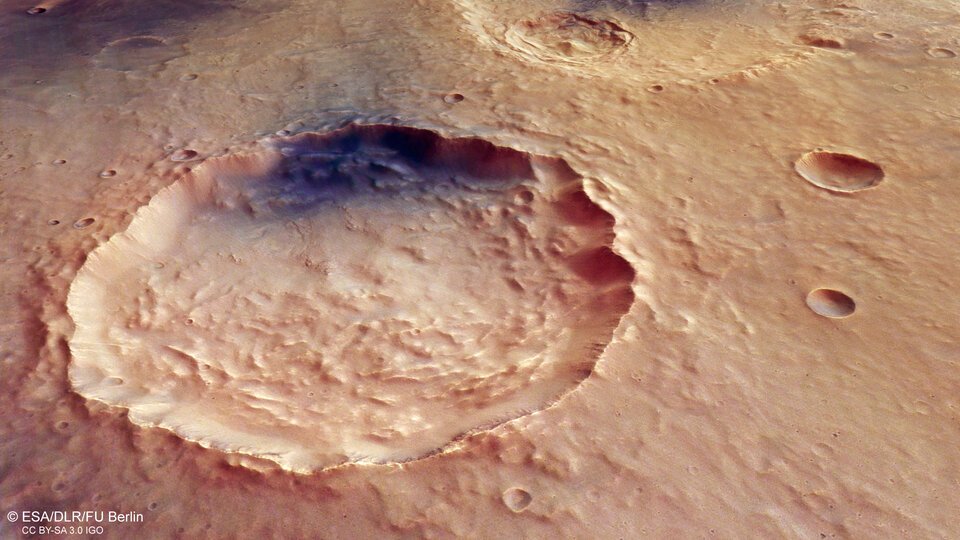 Close-up image showing another crater that is visible in the lower left of the main image (to the left of Trouvelot Crater and the ancient companion that it intersects). Credit: ESA
Its floor is largely covered in dark, mineral-rich rock containing magnesium, iron, pyroxene and olivine. These materials are known as mafic rock, which is commonly linked to volcanic activity.
These deposits may have been excavated during powerful impacts and later redistributed by wind and gravity along the crater walls. Similar dark deposits appear in many other craters across Arabia Terra, suggesting these geological processes are widespread throughout the region.
Two Decades of Mars Exploration
Launched in 2003, Mars Express has spent more than two decades exploring the Red Planet’s diverse landscapes. Using its High Resolution Stereo Camera (HRSC), the orbiter has mapped Mars in colour and three dimensions at remarkable detail. Its views provide insights that have significantly advanced our understanding of the planet.
Published by Space Enthusiast
An amateur rocket enthusiast with a keen interest in all space-related activity. Looking forward to the day when the UK starts launching rockets into space and I’m able to watch launches (from a safe distance of course).