
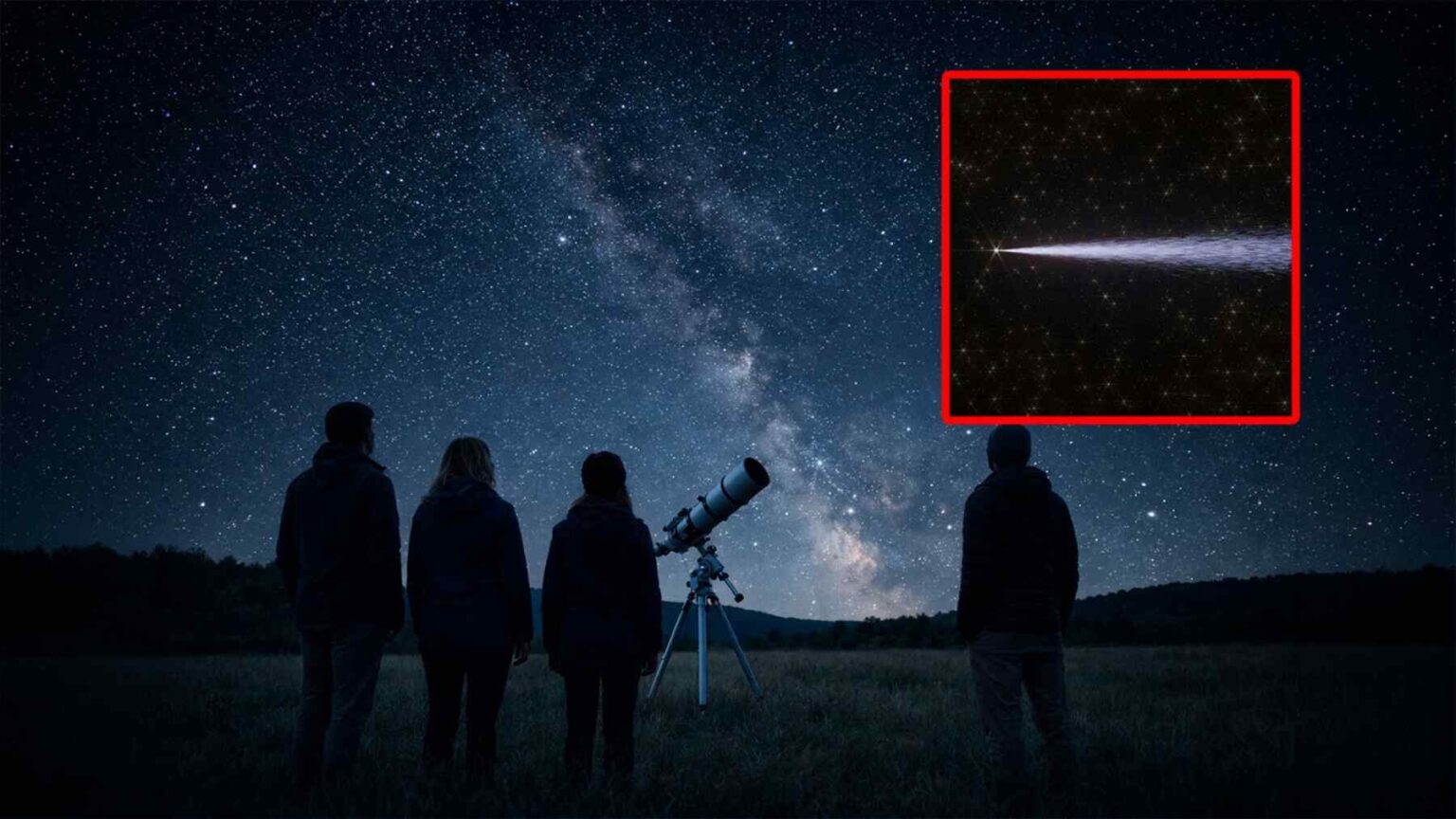
A comet is heading our way and is carrying with it a world of knowledge.
Discovering comets and asteroids from outside our solar system usually requires huge telescopes and advanced systems. But as one group of friends found out, not even NASA has the time to study every distant point of light in the sky.
How will the new finding of a rare comet alter our understanding of the past and future of the universe?
How the darkness of space has become a little bit brighter recently
Indeed, the inky darkness of space has become a little clearer to understand thanks to the light bulb minds here on earth.
The earliest records of astronomy paint a picture of researchers merely staring upwards in amazement. The first documented evidence of a telescope came in 1604 in the Netherlands, when eyeglasses maker Hans Lipperhey filed his patent for the world’s first telescope.
Since then, the remarkable expansion of the telescope industry has led to nearly every home in the nation having a telescope of some sort.
Revealing the mysteries of the cosmos is no simple task, but thanks to the astonishing advancements in telescope technology, we can now gaze into the night sky with a certain level of expectation.
Sometimes, all we have to do is wait for the universe to reveal itself
In science, patience is truly a virtue.
As old probes make their way back into our orbit, new secrets have been revealed. Time and space are intrinsically connected, and waiting for the right moment to peer into the vastness of space can bring revolutionary discoveries to light.
But science, as most other factors of modern society, needs money and time to progress. More money than time in reality.
The need to understand our galaxy and the deepest ones away from us has led to billion-dollar investments in telescopes and other technology that enable us to study the universe in much more detail.
And as our technology progresses, our ability to deepen the collective knowledge of how the universe works is getting better with every new invention.
The James Webb and Hubble telescopes have opened the door to a world of information that will take years to fully decipher. But time is on our side, and it will be decades before we can even think about space exploration featuring humans. Not that it has stopped us from searching for our next Earth-like planet.
A recent study, “New Kreutz Sungrazer C/2026 A1 (MAPS): Third Time’s the Charm?” published in arXiv, has revealed a new finding for the global space community.
An ancient finding has been rediscovered with far-reaching implications
The Kruetz system is a distant galaxy much like our own, regularly sending out fragments of rocks and other celestial bodies into the vastness of space.
According to Zdenek Sekanina, who authored the study, Comet C/2026 A1 is a second-generation fragmented comet that comes from the Kruetz system. It was initially sighted as part of the Great Comet that mystified our ancestors.
The study finds that the aforementioned comet will head into an orbit that will bring it closer to our sun than previously expected.
Keep your eyes on the sky
It will create a striking tail of light that may be visible from Earth during daytime. If it survives the mind-bending heat of the sun, that is. The study finds that the comet has a 1,663-year orbital period and could come a lot closer to our star than we ever thought.
Times, they are indeed changing, at least in space.
While most of us are preparing our telescopes for the next eclipse, this new finding has opened a wealth of new information for us to understand.