
The idea that life on Earth could have come from space was expressed by the ancient Greek philosopher Anaxagoras. Modern science calls this phenomenon panspermia. For a long time, this theory remained only a hypothesis. However, new research by scientists at Johns Hopkins University, published in the journal PNAS Nexus, adds weighty arguments in its favor. It turns out that some microorganisms are capable of withstanding the incredible stresses required for interplanetary travel.
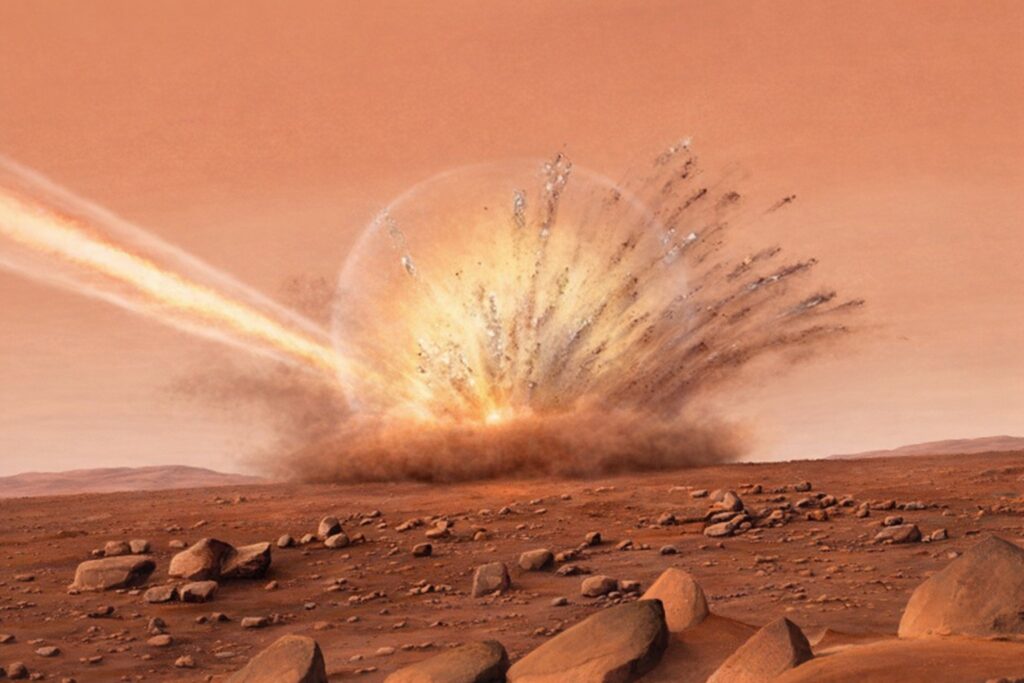
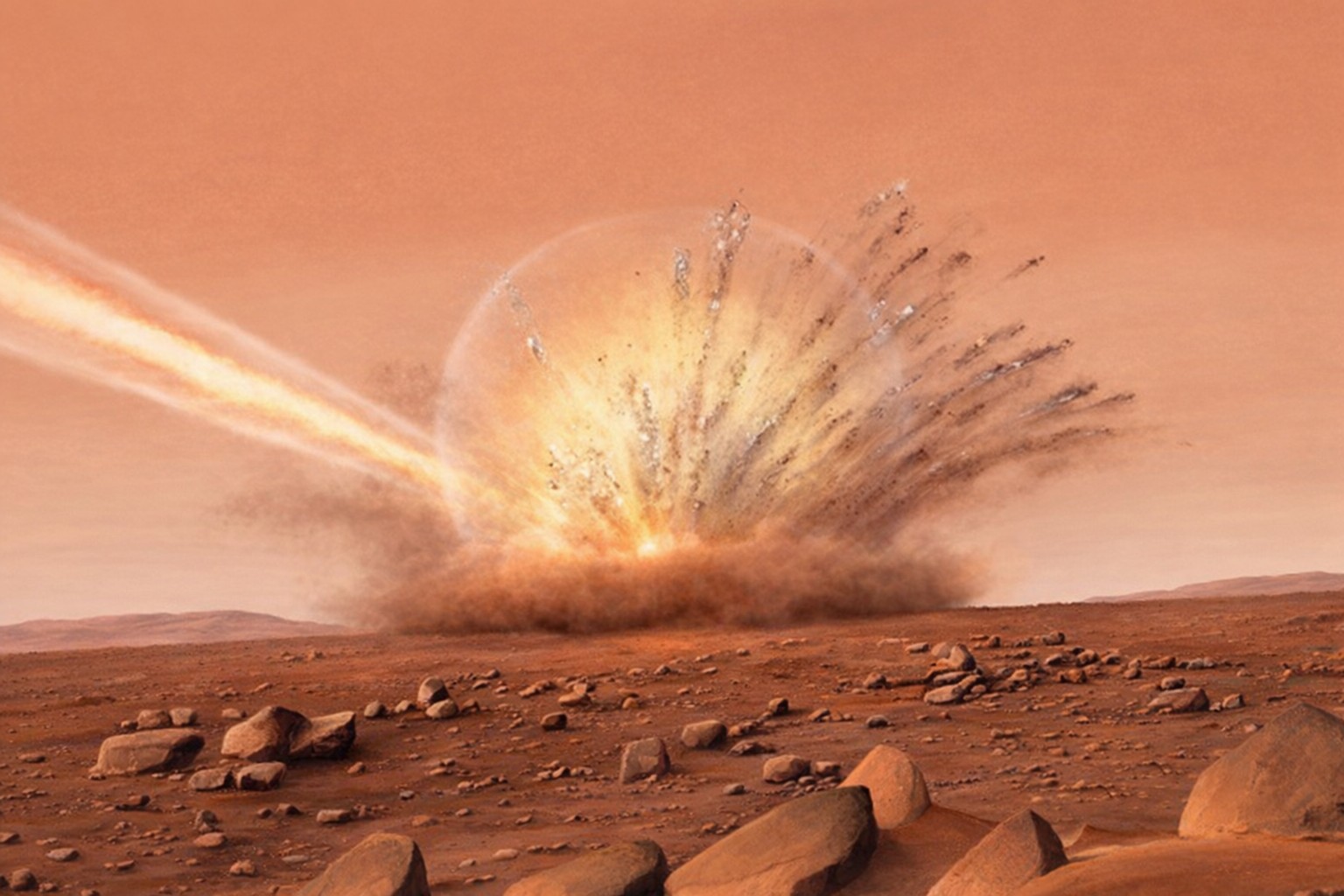 Artistic illustration of a meteorite falling on the surface of Mars. Source: IPGP – CNES – N. Starter
The object of the study was a unique organism – Deinococcus radiodurans. This microbe is known as the most radiation-resistant life form on the planet. Scientists call it a polyextremophile because of its ability to survive in seemingly deadly conditions: in the vacuum of space, in extreme cold, dehydration, and even in acidic environments.
It was this superpower that made him the perfect candidate for the experiment. The main question posed by scientists led by graduate student Lily Zhao was: could the microbe survive a catastrophic asteroid impact that ejects rock fragments from the planet into outer space?
Experiment: How to destroy microbes
The conditions of an asteroid collision are not just high pressure. It is an instantaneous, short-term load accompanied by extreme pressure and tremendous speeds. In the laboratory, researchers recreated these conditions by exposing colonies of Deinococcus radiodurans to the pressure that occurs during an impact.
The results impressed even the scientists themselves. The microorganisms demonstrated high survivability under pressures of up to 3 GPa (gigapascals). To put this into perspective, this is dozens of times greater than the pressure at the bottom of the Mariana Trench.
“We tried to kill it, starting with small doses and gradually increasing the load,” admitted Lily Zhao. “But it turned out to be extremely difficult. Our laboratory equipment broke down faster than the microbes did.”
What happens to the cell?
Using electron microscopy, scientists monitored changes in the cells. As pressure increased, organisms experienced greater stress, which manifested itself in changes in their shape and structure. However, despite the damage, a significant portion of the colonies remained alive and capable of recovery.
“We have shown that microorganisms are capable of surviving in conditions that were previously considered impossible,” the authors of the study note. “They can withstand being ejected from the planet and potentially travel through space.”
Interplanetary travel
Since gravity is weaker on Mars and asteroid impacts can generate pressures of 5 GPa and above, the ability of these microbes to survive at 3 GPa is an extremely encouraging sign for proponents of the panspermia theory.
“This discovery changes our understanding of how life could have begun on Earth,” comments senior author K.T. Ramesh. “Life can survive after being ejected from one planet and move to another.”
Lily Zhao herself adds with a smile: “That means we are all potential Martians!”
Previous reports have detailed how scientists developed a “death calculator” for bacteria on Mars.
Provided by sciencealert.com