
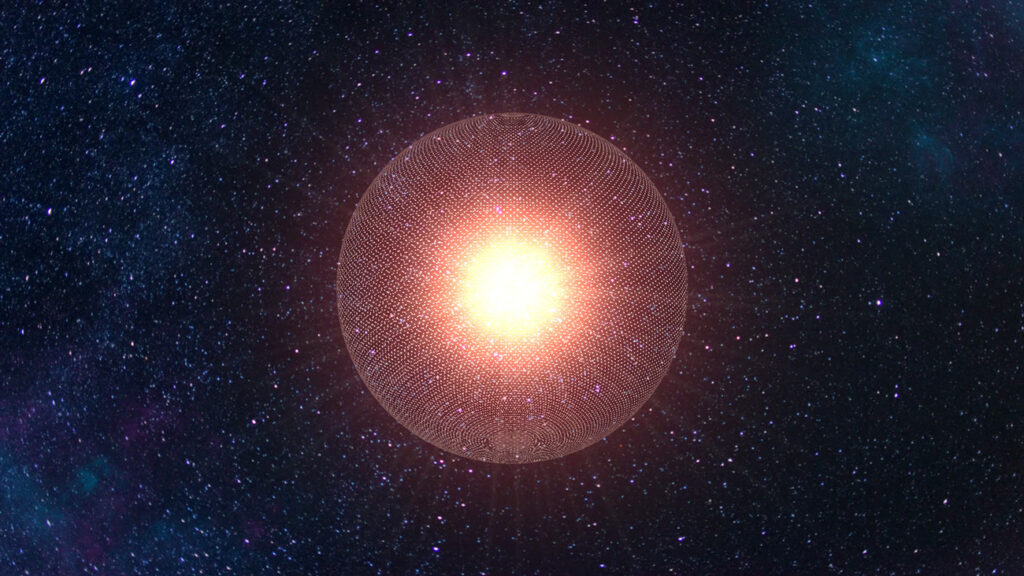
 A large number of independent constructs orbiting in a dense formation around the star. Credit: Wikimedia Commons
While it sounds like the plot of an Andy Weir novel. If an advanced civilization wanted to tap nearly all the power of its star, it could gather energy by putting a giant collection of light-catching structures around the star and just directly harvest the energy.
That’s the foundation of the “Dyson sphere” idea Freeman Dyson laid out in 1960, though most modern versions imagine a swarm of many collectors rather than a single rigid shell.
Now, a new study published by physicist Amirnezam Amiri at the University of Arkansas revisits this classic idea with a practical tool astronomers already use every day: The Hertzsprung–Russell diagram, or H–R diagram, that sorts stars. An H-R diagram plots stars based on their surface temperature and luminosity.
Amiri’s question is if a star were surrounded by a Dyson sphere — or, more realistically, a dense Dyson swarm that blocks most starlight — where would that system land on the H–R diagram?
You can’t hide a star’s energy, only change how it leaves
The paper’s guiding idea is that a star pours energy into space. If something captures that energy, it must eventually come back out, because physics does not allow it to vanish.
A normal star glows in visible light because its surface is extremely hot. A Dyson sphere would block that hot surface from view. Instead, we’d see the outer surface of the megastructure, which would be far cooler because it spreads the star’s energy across a much larger area. Cooler surfaces radiate mostly in infrared (heat radiation) so the system’s light shifts from visible to infrared.
This is why Dyson originally framed the search as an infrared hunt: Look for stellar systems that are brighter than expected because they’re rerouting a star’s output into heat.
Standard stars always appear in predictable spots on the H–R diagram because the laws of physics dictate exactly how a ball of gas must behave. However, a Dyson sphere changes the rules by hiding the star’s actual surface. Instead of seeing the star itself, telescopes only detect the light and heat radiating from the alien megastructure surrounding it.
×
Thank you! One more thing…
Please check your inbox and confirm your subscription.
Amiri models Dyson spheres around two promising host types — red M-dwarfs and white dwarfs — and shows that as the megastructure sits farther from the star, its outer temperature drops in a predictable way. Meanwhile, if the structure intercepts essentially all starlight, the total luminosity tied to the star’s power stays the same; it’s just pushed into infrared wavelengths.
The result is an object that, on paper, slides into a region of the H–R diagram where normal stars do not exist; those at extremely low apparent temperatures paired with a luminosity consistent with a real star underneath.
That “this shouldn’t be here” placement is the observational hook, the smoking gun for a potential highly advanced alien civilization.
Why dwarf stars?
 Artist’s concept showing DG CVn — a binary system consisting of two red dwarf stars — unleashing a series of powerful flares seen by NASA’s Swift spacecraft on April 23, 2014. Credit: NASA’s Goddard Space Flight Center/S. Wiessinger.
Amiri focuses on low-luminosity stars for a reason. Red M-dwarfs are the most common stars in the Milky Way and can remain stable for very long times (even trillions of years), making them attractive long-term power sources. White dwarfs are compact stellar remnants after a large star dies — small, dense and steadily cooling — that can also radiate for billions of years.
In Amiri’s calculations, Dyson spheres around white dwarfs tend to produce cooler, fainter thermal emission that peaks in the near- to mid-infrared, while M-dwarf cases can radiate more strongly but still shift heavily into infrared depending on the structure’s size.
So what would an astronomer actually search for?
Not a perfect sci-fi silhouette, but rather just a point of light with a suspicious “color profile.” In practice, that means something that looks like a star but has an infrared signature that implies it’s far colder than any star should be. Amiri’s paper is principally a translation layer between the thought experiment and survey strategy: Given a host star type, here’s how the megastructure’s temperature and infrared peak should behave as you change its radius, and here’s where it would fall relative to normal stellar populations.
This is why infrared surveys matter. Wide-field infrared maps can flag odd sources, and then more capable infrared instruments can follow up. The paper presents its results as constraints to guide future technosignature searches that rely on infrared measurements.
There is a catch, though. The universe makes convincing fakes.
Infrared “excess” is not rare. Dusty disks, background galaxies, blended sources and simple line-of-sight coincidences can all make an otherwise ordinary star look like it has extra infrared emission.
We’ll have the opportunity to learn more soon. Project Hephaistos searched a sample of about five million objects using the telescopes Gaia (optical), 2MASS (near-infrared) and WISE (mid-infrared) and reported back seven M-dwarf candidates that appeared sufficiently interesting to warrant further scrutiny.
Amiri’s work does not solve the contamination problem, though. What it does provide is a clearer map of what the clean, idealized signature should look like on a standard stellar classification tool. That helps observers decide which odd infrared sources deserve the expensive follow-up needed to rule out dust, background galaxies, and other mundane explanations.
The Dyson sphere remains highly hypothetical. Amiri is not claiming a detection — he’s tightening the description of a target. Most of the time, the culprit will be dust or a background galaxy, so let’s not get too excited.
But the whole point of technosignature work is to identify the rare cases where the boring explanations run out.
The new study appeared in the preprint server arXiv.