
Cracking open the early solar system
Fragmenting comets are scientifically valuable because they expose material that has been shielded from sunlight and radiation for billions of years.
“We say that comets are the old building blocks of the solar system,” Bodewits said. “But they’ve been processed ever since by heat, by light, by radiation. The outside is not necessarily representative of that old material.”
When a comet cracks open, its interior is briefly revealed.
The Auburn team also collected ultraviolet light measurements, capturing wavelengths humans cannot see. Those data can help measure water, carbon monoxide and sulfur-bearing species, building a chemical fingerprint of the comet. From ground-based observations, the comet already appeared chemically unusual, showing high levels of nitrogen-related compounds and far fewer carbon-chain molecules than astronomers typically see.
“There’s something really interesting about this,” Noonan said. “It either came from a very unique place in the protoplanetary disk chemically, or it comes from a population that’s very poor at surviving to this point in the solar system.”
Positioned for discovery
Comet science draws on expertise ranging from molecular spectroscopy to radiation pressure and plasma physics. That interdisciplinary foundation helps Auburn compete for time on major observatories.
“The nature of Auburn’s physics department means we’re able to connect a lot of different aspects of physics in a way that strengthens our work,” Noonan said.
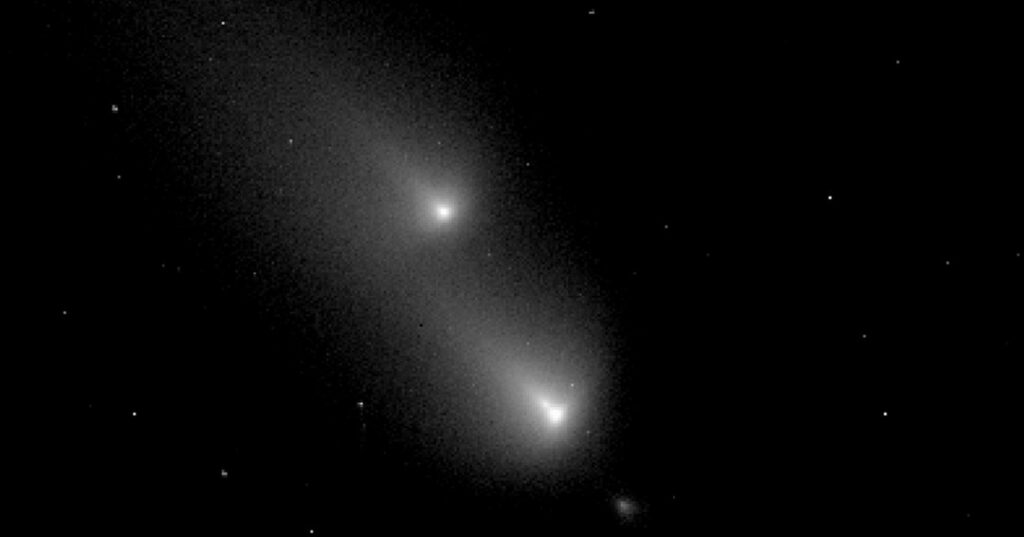
The result in this case is extraordinary. The images represent an unusually high-resolution view of a comet fragmentation event captured close in time to the breakup. One fragment even disappeared during the three-day sequence, dissolving before it would have been detectable from the ground.
Comets, Bodewits explained, are fragile mixtures of ice and dust with half the density of water ice.
“They’re like freshly fallen snow,” Noonan said.
As of two weeks ago, two fragments remained. The comet is now headed permanently out of the solar system.
Because the team had already secured time on Hubble, they were able to capture the breakup as it unfolded and analyze it in detail.
“We can really reconstruct what happened,” Bodewits said.