
A scientist who theorized unusual space object 3I/ATLAS could have been an alien probe now reckons an extra-terrestrial breakthrough is on the horizon.
Perhaps the biggest space phenomenon of last year, the mysterious, fast-moving interstellar comet hurtling past Earth had the science community baffled.
It was determined to be traveling at more than 41 miles per second, far too fast to be held by the Sun’s gravity.
Harvard physicist Avi Loeb was quick to point out multiple anomalies and suggested 3I/ATLAS could be ‘hostile’ and unnatural – even an alien probe.
But NASA and other scientific bodies insisted it was a rare space rock – in fact, it was the oldest interstellar comet ever spotted and only the third of its kind so far, after 1I/Oumuamua in 2017 and 2I/Borisov in 2019.
On December 19, 3I/ATLAS made its closest approach to our planet, but it was still 270 million kilometers away. Most importantly; too far to make contact with us.
 Avi Loeb has been outspoken about 3I/ATLAS (Anibal Martel/Anadolu Agency via Getty Images)
Despite its safe pass by our planet, the Harvard physicist has still entertained the idea 3I/ATLAS could be something more, and even issued a scathing response as NASA released ‘boring’ photos of the supposed space rock.
Now, the rock is moving on into deep space, never to return. 3I/ATLAS is due to pass by Jupiter around March 16 as it heads out of our solar system for good.
That is, unless it really is an alien spaceship and plans on making a u-turn back to us.
Loeb has since made a bet that alien life of some form will visit Earth within the next four years.
That’s an actual bet too, via Long Bets, against sceptic Michael B. Shermer, who thinks otherwise.
Podcaster and author Shermer predicted: “The Discovery or disclosure of alien visitation to Earth in the form of UFOs, UAPs, or any other technological artifact or alien biological form, as confirmed by major scientific institutions and government agencies, will not happen by December 31, 2030.”
 Loeb reckons aliens could make contact with us by 2030 (Colin Anderson Productions PTY LTD/Getty Images)
But Loeb argues: “The search for technological artifacts has just started in earnest in 2025 with the discovery of the anomalous interstellar object 3I/ATLAS, the launch of the Rubin Observatory and the construction of three Galileo Project Observatories.
“Given that there are billions of Earth-Sun analogs in the Milky-Way galaxy – most of which are billions of years older than the solar system, and that it will take less than a billion years for our Voyager spacecraft to cross the Milky-Way disk, we must engage in the scientific search for extraterrestrial technological artifacts.”
Loeb concludes: “It is better to be an optimist because life is sometimes a self-fulfilling prophecy. This is why I am engaged in the search with the hope that we will find a partner on our blind date with interstellar objects.”
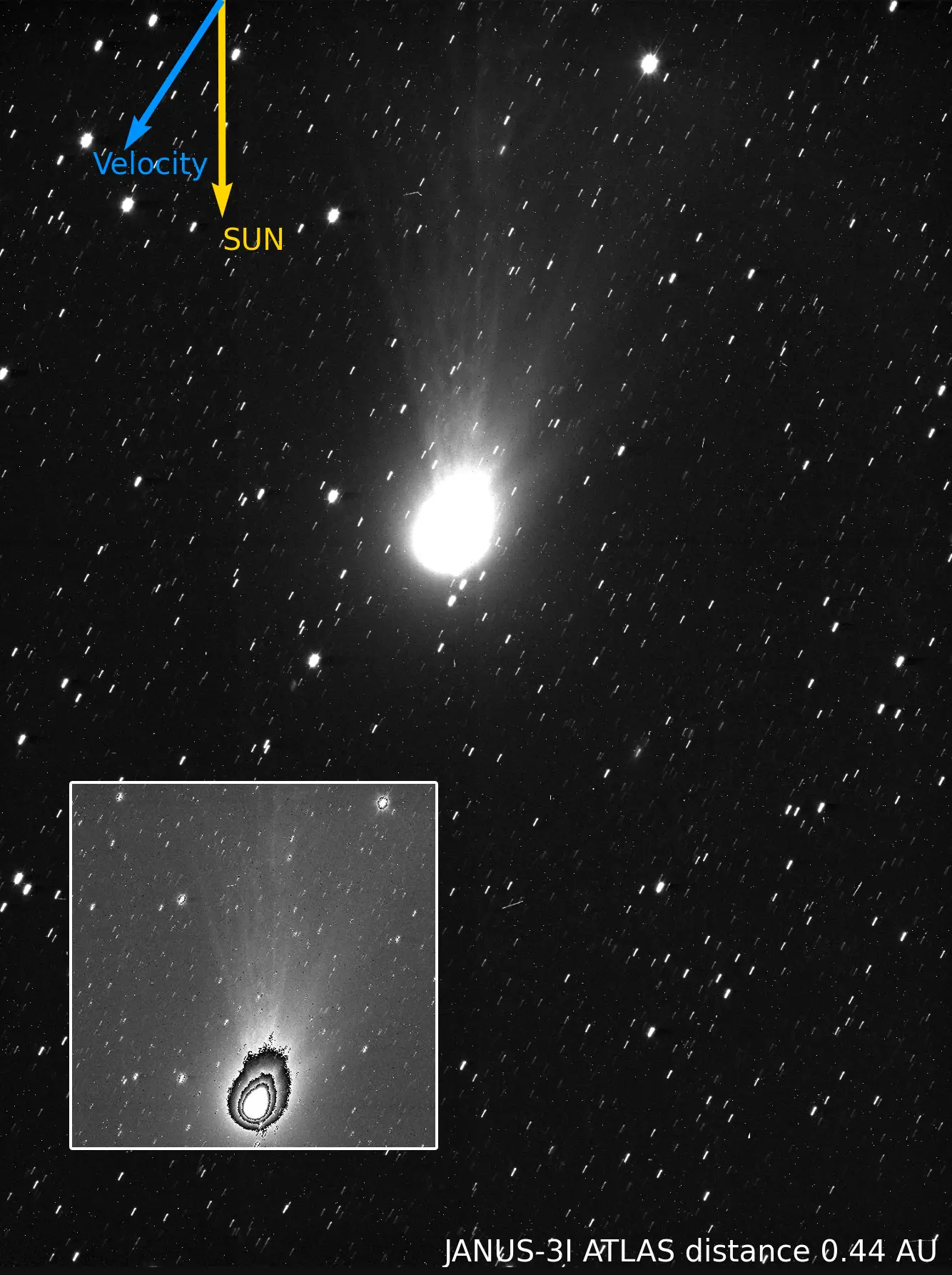 The latest photos of 3I/ATLAS from the European Space Agency’s Juice spacecraft (ESA/Juice/JANUS)
$1,000 will go to the Galileo Project Foundation, whoever wins.
News of Loeb’s bet comes as the European Space Agency (ESA) released new photos of 3I/ATLAS taken by the JANUS camera on its Juice spacecraft, which is headed for Jupiter to explore the planet’s icy moons.
The striking photo shows interstellar comet 3I/ATLAS spewing dust and gas, with its tiny nucleus surrounded by a bright halo of gas known as the coma.
“A long tail stretches away from the comet, and we see hints of rays, jets, streams and filaments,” the ESA explains.
The image was taken on 6 November, just seven days after the comet made its closest approach to the Sun.
At the time, Juice was about 66 million kilometers away from 3I/ATLAS.