
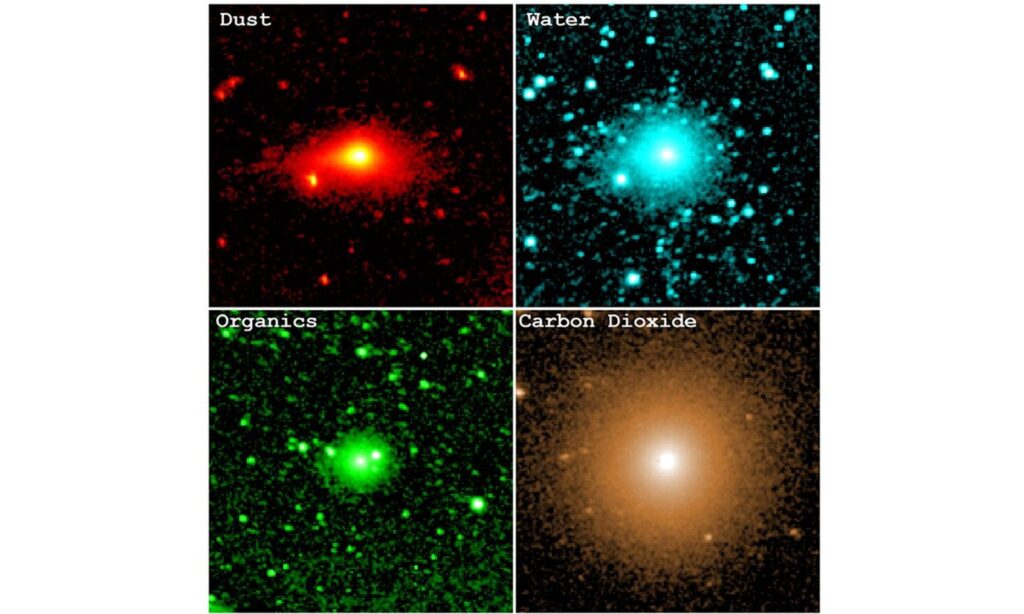
NASA has confirmed that an interstellar comet brightened dramatically after passing the Sun and released a fresh surge of water vapor and carbon-rich molecules.
That delayed outburst exposes material sealed for billions of years in deep freeze between stars and now briefly available for direct study.
What SPHEREx saw

During a December 2025 observing run, a NASA space telescope called SPHEREx, designed to map the sky in infrared light, recorded the comet’s glow in fine detail.
Analyzing that glow, Dr. Carey Lisse and colleagues at Johns Hopkins Applied Physics Laboratory (APL) identified methanol, cyanide, and methane streaming into space.
Roughly two months after the comet’s closest approach to the Sun, its brightness climbed instead of fading, marking a second, stronger phase of activity.
That unexpected timing shows that surface warmth alone cannot predict when buried ice will erupt, setting up the deeper explanation that follows.
Heat penetrates the comet
Sunlight warmed the outer skin first, but the biggest change started deeper after heat crept down through insulating layers.
Buried ice began to sublimate, turning directly into gas in the vacuum of space, and the escaping vapor fed a cloud around the nucleus.
Once heat reached deeper pockets, water that stayed frozen earlier began venting rapidly, carrying other ices with it.
Delayed outgassing means a comet can look quiet near the Sun, then spike later, when observers expect fading.
Seeing in 102 colors
Instead of one broad image, SPHEREx split the comet’s light into 102 infrared colors during each pass.
Each molecule emits or absorbs energy at its own wavelengths, so the full pattern revealed which gases were present.
Across the spectrum, the telescope separated glowing gas from warm dust, allowing scientists to track both chemistry and gritty debris.
That level of detail gave scientists chemical clues they could not get from normal photographs, even as the comet sped away.
Molecules hidden inside comet
Signals in the infrared pointed to organic molecules, carbon-based compounds common in space chemistry, mixed into the comet’s gas cloud.
Coverage in a Sky at Night Magazine report noted that buried water ice can seal away carbon-rich material until heat arrives.
“And since comets consist of about one-third bulk water ice, it was releasing an abundance of new, carbon-rich material that had remained locked in ice deep below the surface,” said Dr. Carey Lisse, a planetary scientist at Johns Hopkins Applied Physics Laboratory in Laurel, Maryland.
Those organics can form without life, so the detection points to ingredients, not evidence that anything lived there.
Radiation forms outer crust
Space between stars bombards small bodies with cosmic rays, high-energy particles that can reshape surface ice over time.
After long exposure, that radiation can harden the outer layer, leaving cleaner ice protected deeper below the surface.
Once the Sun warmed the interior, APL saw signs that fresh ice broke through that crust and mixed with dust.
A processed crust can hide a comet’s true composition for months, so short surveys may miss its richest phase.
Comet releases bigger debris
A short, pear-shaped dust tail suggested the comet was throwing off heavier grains than most comets show.
Solar light pushes small dust through radiation pressure, a gentle force from photons, but big pieces resist that shove.
BB-sized chunks and sandier grains likely stayed near the nucleus because sunlight could not accelerate them very far.
That heavy spray also complicates tracking, since large grains can mimic a solid body when telescopes measure brightness.
Discovery of the comet
On July 1, 2025, astronomers spotted the object using a telescope system built to detect incoming asteroids and comets.
In that designation (3I/ATLAS), the “I” marks an interstellar origin, while the number three signals that only two such visitors had been found before.
Its speed and path showed the Sun could not capture it, so the comet will leave our system for good.
Rarity forced astronomers to act quickly, because the comet offered only a short window for detailed measurements.
A telescope in orbit
Circling Earth, SPHEREx keeps sweeping the sky instead of staring at one spot for long.
That scanning habit put the comet in its sights at just the right moment, even though SPHEREx had other goals.
NASA launched the SPHEREx mission on March 11, 2025, to map galaxies and hunt for life-friendly chemistry.
Side benefits come with a survey telescope, and repeated full-sky maps make surprises more likely than with single-target missions.
Data open to all
After the team processed the SPHEREx observations, they posted the dataset for anyone to download and analyze.
Public access lets outside groups compare 3I/ATLAS with familiar comets, using the same raw measurements and filters.
Before the comet fades from view, SPHEREx should scan it again in April 2026, extending the timeline.
Open data also speeds follow-up, but the comet is already heading out, so the best measurements must happen quickly.
Comet fades from view
SPHEREx turned a rare interstellar flyby into a chemical report, showing that heat lag can expose buried ices and gases.
Future passes and public reanalysis could tighten the inventory, but 3I/ATLAS will keep fading as it exits the solar system.
—–
Like what you read? Subscribe to our newsletter for engaging articles, exclusive content, and the latest updates.
Check us out on EarthSnap, a free app brought to you by Eric Ralls and Earth.com.
—–