
If life once existed on Mars, the most likely place to find evidence of it may be locked away in the planet’s ice.
A new study from NASA’s Goddard Space Flight Center and Penn State finds that organic molecules can survive more than 50 million years when frozen in Martian ice, even under constant cosmic radiation.
The results, published in Astrobiology, suggest that future missions searching for life on Mars might have better luck by drilling into subsurface ice instead of sampling rocks or soil.
Testing Martian Conditions in the Laboratory
To test how long biological material might last on Mars, researchers recreated Martian conditions in the laboratory. They sealed E. coli bacteria in tubes of frozen water and prepared other samples by mixing ice with materials resembling Martian sediment, such as silicate rocks and clay.
The samples were placed in a gamma radiation chamber at Penn State’s Radiation Science and Engineering Center and cooled to –60°F, similar to temperatures found in Mars’s icy regions. The frozen bacteria were then exposed to radiation levels equivalent to about 20 million years of cosmic rays on the Martian surface.
After irradiation, the team kept the samples frozen and sent them to NASA Goddard, where scientists analyzed the number of amino acids that survived. Computer models then simulated another 30 million years of radiation exposure, extending the total preservation period to about 50 million years.
Ice as a Natural Shield
The results showed a clear difference between the sample types. In pure ice, over 10 percent of the amino acids remained after the full 50-million-year simulation. In contrast, samples containing Martian-like sediment broke down about 10 times faster, leaving behind very little organic material.
“Based on the 2022 study findings, it was thought that organic material in ice or water alone would be destroyed even more rapidly than the 10% water mixture,” said lead researcher Alexander Pavlov, a space scientist at NASA Goddard. “So it was surprising to find that the organic materials placed in water ice alone are destroyed at a much slower rate than the samples containing water and soil.”
Researchers think this difference comes from how radiation interacts with minerals. Mixing ice with soil particles forms a thin boundary layer that allows radiation-generated particles to move more freely and damage organic molecules. Solid ice likely traps these byproducts, helping protect sensitive biological compounds from breaking down.
A New Target for Life-Detection Missions
These findings indicate that pure ice deposits or ice-rich permafrost may be the best places for future missions to search for traces of life on Mars.
“Fifty million years is far greater than the expected age for some current surface ice deposits on Mars, which are often less than two million years old,” said Christopher House, a Penn State geosciences professor and co-author of the study. “That means if there are bacteria near the surface of Mars, future missions can find it.”
The research also has implications for other worlds. When the team simulated the colder environments of icy moons like Europa and Enceladus, they found that organic material broke down even more slowly.

This result is promising for NASA’s Europa Clipper mission, which launched in 2024 and is expected to reach Jupiter in 2030. The spacecraft will make multiple flybys to study whether environments beneath Europa’s ice shell could support life.
Digging Beneath the Martian Surface
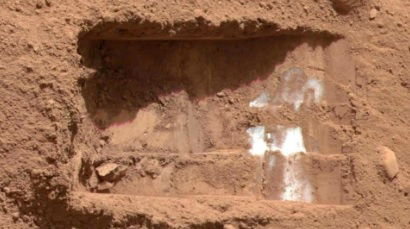
Finding preserved organic material on Mars will likely depend on how deep future spacecraft can dig. NASA’s Phoenix lander, which reached Mars in 2008, was the first mission to excavate and photograph subsurface ice in the planet’s northern plains.
“There is a lot of ice on Mars, but most of it is just below the surface,” House said. “Future missions need a large enough drill or a powerful scoop to access it, similar to the design and capabilities of Phoenix.”
If ancient microbes ever lived on Mars, this study suggests that their molecular traces could still be present, locked in ice that has stayed frozen for millions of years.
Austin Burgess is a writer and researcher with a background in sales, marketing, and data analytics. He holds a Master of Business Administration, a Bachelor of Science in Business Administration, and a Data Analytics certification. His work combines analytical training with a focus on emerging science, aerospace, and astronomical research.