This article was underwritten in part by the Mickey Flacks Journalism Fund for Social Justice, a proud, innovative supporter of local news. To make a contribution go to sbcan.org/journalism_fund.
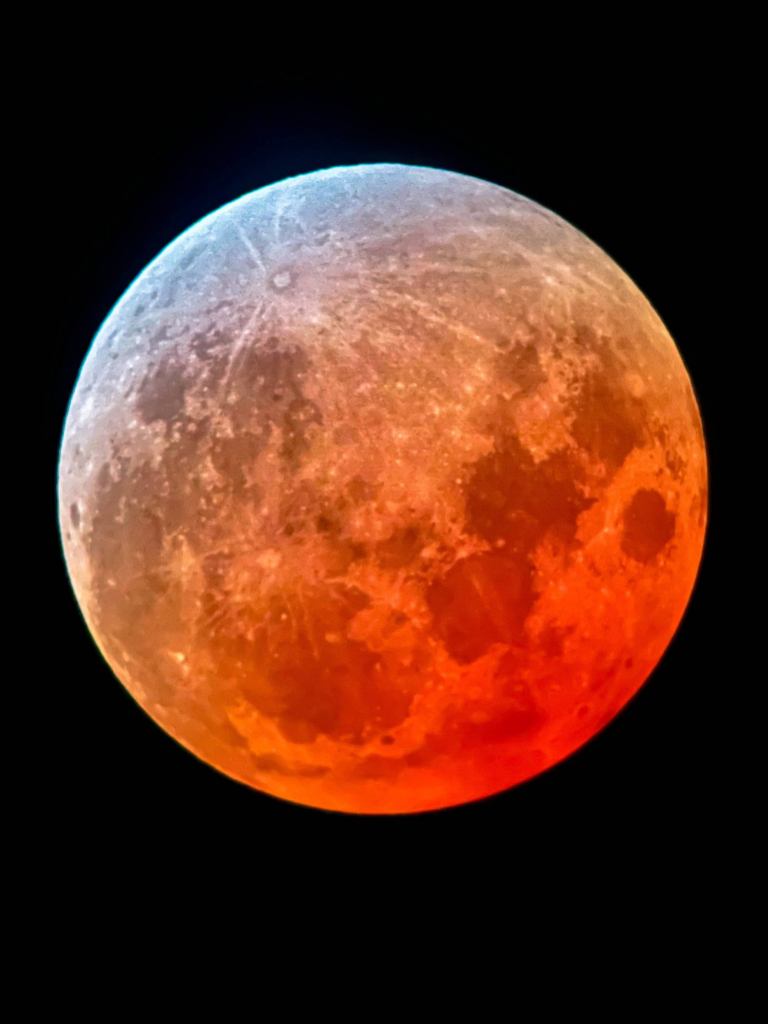 Tuesday morning’s moon during the lunar eclipse’s totality, as seen through Westmont Observatory’s 8″ refractor telescope. | Credit: Alisha Genetin
Dimmed red lanterns lined the staircase to the upper deck of Westmont College’s Observatory very early on Tuesday morning. By 3:30 a.m., more than 50 people gathered to view the night’s lunar eclipse. The full moon, which had glowed like a bright white marble just a few hours earlier, looked dusty red and dulled.
“A lunar eclipse is when the moon passes through Earth’s shadow,” said Dr. Jennifer Gee, a physics professor at Westmont College and the college’s observatory director. “So, the sun and the moon are on opposite sides of the earth.”
Gee opened the observatory to the public from 3 to 5 a.m. on Tuesday. That way, she said, people could witness the moon at the peak of the eclipse — called totality — and as it passed out of the earth’s umbra (that’s its direct shadow).
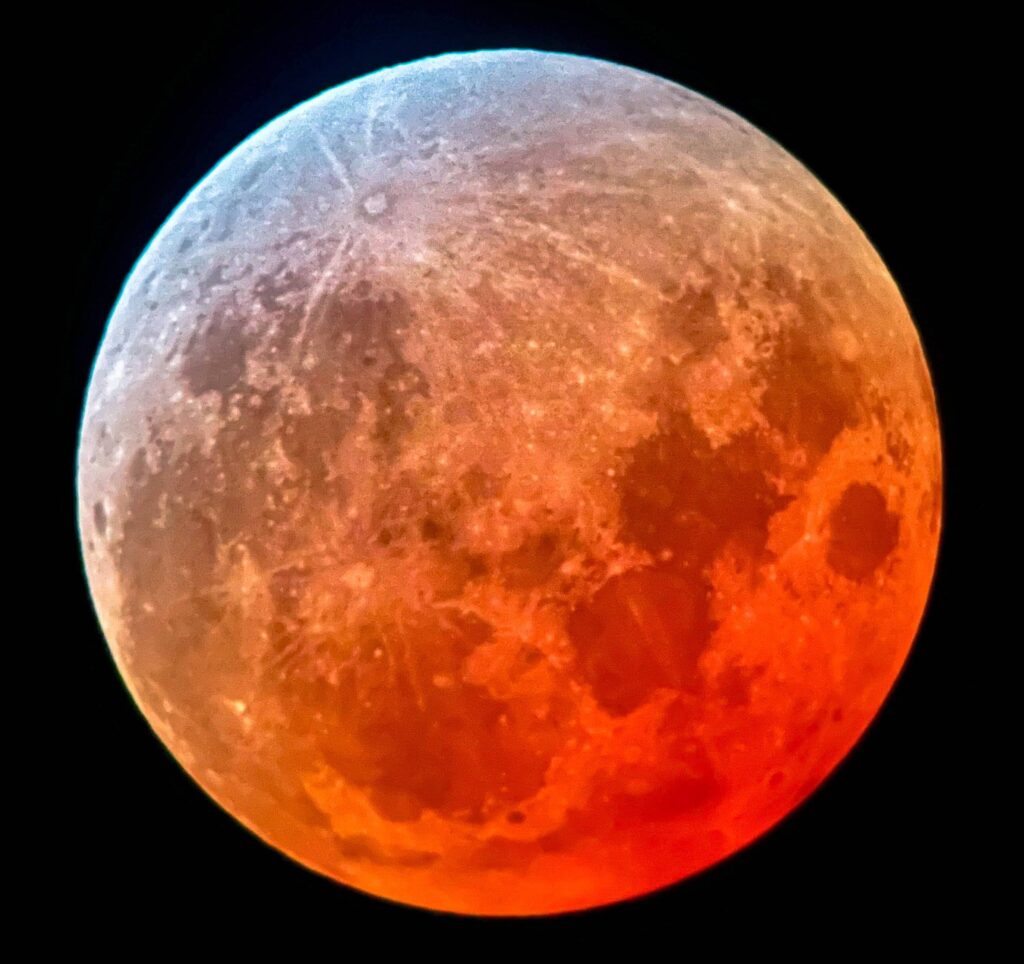
Tuesday’s moon was colloquially referred to as a “blood moon.” Light from the sun is made up of several colors — different frequency light waves are different colors on the visible spectrum. During an eclipse, Earth is between the sun’s rays and the moon, and lower-frequency light waves (“red” in the visible spectrum) pass through the earth’s atmosphere the most. It leaves the moon with its reddish “blood” tint.
Unlike with a solar eclipse, no one needed special eyewear to watch the event. Clad in hats, jackets, and blankets, folks chatted with each other and gazed up at the moon high in the sky, surrounded by stars. The next lunar eclipse that is visible from Santa Barbara will occur in June 2029.
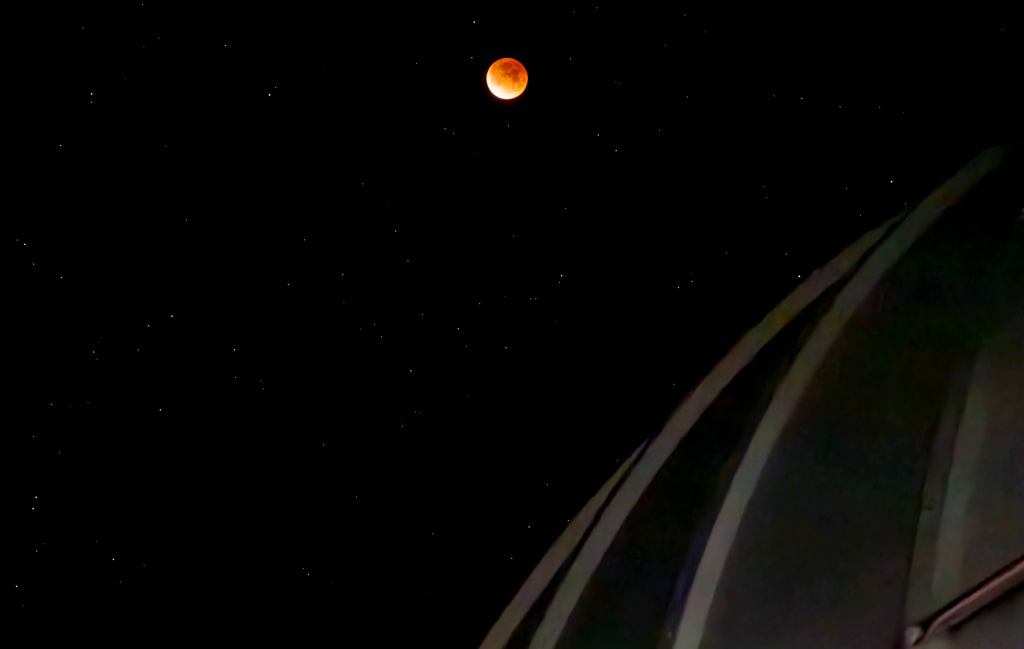 Tuesday’s ‘blood moon’ lunar eclipse as seen just outside Westmont’s Observatory. | Credit: Alisha Genetin
Students and a few community members lined up to take a closer look at the moon through an eight-inch refractor telescope. Emeritus Professor of Physics Ken Kihlstrom stood at the entrance to the telescope room and answered questions from folks. He said the refractor telescope is often used to get a sharp image of things in the night sky — think the moon or Saturn’s rings. The observatory’s other telescope, a 24-inch Ritchey-Chretien telescope, uses a mirror to peer into space. Kihlstrom said this telescope is more effective with objects (rather than parts of the sky) that are dimmer and don’t have sharply defined features. He said it also allows a camera to be mounted on it for research or photography.
By 4:30 a.m., as birds began to chirp, the moon was moving out from earth’s shadow, and its white glow began to creep back across its face in a crescent shape. The eclipse ended around 6:20 a.m.
Gee said Westmont’s Observatory is open to the public every third Friday of the month. The observatory also partners with the Santa Barbara Astronomical Unit from the Museum of Natural History, which can help people get started as amateur astronomers. At Westmont, Gee said, she’s working to build a program studying variable stars. Recently, she said, Westmont’s academic senate and faculty voted to approve an astrophysics major; it still needs to be approved by the Board of Trustees.
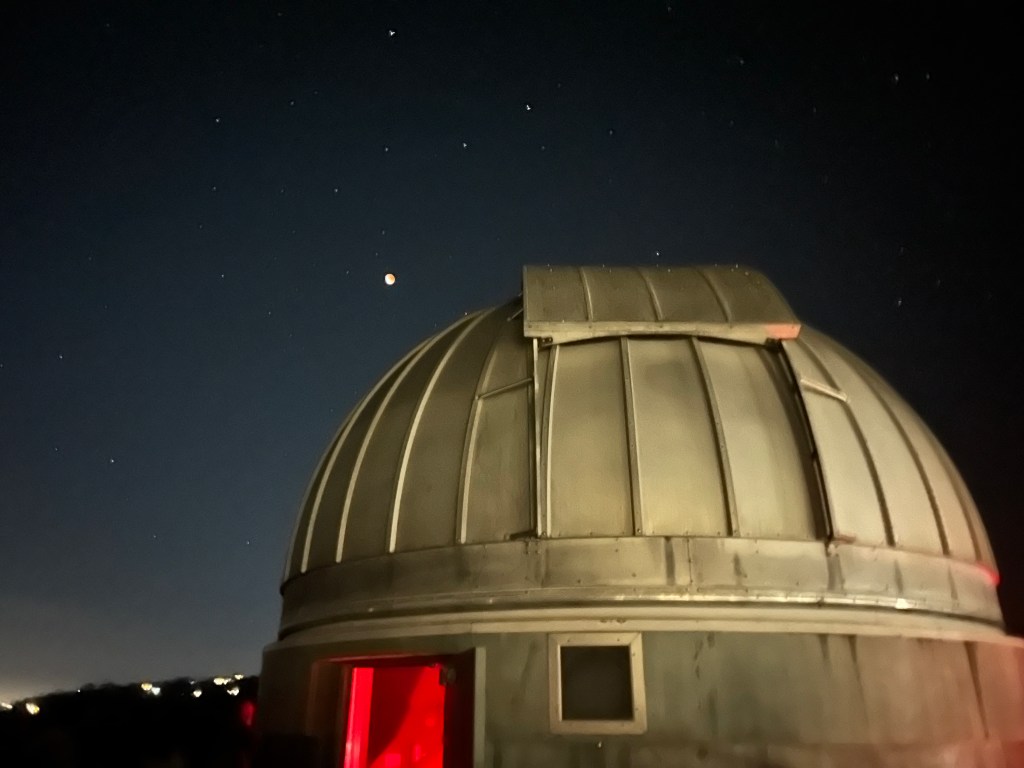 Westmont’s Observatory during the Lunar Eclipse on Tuesday morning. | Credit: Christina McDermott