
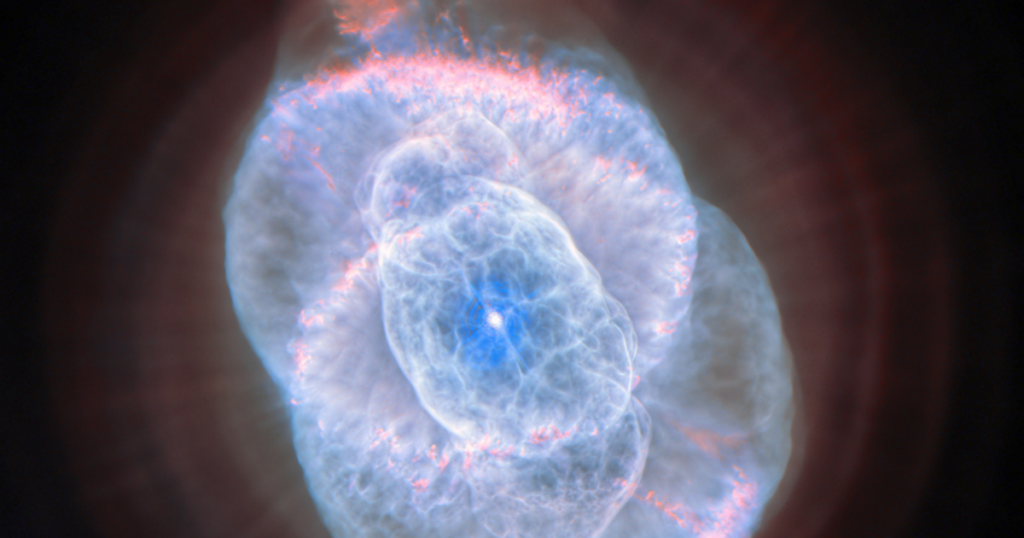

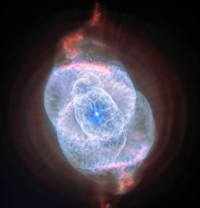
The Cat’s Eye Nebula known as NGC 6543. (ESA/Hubble & NASA et al. via SWNS)
By Dean Murray
Space scientists have revealed a jaw-dropping image of a cosmic cat’s eye.
A new NASA/ESA Hubble Space Telescope image features one of the most visually intricate remnants of a dying star: the Cat’s Eye Nebula, also known as NGC 6543.
The extraordinary planetary nebula, 4,400 light-years away in the constellation Draco, has captivated astronomers for decades with its elaborate and multilayered structure.
The NASA Hubble Mission Team said Tuesday, March 3: “Planetary nebulae, so-called because of their round shape, which made them appear to look like planets when viewed through early telescopes, are in fact expanding gas thrown off by stars in their final stages of evolution.
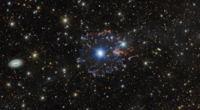
(ESA/Hubble & NASA et al. via SWNS)
By Talker
“It was the Cat’s Eye Nebula itself where this fact was first discovered in 1864 — examining the spectrum of its light reveals the emission from individual molecules that’s characteristic of a gas, distinguishing planetary nebulae from stars and galaxies.”
The new image was created with Hubble joined by ESA’s Euclid space telescope to reveal the remarkable complexity of stellar death in this object.
NASA added: “Combining the focused view of Hubble with Euclid’s deep field observations not only highlights the nebula’s exquisite structure but also places it within the broader context of the universe that both space telescopes explore. Together, these missions provide a rich and complementary view of NGC 6543 — revealing the delicate interplay between stellar end-of-life processes and the vast cosmic tapestry beyond.”