
Europe is lagging behind the US and China when it comes to reusable space technologies. Its most powerful rocket, the Ariane 6, utilizes a fully expendable design. However, a new self-healing spacecraft material may help the continent bridge that gap.
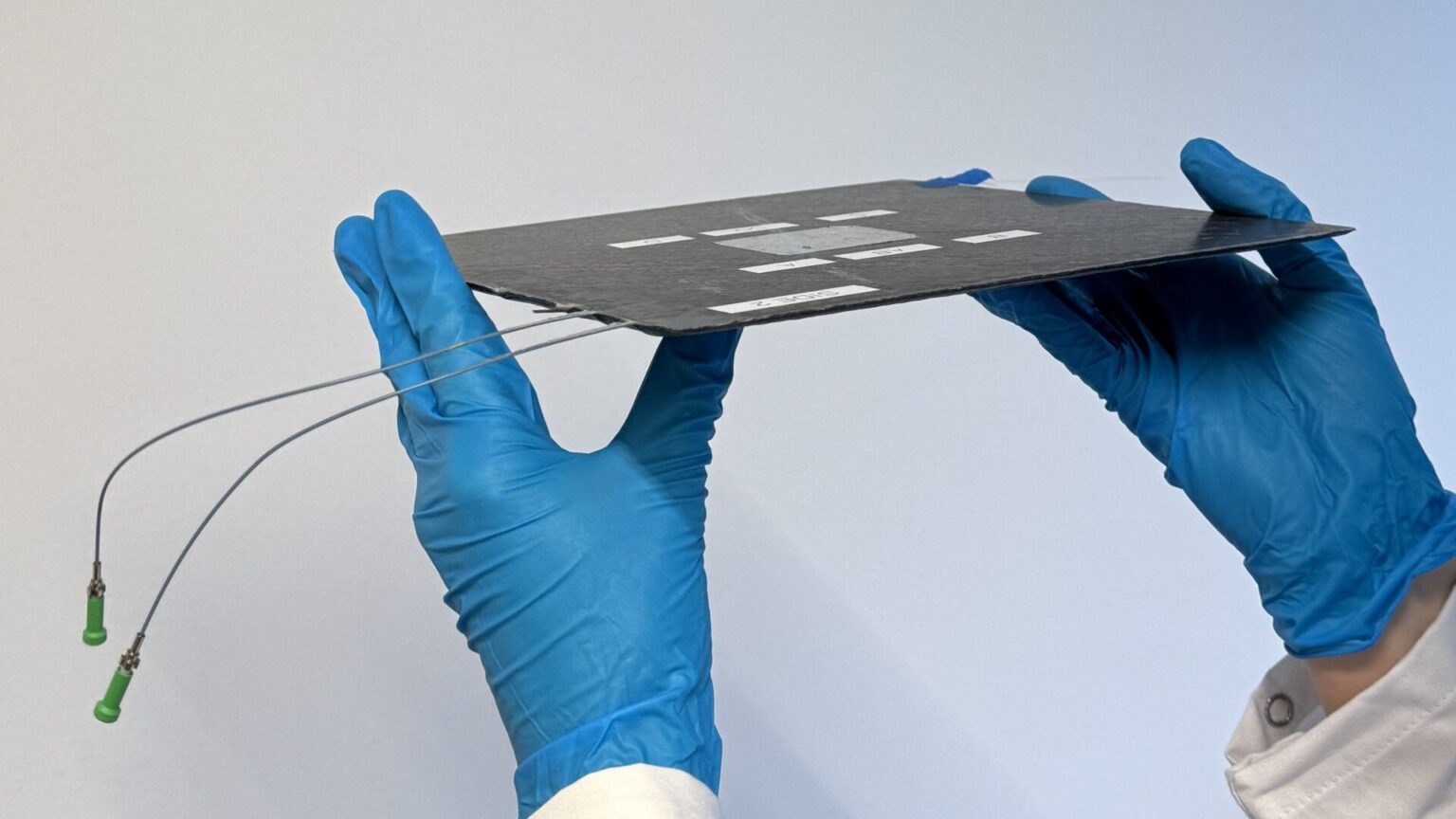
Swiss company CompPair has partnered with the European Space Agency (ESA) to modify its self-healing fiber material for use in space. The firm’s ‘HealTech’ composite material “self-heals” when heated, thanks to an agent that activates at higher temperatures.
Under ESA’s Project Cassandra, the company will test the material, which could eventually enhance Europe’s space transportation capabilities.
HealTech: ESA and CompPair’s self-healing space material
ESA’s Project Cassandra—a loose abbreviation of Composite Autonomous SenSing AnD RepAir—is part of its Future Innovation Research in Space Transportation (FIRST!) Initiative. The goal of FIRST! is to find and test new materials for the benefit of European space transportation.
Cassandra is focused on using sensors as well as a heating element, allowing for a composite carbon-fibre material to self-repair. In space, this would allow autonomous spacecraft to extend their lifetimes as they would be able to self-repair initial stages of damage.
According to an ESA post, composite materials like carbon fiber-reinforced polymers are increasingly being put to use as spacecraft materials. These materials are composed of a polymer matrix, reinforced with layers of carbon or glass fibers. They are lightweight materials that are resistant to corrosion, making them especially useful for space travel.
However, one downside to composite materials is that they are sensitive to damage. Small cracks on the material’s surface can get worse over time. This is especially the case under repeated use, as would be required on a reusable spacecraft.
Within ComPair’s ‘HealTech’ material, a healing agent activates at higher temperatures. According to ESA’s post, this agent “activates and reflows to repair damage caused by impacts or stress.”
Spacecraft material ‘self-heals’ at 140°C
The CompPair team created a prototype of its composite structure for space by integrating a network of fibre-optic sensors into HealTech’s resin-imbued fibres. The sensors detect any damage, triggering the heating mechanism. Once triggered, the material is heated to 100–140°C (212°F-284°F) via integrated 3D-printed aluminium grids.
According to ESA, testing has been performed on different-sized samples of the material, ranging from 2×10 cm to 40×40 cm. The tests were performed to collect data on the efficiency of the damage monitoring, the heating process, and self-repair.
Separately, thermal shock tests allowed researchers to monitor how the material would react to the conditions of a cryogenic tank. Next, the researchers will adapt the material to a larger shape, such as a complete cryogenic fuel tank.
“Implementing this technology into our systems could have enormous benefits for space transportation,” ESA’s Bernard Decotignie noted, “It will help develop reusable space infrastructure and reduce mission costs. This really proves what European innovation can do for the space sector.”
CompPair CTO Robin Trigueira added that he is “excited by the autonomy and durability benefits we can bring for future spacecraft and launchers, closing the gap between science-fiction and reality!”