
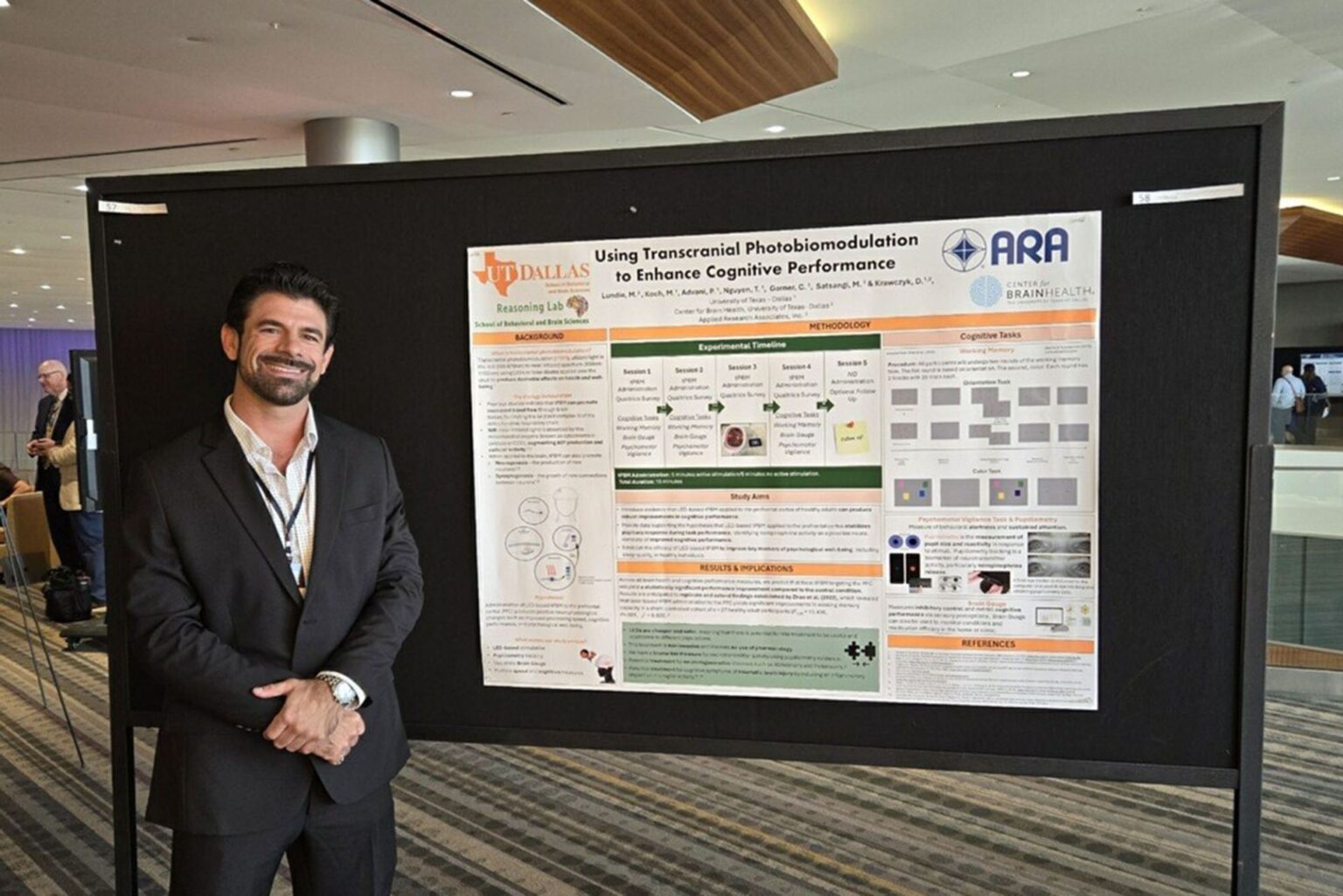
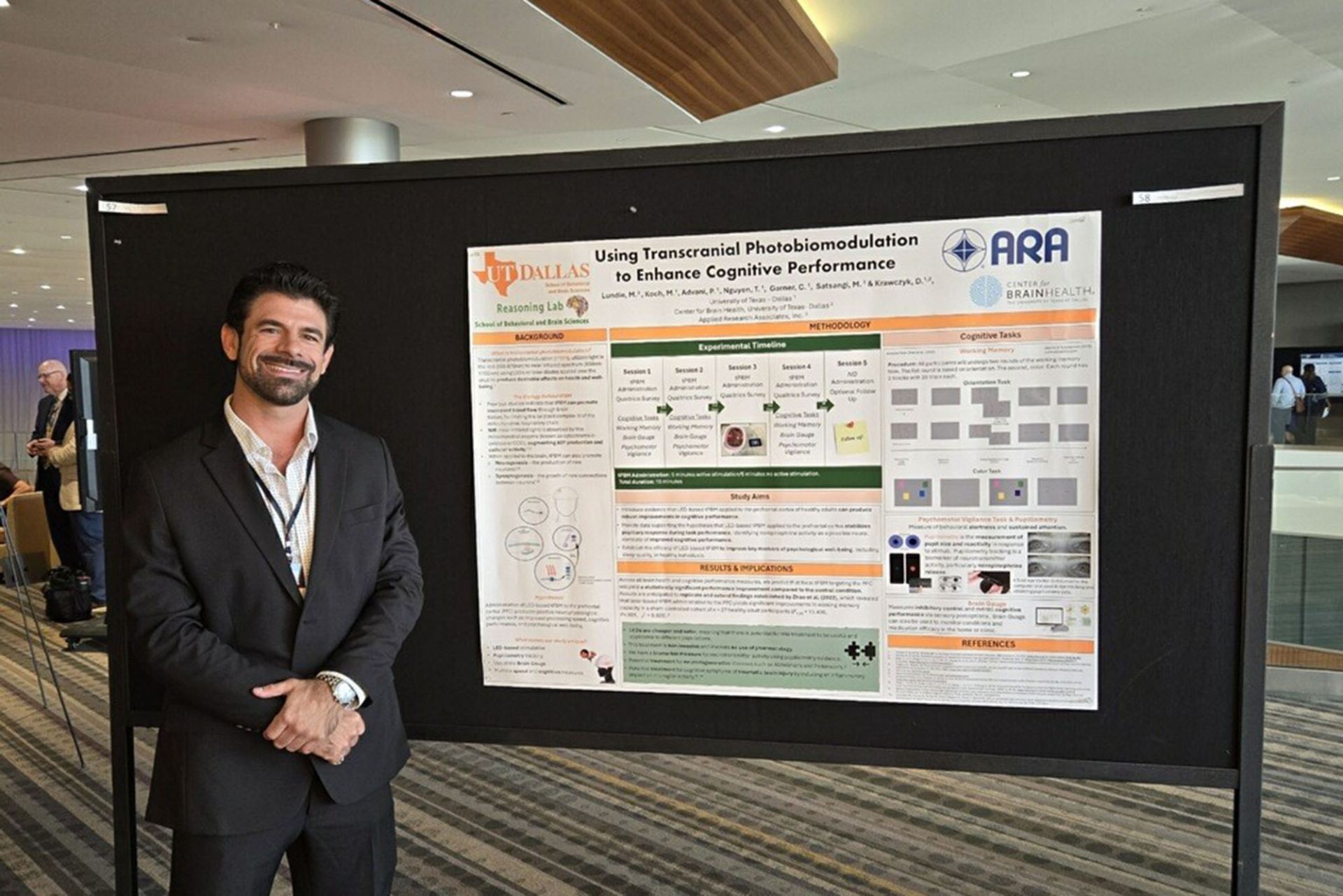
Michael Lundie MS’21, PhD’22 poses next to a research poster outlining his project to improve cognitive performance using LEDs to enhance metabolism in brain cells.
For Michael Lundie MS’21, PhD’22, an unexpected challenge while completing his dissertation at The University of Texas at Dallas enhanced his opportunity to have an influence on people’s lives as a cognitive scientist.
In 2020, Lundie was set to begin research in the School of Behavioral and Brain Sciences for his final PhD project. He was planning to study the structure and functional correlates of traumatic brain injury (TBI) using MRI in order to improve the source location of electroencephalogram signals in the brain.
But a moratorium on in-person contact on campus because of the COVID-19 pandemic brought the project to a halt. The fate of the funding Lundie received from a Friends of BrainHealth Distinguished New Scientist Award was uncertain since it was earmarked for human subject research he could no longer conduct.
“I was pretty heartbroken,” he said. “This was a real obstacle for research structures requiring up-close and personal techniques like neuroimaging.”
With advice from his advisor, Dr. Daniel C. Krawczyk, professor of psychology and the Debbie and Jim Francis Chair in Behavioral and Brain Sciences, Lundie pivoted to research in which he would collect data online. The new project explored the psychological underpinnings of political attitudes and focused on confirmation bias.
“There are things that have been understood about confirmation bias that seem uncanny and strange,” Lundie said. “For instance, having a higher IQ does not protect against confirmation bias. By some theoretical accounts, if somebody has the sufficient mental resources to defend their beliefs, that supersedes contrary evidence.”
Within a week of earning his PhD, Lundie joined military defense contractor Applied Research Associates (ARA) as a staff cognitive scientist who focuses on national security and military health research areas. ARA’s mission is to solve problems of national importance by providing science and engineering research, technical support services, specialty products and integrated solutions.
Lundie said that U.S. military leaders have become interested in the use of cognitive science to gauge fitness for combat. At ARA, he works on several research projects, but two of his most important began as his dissertation, including his original topic on TBI.
“That seemed like a very exciting prospect for understanding the neuroanatomical correlates of traumatic brain injuries and the symptoms associated with it,” Lundie said.
Lundie has expanded the idea behind his project by recalling research from a UT Arlington scientist whom he and Krawczyk had come across while working on his doctorate. That research involved exposing the brain to low-level laser therapy, or photobiomodulation, to improve cognition.
“‘So, you just shine a light on the head, and it improves cognitive function?’ I asked,” Lundie said. “It strained my credulity to think about it.”
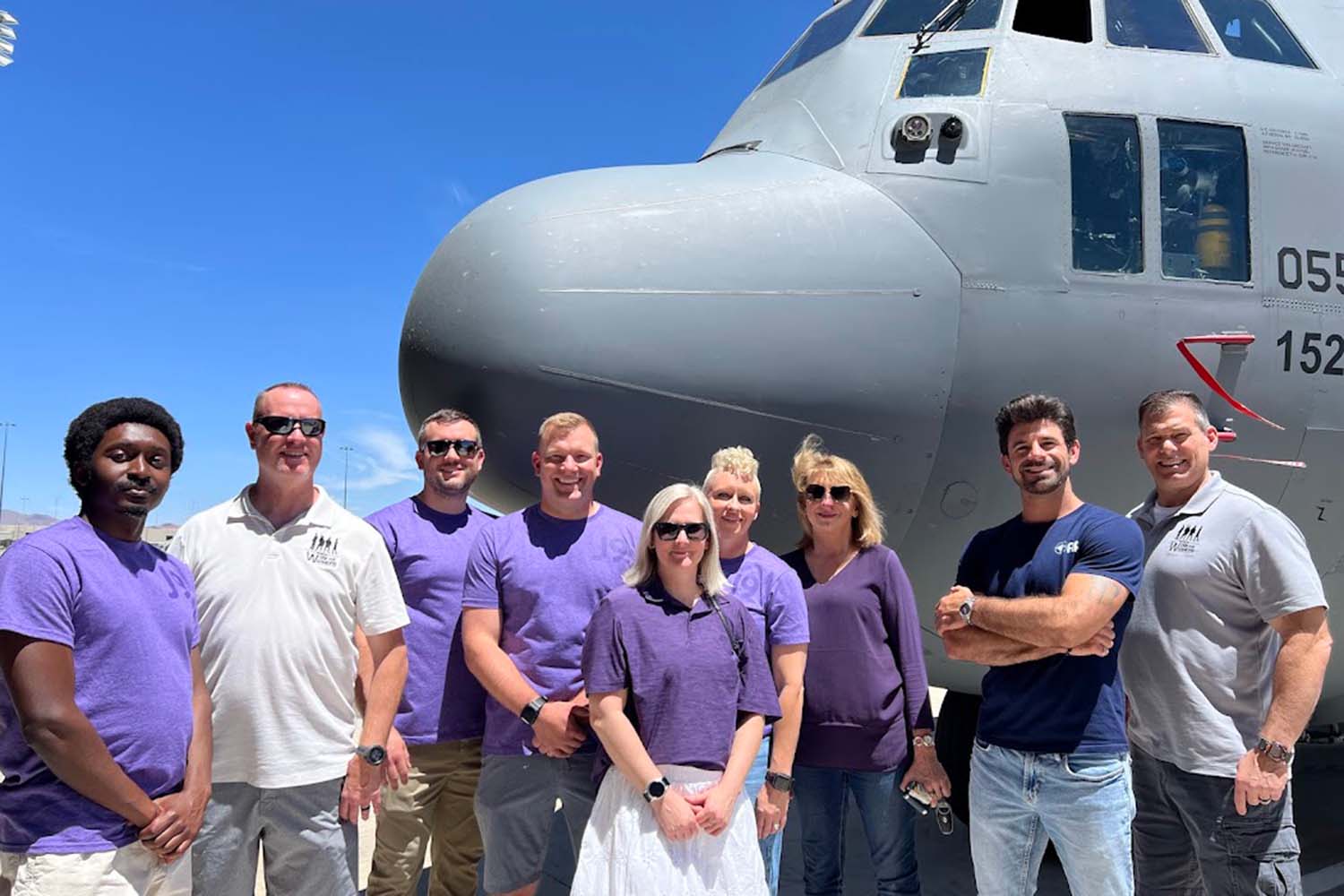
Michael Lundie MS’21, PhD’22 (second from right) and his colleagues investigated the benefits of cognitive training for Nevada National Guard personnel.
Lundie knew of treatments for soft tissue injuries involving photobiomodulation, including his own treatments after injuries in martial arts. Lundie was also aware of case studies of athletes receiving photobiomodulation to treat neck injuries and then experiencing improved cognition. Working with Krawczyk, Lundie took the concept to ARA, which approved the project.
Lundie and Krawczyk plan to develop a prototype for a device that uses LEDs in a helmet to irradiate portions of the brain with near-infrared light, a therapy known as transcranial photobiomodulation (tPBM). The therapy affects mitochondria in cells, increasing cellular metabolism and metabolic activity, which research suggests increases cognitive function.
In a study published in September in the journal Military Medicine, Lundie, who was corresponding author, showed that tPBM used on healthy adults resulted in improved working memory and in pupil dilation, which serves as a biomarker of increased sustained attention. Other contributors were all from UT Dallas, including senior author Krawczyk.
Lundie and Krawczyk are working on a provisional patent for a tPBM device through ARA. Lundie plans to continue research using air traffic controller trainees as subjects for a proof-of-concept for the technology.
“I’m especially interested in developing this technology to improve performance in various military operational domains,” Lundie said.
Lundie is continuing his research on political attitudes, and he and Krawczyk are collaborating on a book and exploring ideas for how people can reconnect.
“When we live in a world where there’s so much cynicism, it’s almost a point of irony to try to live a life that seeks to make genuine contributions,” Lundie said. “How do we recapture a feeling of connection when so many of the means by which we mediate our lives would do just the opposite? Can we be lured into having productive conversations where the goal is to humanize? That’s a near-term goal of my work.”