
Pictures of 3I/ATLAS will soon be all we have to remind us of the strange interstellar comet and its brief visit to our cosmic neighborhood.
Fortunately, thanks to the world’s space agencies, we’ll have quite the photographic collection of the intriguing object, which in 2025 attracted plenty of buzz when it became the center of an alien spaceship conspiracy theory.
NASA officials and scientists have long pushed back on the notion that 3I/ATLAS is extraterrestrial in nature, but that doesn’t make the comet any less fascinating. Because 3I/ATLAS’s time in our solar system is fleeting, the world’s astronomers and space agencies have been racing to study planetary material that formed from another star.
Among them, a European Space Agency orbiter bound for Jupiter spotted and imaged 3I/ATLAS toward the end of 2025. And images beamed back from that rendezvous only recently reached us on Earth.
2025 was a year of cosmic discoveries. Here’s a look back at 6
1 of 11
NASA’s Hubble Space Telescope last observed come 3I/ATLAS on Nov. 30, about four months after Hubble’s first look at the interstellar comet. 3I/ATLAS became one of the biggest cosmic stories of the year when astronomers deemed it to be the third-ever discovered interstellar object in our solar system originating from an entirely different part of the galaxy.
Here’s what to know about 3I/ATLAS, and a look at the ESA’s new photo of the interstellar comet.
What is 3I/ATLAS?
The object known as 3I/ATLAS made news in July 2025 when it was confirmed to be the third object ever discovered originating outside Earth’s solar system. A telescope in Chile – part of the NASA-funded Asteroid Terrestrial-impact Last Alert System, or ATLAS – was the first to spot the object whizzing at 137,000 mph, according to NASA.
The object was somehow ejected as many as billions of years ago into interstellar space – the region between stars – before it entered into our solar system, NASA says. The interloper into our cosmic neighborhood came from the general direction of the constellation Sagittarius, where the central region of our Milky Way galaxy is located.
Scientist who have observed 3I/ATLAS say it shows all the tell-tale signs of being a comet from outside our solar system. Unlike comets bound to the sun’s gravity, 3I/ATLAS is traveling on a hyperbolic orbit that suggests it did not originate within our solar system, according to NASA.
3I/ATLAS shines in new photo from Jupiter orbiter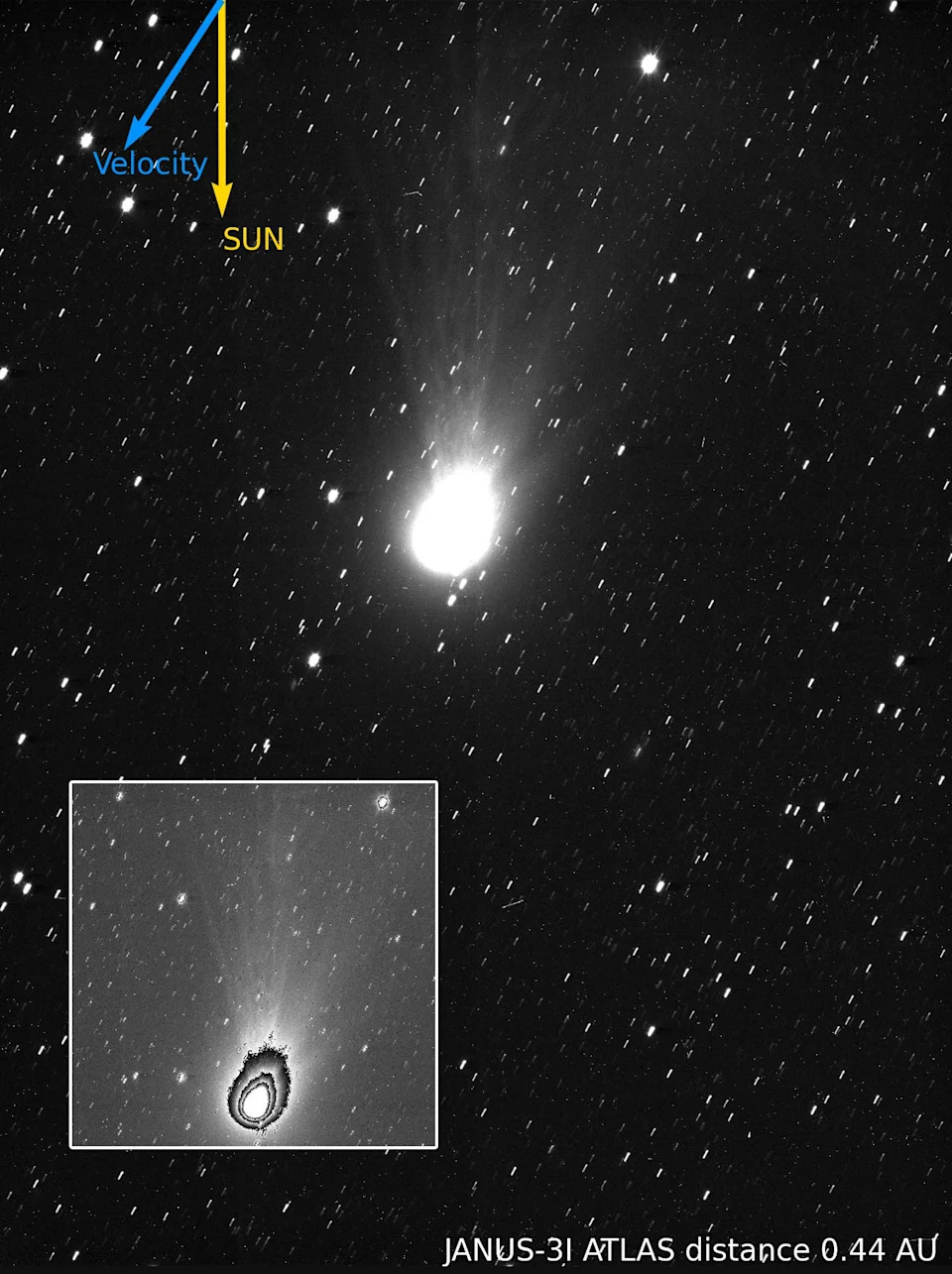
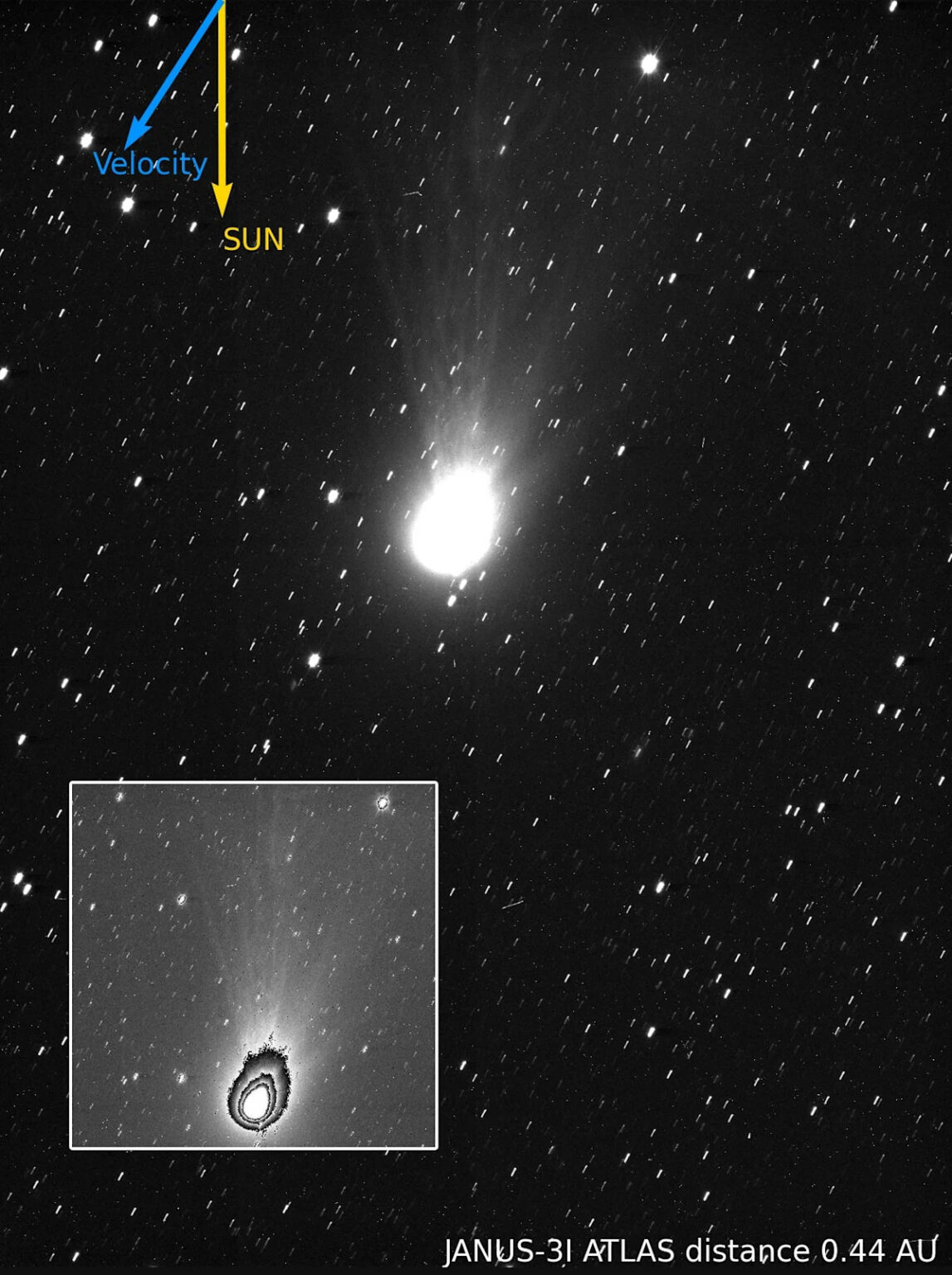
This striking image from the science camera on ESA’s Jupiter Icy Moons Explorer (Juice) shows interstellar comet 3I/ATLAS spewing dust and gas.
The ESA’s Jupiter Icy Moons Explorer (Juice) observed the comet between Nov. 2 and Nov. 25 when 3I/ATLAS was in a “very active state” following its closest approach to the sun Oct. 30, according to the agency. Because the spacecraft is far from Earth on the other side of the sun, scientists didn’t expect to receive its observations until February, according to the ESA.
An image the ESA released at the end of February captured Nov. 6 by the Juice orbiter shows a shining 3I/ATLAS spewing gas and dust from 41 million miles away. While the comet’s nucleus is not visible, you can see the bright halo of gas known as the coma surrounding it, as well as a long tail stretching from the the object.
The new image is one of about 120 captured across the wavelength range with Juice’s JANUS camera, designed to take detailed, high-resolution photos. The ESA previously released in December an image taken with Juice’s navigation camera, while other instruments aboard the spacecraft also documented 3I/ATLAS.
Are there photos of 3I/ATLAS? See all NASA images of comet
NASA released a trove of never-before-seen images of 3I/ATLAS Nov. 19 that revealed new characteristics of the object.
A look at all of the photos NASA has released of 3I/ATLAS since its discovery, including detailed explanations of each, are available below.
NASA’s fleet of telescopes, spacecraft glimpse 3I/ATLAS. See photos of interstellar comet
1 of 13
NASA’s Psyche mission acquired four observations of interstellar comet 3I/ATLAS over the course of eight hours on Sept. 8 and 9, 2025, when the comet was about 33 million miles from the spacecraft. The data, captured by Psyche’s multispectral imager, is helping astronomers both refine the trajectory of 3I/ATLAS and learn more about the faint coma, or cloud of gas, surrounding its nucleus.
When did 3I/ATLAS approach Earth?
The comet, which is not a danger to Earth, came within about 170 million miles of our planet Dec. 19, 2025. That was nearly twice the distance of Earth to the sun and more than 700 times the distance of Earth to the moon.
How long will 3I/ATLAS remain in our solar system?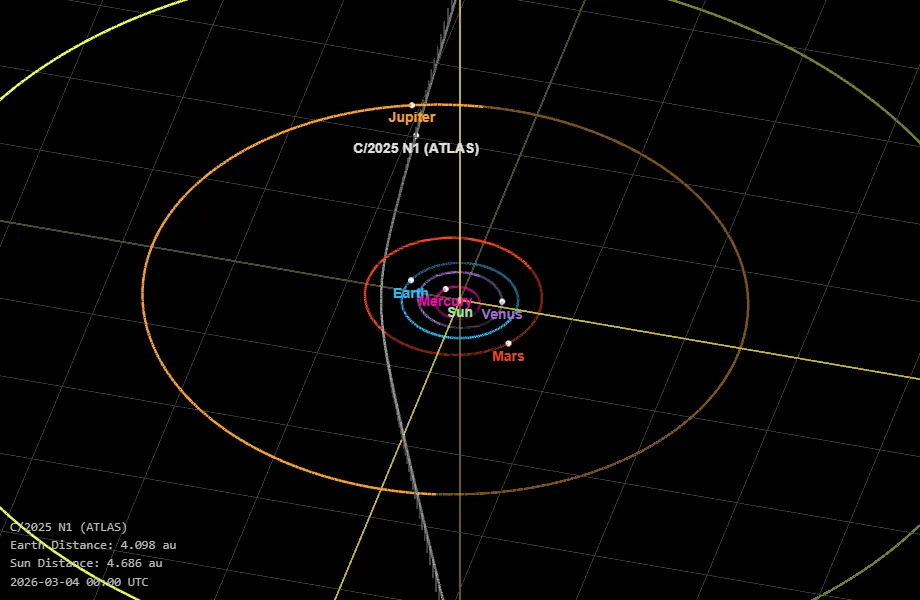
Here’s a look at 3I/ATLAS’s location in Earth’s solar system as of March 4, 2026.
The interstellar comet is simply passing through our solar system and will eventually exit back into interstellar space, never to be seen again.
In fact, its path out of our cosmic neighborhood began ever since 3I/ATLAS made its closest approach to the sun at the end of October. As the comet speeds away from the center of our solar system, it can still be observed until spring 2026 in the pre-dawn sky with even small telescopes, according to NASA.
Where is 3I/ATLAS now? How to track 3I/ATLAS
NASA’s online simulation Eyes on the Solar System shows the location and path of 3I/ATLAS as it moves through our solar system. You can also keep up to date with the comet’s movements where it’s catalogued by NASA’s Jet Propulsion Laboratory in Southern California.
Eric Lagatta is the Space Connect reporter for the USA TODAY Network. Reach him at elagatta@usatodayco.com
This article originally appeared on USA TODAY: 3I/ATLAS update. See new photo of interstellar comet