
Enabling & Support
04/03/2026
2 views
0 likes
ESA’s goal to implement a circular economy in space by 2040 requires innovative approaches to in-orbit servicing, manufacturing and recycling. The recent System Studies for the Circular Economy in Space campaign, funded by the Preparation element of ESA’s Basic Activities, resulted in four pre-Phase A mission studies that explore how Europe can move towards treating orbital space as a finite resource.
As the number of satellites in orbit continues to grow, the space industry faces a fundamental challenge: the current single-use culture in space is neither sustainable nor economically efficient. ESA’s circular economy vision encompasses on-orbit refurbishment, manufacturing and recycling – activities that could extend satellite lifespans, enable construction of structures too large to launch from Earth, and reduce the environmental impact of space activities.
“Through the Clean Space Initiative, ESA aims to reduce the environmental impact of its missions, mitigate the issue of space debris and enable the space circular economy through active debris removal and in-orbit servicing. This is the way to ensure the long-term sustainability of future space missions,” Antonio Caiazzo, space systems engineer at ESA and campaign manager, explained when the campaign launched.
The ‘System Studies for the Circular Economy in Space’ campaign was run through the Open Space Innovation Platform (OSIP). It invited industry and academia to propose mission and system concepts capable of providing on-orbit refurbishment, manufacturing and recycling in Earth orbit. Four teams conducted six-month pre-Phase A concept studies, exploring approaches from satellite servicing in geostationary orbit to autonomous recycling facilities and robotic fabrication of large-scale structures.
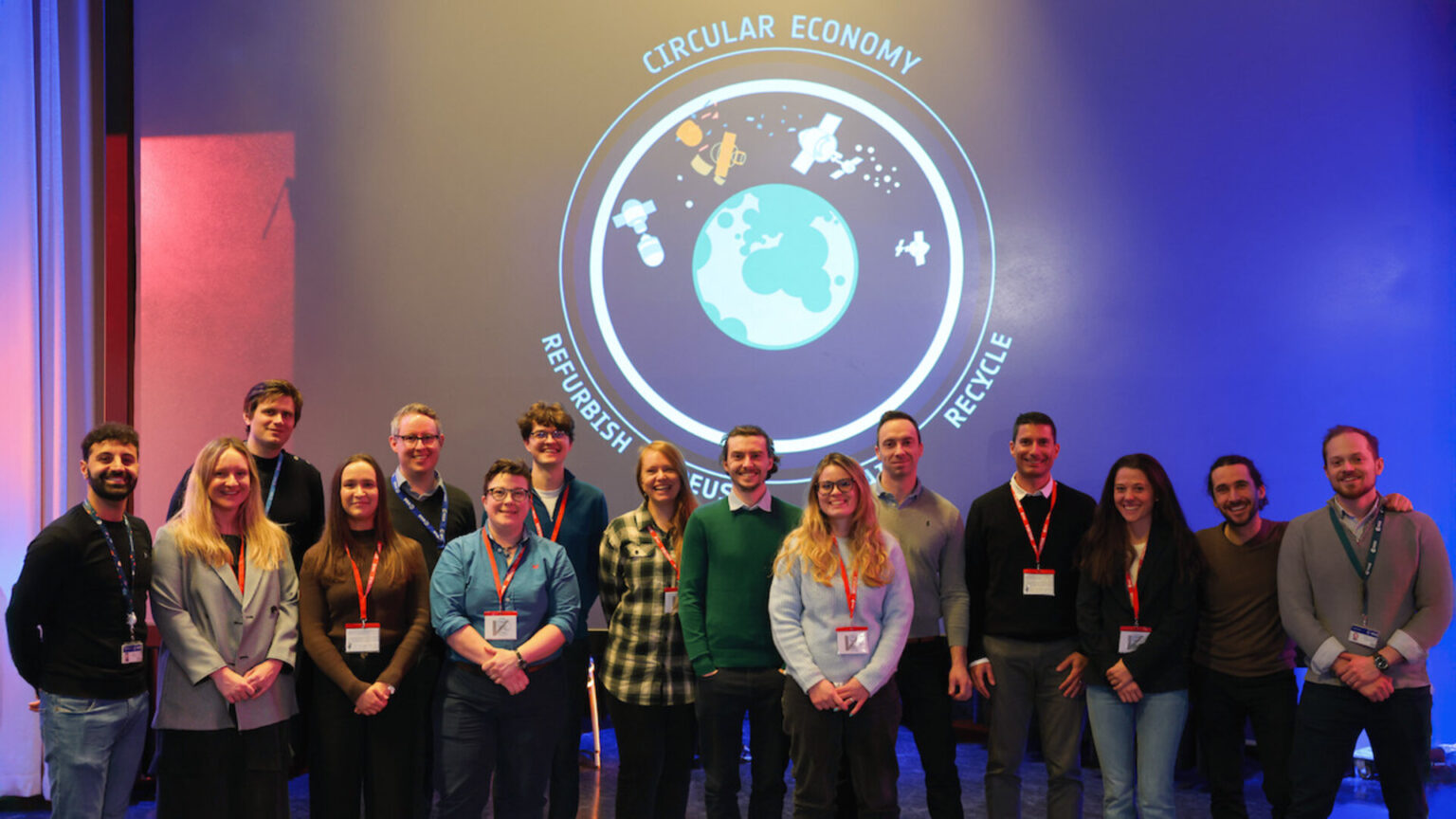
On 27 February 2025, the teams came together at the European Space Research and Technology Centre (ESTEC) in Noordwijk, the Netherlands, to present their results to ESA and each other. Throughout the day, teams shared their findings and built connections for potential future collaborations.
“The studies showed that in orbit refurbishment, manufacturing, and recycling are not just technological experiments but are viable options to form the foundation of a future circular economy in space” says Ross Findlay, Head of Sustainable Engineering at ESA. “The study results also confirmed the readiness and aptitude of European industry to undertake this challenge.”
Meet the teams
The IRUS (In-orbit Refurbishment and Upgrading Service) project, led by Astroscale Ltd, developed capabilities to refurbish and upgrade satellites in low Earth orbit (LEO). Working with In-Space Missions and DHV Technology, the team designed a mission based on heritage from Astroscale’s ELSA-M and COSMIC missions. The servicer uses robotic arms and modular payload containers to dock with client satellites and replace critical components including onboard computers, reaction wheels, batteries and solar arrays. The team identified a strong market for refurbishment or upgrading between 2030 and 2040, providing commercial viability for satellites designed with serviceability in mind.
LOOP (Preparing the foundations of circular on-orbit economy), coordinated by Growbotics Space Ltd with Thales Alenia Space and 3Keel, focused on establishing circular economy principles for satellites in geostationary Earth orbit (GEO). The project investigated the design of satellite repair kits with emphasis on payload refurbishment, and explored options for servicing electric propulsion subsystems, power processing units and electrical thruster equipment. The team’s work on modular architectures and standardised interfaces aims to demonstrate the commercial viability of refurbishment for satellites specifically designed for circular economy principles in this strategically and economically important orbital region.
KINETIK Space’s ROBOFAB (Robotic Fabrication for Space Applications) project addressed the challenge of constructing large-scale structures in orbit. The concept envisions a single satellite equipped with robotic arms, carbon tube forming capabilities and 3D printing systems to manufacture giant structures such as solar sails, solar farms, large antennas and telescope reflectors directly in space. By eliminating the need to launch pre-fabricated or folded components, this approach could enable construction of space infrastructure that would be impractical or impossible to deploy from Earth.
Thales Alenia Space’s Recycling Space Plant project, developed with PROMES Laboratory, designed a dedicated recycling facility for Sun-synchronous orbit. The concept uses a solar furnace payload to process defunct satellites and rocket stages, converting space debris into usable raw materials for manufacturing new equipment and parts in orbit. The study addressed critical challenges including materials selection, recycling processes suitable for the space environment, and the power and thermal management systems needed to operate a recycling facility in orbit. This long-term vision aims to close the materials loop in space by 2045.
Overview of the main ISAM missions at ESA
Winners selected for further development
Following evaluation of the studies, two activities were selected for further consolidation through sessions at ESA’s Concurrent Design Facility (CDF):
Astroscale’s IRUS project, focusing on the short-term feasibility of in-orbit refurbishment
Thales Alenia Space’s Recycling Space Plant, addressing the long-term innovation of in-orbit recycling
“We selected IRUS and the Recycling Space Plant for CDF consolidation because together they combine near term demonstrability with long term system level impact—proving what can be done today while defining what must be built for tomorrow. Through the CDF, our aim was to mature these concepts into concrete, mission ready architectures that can anchor Europe’s future Space Circular Economy,” says Antonio.
The campaign demonstrated strong interest in near-term in-orbit refurbishment missions, particularly those targeting critical spacecraft components. Key findings highlighted the importance of modular, replaceable units and service-compatible satellite architectures for enabling cost-effective and scalable in-orbit servicing. The studies confirmed that refurbishment missions are both technically feasible and commercially attractive, with the economic case strongest for satellites designed from the outset with serviceability in mind.
What comes next?
Building on the success of this campaign, ESA is moving forward with concept consolidation contracts and preparing mission proposals.
Since the SysNova campaign ended, two Phase A contracts for On-orbit Refurbishment Missions (ORUM) have been awarded, and interest remains within ESA Member States for additional development contracts. The agency hopes to propose these for follow-on funding at the next Council Meetings at Ministerial Level. In addition, the agency is assessing the viability of opening a second Circular Economy SysNova campaign to follow the evolution of interest in this topic within European industry.
ESA is also investigating potential collaboration with external stakeholders, including the European Commission, which is working on similar in-space operations and services activities. The roadmap for the space circular economy includes investigation campaigns, consolidation studies, technology contracts and full mission proposals, with key demonstration goals focusing on refurbishment of onboard components and the development of modular, serviceable satellite designs.
The System Studies for the Circular Economy in Space campaign represents a crucial step towards ESA’s vision of a sustainable space economy, where orbital space is treated as a finite resource and space assets are reused and recycled rather than disposed of after a single use.
Like