
NEED TO KNOW
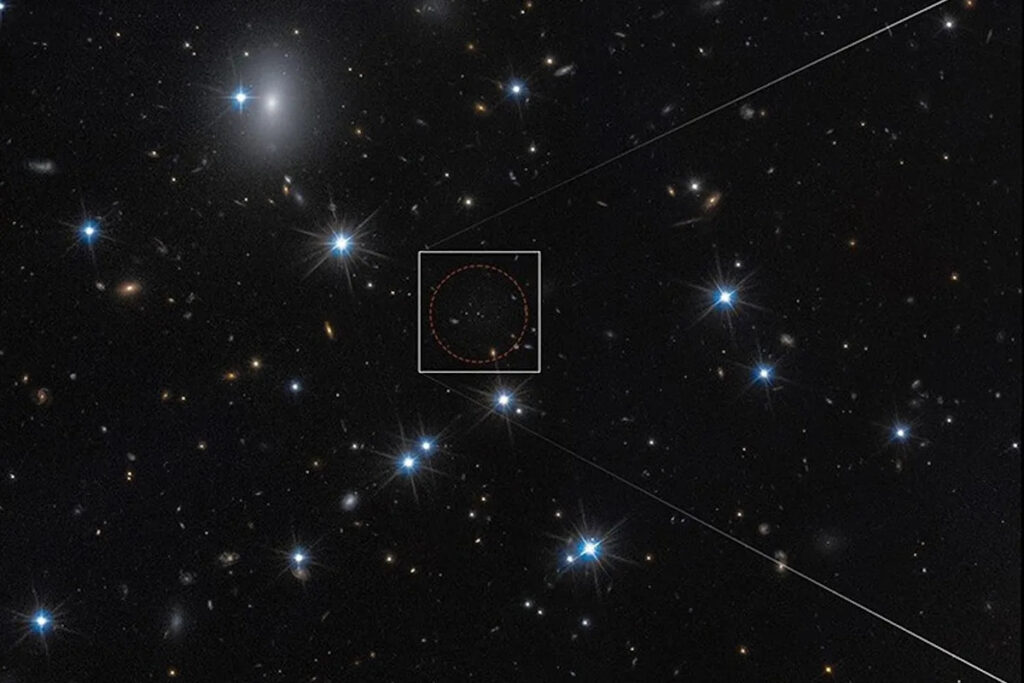
A new galaxy, named Candidate Dark Galaxy-2 or CDG-2, was recently discovered using the Hubble Space Telescope, according to a new paper
CDG-2 is believed to made up of 99% dark matter, which NASA said is “an invisible form of matter that does not reflect, emit, or absorb light”
NASA even said CDG-2 “may be among the most heavily dark matter-dominated galaxies ever discovered”
A new, nearly invisible galaxy made up almost entirely of dark matter has been discovered.
The rare galaxy, named Candidate Dark Galaxy-2 or CDG-2, was recently discovered using the Hubble Space Telescope, according to a paper published in The Astrophysical Journal Letters.
CDG-2 “may be among the most heavily dark matter-dominated galaxies ever discovered,” according to a news release from NASA, which described dark matter as “an invisible form of matter that does not reflect, emit, or absorb light.”
These “low-surface-brightness galaxies” are “nearly invisible” due to the dark matter that dominates the space and only contain “a sparse scattering of faint stars,” NASA said.
Based on preliminary analysis, the agency said that “remarkably, 99% of its mass, which includes both visible matter and dark matter, appears to be dark matter.”
“To be technically correct, CDG-2 is an almost-dark galaxy,” Dayi Li, a post-doctoral fellow in statistics and astrophysics at the University of Toronto and lead author of a study about the CDG-2 discovery, told CNN.
But, he added, “the importance of CDG-2 is that it nudges us much closer to getting to that truly dark regime, while previously we did not think a galaxy this faint could exist.”
Dark galaxies are believed to have very few stars, if any at all, according to CNN.
In the case of CDG-2, a preliminary analysis suggested globular clusters accounted for 16% of the newly discovered galaxy’s visible content, according to NASA.
Globular clusters are defined by the European Space Agency as “stable, tightly bound clusters of tens of thousands to millions of stars.”
NASA said it is believed that much of CDG-2’s matter for star formation “was likely stripped away by gravitational interactions with other galaxies inside the Perseus cluster.”
Never miss a story — sign up for PEOPLE’s free daily newsletter to stay up-to-date on the best of what PEOPLE has to offer, from celebrity news to compelling human interest stories.
Since CDG-2 seems to have very few stars, Li and his colleagues believe dark matter could be holding the globular clusters together, according to CNN.
Still, Yao-Yuan Mao, assistant professor of physics and astronomy at the University of Utah in Salt Lake City, told CNN that the discovery of CDG-2 “is a very exciting find.”
“The faint, diffuse light seen in the Hubble images of CDG-2 makes a strong case that we are looking at a cohesive object, rather than a random alignment of four bright globular clusters,” he told CNN.
Read the original article on People