
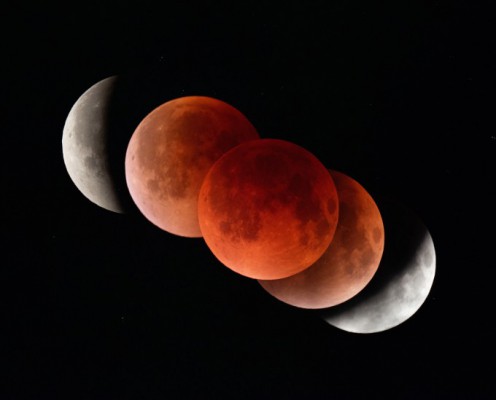
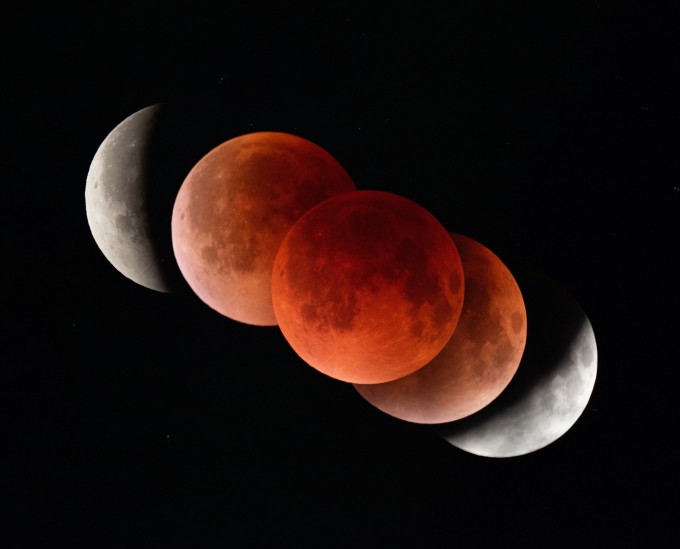
A total lunar eclipse photographed by Jeon Young-beom, a principal researcher at KASI, on September 8, 2025. Courtesy of KASI.
On the evening of the 3rd, a total lunar eclipse will occur, revealing a red moon shrouded in Earth’s shadow. This marks the first time in 36 years, since February 10, 1990, that a total lunar eclipse has coincided with Jeongwol Daeboreum, the 15th day of the first lunar month.
According to the Korea Astronomy and Space Science Institute (KASI) on the 3rd, the partial eclipse will begin at 18:49 as the Moon starts to enter Earth’s umbra. At 20:04, the Moon will be fully inside the umbra, marking the start of totality. The maximum eclipse will be at 20:33, and totality will end at 21:03. During the approximately one-hour-long total eclipse, the Moon will appear darker and redder than usual.
The reason the Moon turns red is that sunlight passing through Earth’s atmosphere is scattered. Shorter-wavelength blue light is scattered away, while longer-wavelength red light is refracted toward the Moon. This light carries information about Earth’s atmosphere. Through spectroscopic observation, atmospheric components such as ozone, water vapor, and nitrogen dioxide can be identified.
A total lunar eclipse also presents an opportunity to observe Earth as if it were an exoplanet. This is because sunlight reaches the Moon after passing through Earth’s atmosphere, similar to when an exoplanet transits its host star. Astronomers use this ‘transit spectroscopy’ scenario to test and refine methods for detecting biosignature gases in the atmospheres of exoplanets.
During the total lunar eclipse of January 20-21, 2019, researchers from the National Aeronautics and Space Administration (NASA) and the European Space Agency (ESA) analyzed Earth’s transit light using the Hubble Space Telescope’s Space Telescope Imaging Spectrograph (STIS). They confirmed a strong ozone signal in the visible light spectrum but could not secure a distinct signature in the near-ultraviolet.
Ozone is a gas closely linked to oxygen and is considered a key indicator for inferring biological activity on exoplanets. The results demonstrated the need for precise wavelength selection and observational design in detecting biosignature gases. The research findings were published in 2020 in the international academic journal ‘The Astronomical Journal’.
In 2023, a study was published in the international journal ‘Nature’ that used the lunar eclipse records of medieval monks to reconstruct the timing of major volcanic eruptions in the 12th and 13th centuries. A research team led by Professor Markus Stoffel from the Institute for Environmental Sciences at the University of Geneva, Switzerland, analyzed eclipse records from 1100 to 1300. They confirmed that unusually dark total lunar eclipses occurred 3 to 20 months after volcanic eruptions. This is because erupted sulfur dioxide forms stratospheric aerosols that dim the moonlight. Tree ring and ice core data also supported this analysis.
Jeon Young-beom, a principal researcher at KASI, stated, “A lunar eclipse is a phenomenon where the Moon enters Earth’s shadow, so its scope for astronomical research is relatively limited.” However, he added, “In the future, if a telescope is installed on the Moon, it could open up observational possibilities by using the scene of Earth eclipsing the Sun.” This means that from the Moon, one could observe the Sun’s surroundings without being blinded by its intense light, as Earth would block it. He explained that the practical applications and observational precision of such a setup would require further review.
doi.org/10.3847/1538-3881/aba0b4
nature.com/articles/s41586-023-05751-z
Copyright ⓒ DongA Science. All rights reserved.