
Enabling & Support
03/03/2026
1 views
0 likes
In brief
A new self-monitoring and self-healing carbon-fibre composite material has been developed by CompPair in collaboration with Com&Sens and CSEM as part of the European Space Agency’s ‘First!’ iniative.
Project Cassandra has shown Healtech material can be heated in place to repair cracks that might form during use.
The technology could be ideal for reusable space transportation elements.
In-depth
Healable spacecraft structures could soon be possible thanks to cutting-edge composite technology. Swiss companies CompPair and CSEM with Belgian company Com&Sens have partnered with the European Space Agency (ESA) to modify their self-healing carbon fibre product for use in space transportation.
Project Cassandra (a loose abbreviation of Composite Autonomous SenSing AnD RepAir) includes sensors and a heating element into a composite carbon-fibre material, allowing spacecraft to autonomously repair initial stages of damage .
Cassandra is part of ESA’s Future Innovation Research in Space Transportation (FIRST!) Initiative which is finding and testing innovative technology that will benefit European space transportation.
Composite materials in space
Infrared images of Cassandra repair process on a test sample through heating
Composite materials like carbon fibre reinforced polymers are increasingly being used in spacecraft structures. They are composed of a polymer matrix, reinforced with layers of carbon or glass fibres. This creates a strong and lightweight material, resistant to corrosion. However, composite materials are also sensitive to damage – especially if they were to fly to space and back repeatedly – and small cracks can worsen over time. Repairs can be expensive and time consuming and may weaken the structural integrity.
With this in mind, CompPair developed ‘HealTech’, a composite material that can “self-heal”. By heating the material, a healing agent inside activates and reflows to repair damage caused by impacts or stress.
Spotting damage with optical fibre sensor network
Cassandra demonstrator diagram
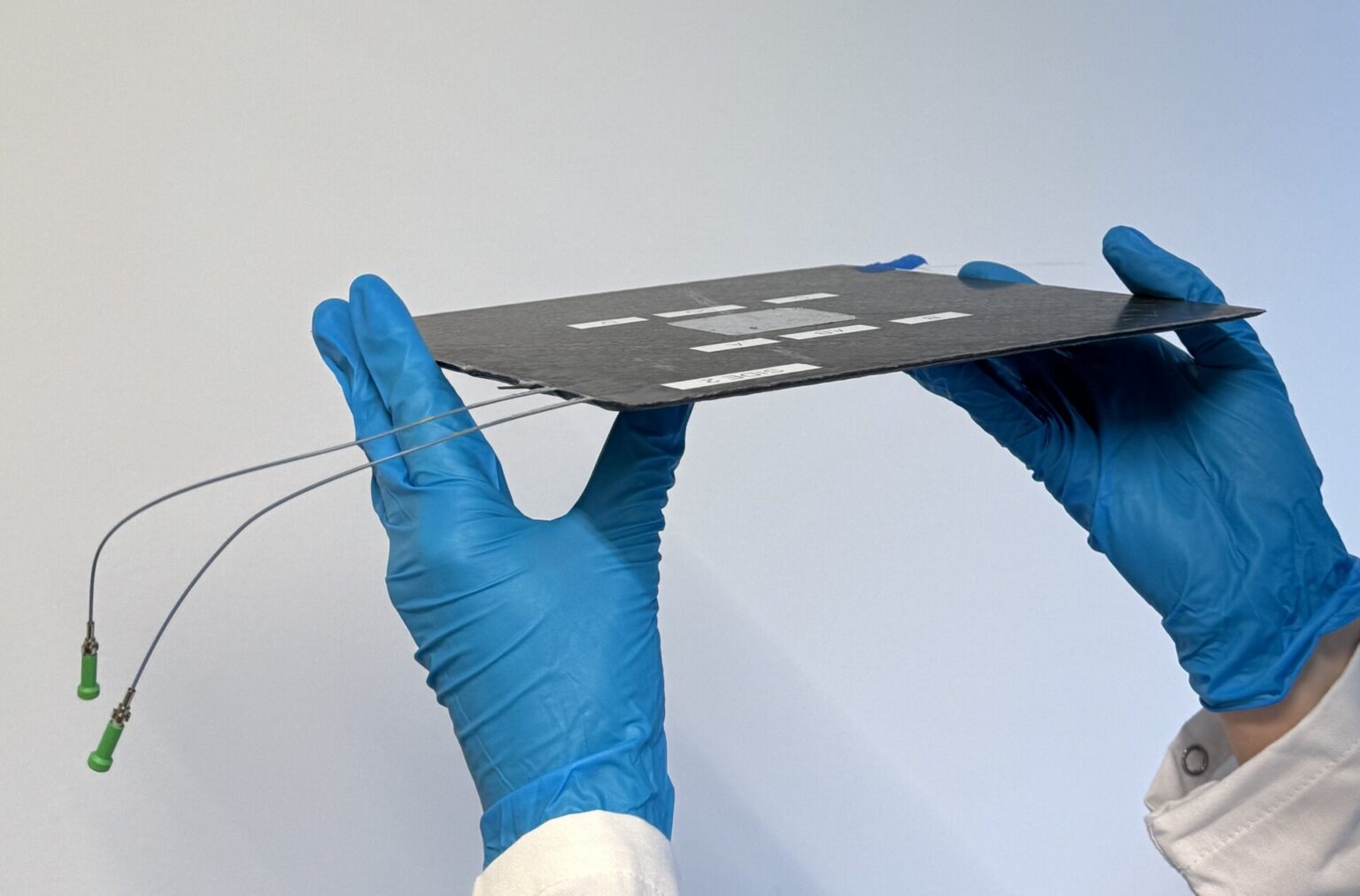
A prototype of the composite structure was created by integrating a network of fibre-optic sensors into HealTech’s resin-imbued fibres. The sensors pinpoint any damage to the structure. Once spotted, the material is heated through integrated 3D-printed aluminium grids to 100–140°C.
Various samples of the material ranging from 2×10 cm to 40×40 cm have undergone testing. The tests focused on the efficacy of the material’s damage monitoring, homogenous heating and self-repair abilities. Additionally, thermal shock tests were conducted to monitor the response of the material to the typical conditions of a cryogenic tank.
The next stage of testing will involve adapting the material to a larger shape such as a complete cryogenic fuel tank.
Benefits for Europe
Cassandra demonstrator panel in a laboratory
This material could reduce waste resulting from space missions, and would be ideal for reusable launchers. “Implementing this technology into our systems could have enormous benefits for space transportation,” says ESA’s Bernard Decotignie, “It will help develop reusable space infrastructure and reduce mission costs. This really proves what European innovation can do for the space sector.”
CompPair Chief Technology officer Robin Trigueira said, “I’m excited by the autonomy and durability benefits we can bring for the future spacecrafts and launchers, closing the gap between science-fiction and reality! This project is a major step for CompPair in the space sector, HealTech is unlocking unprecedented technological advancement for composite material health monitoring and management, clearly highlighting the possibilities brought by healable composites for reusable space structure costs efficiency.”
Head of research and development for CompPair, Cecilia Scazzoli explains, “I’m thrilled that we have demonstrated that HealTech composites with health monitoring and heating systems show autonomous damage sensing and healing and high resistance to micro-cracking. This makes them suited to the demanding requirements of propellant tanks and reusable space structures, and paves the way for lighter, more maintainable spacecraft components.”
Like