
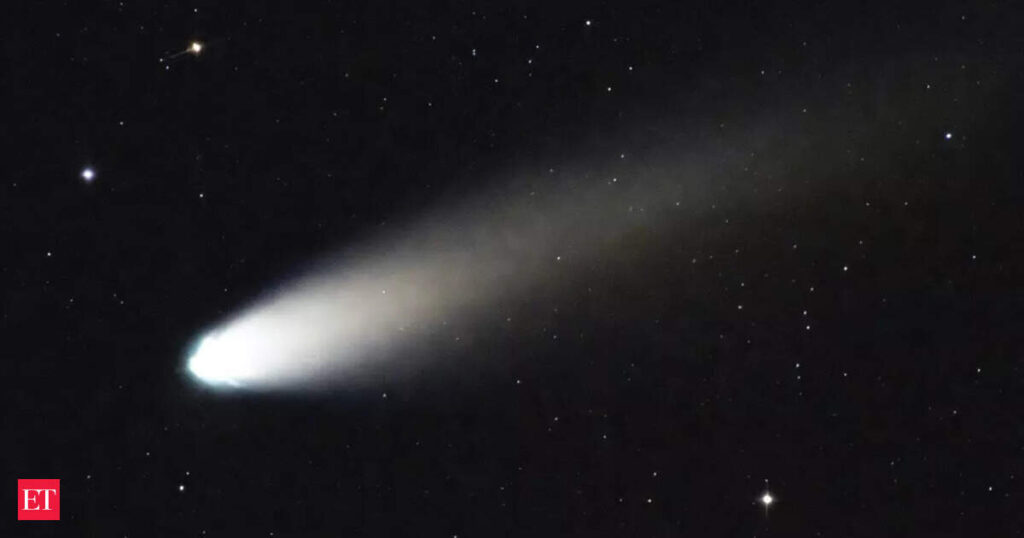
Astronomers recently identified a comet traveling through the inner solar system at an unusually high velocity, drawing attention from planetary scientists studying the outer reaches of our cosmic neighborhood. Observations compiled by the Minor Planet Center and follow-up measurements from ground-based observatories revealed that the comet was moving at more than 70 kilometers per second relative to the Sun as it approached perihelion. Such speeds are characteristic of objects originating from the distant Oort Cloud, a spherical reservoir of icy bodies extending tens of thousands of astronomical units from the Sun.
Orbital calculations showed that the comet followed a highly elongated trajectory with eccentricity near the boundary between gravitationally bound and unbound orbits. This indicated that gravitational perturbations, possibly from passing stars or galactic tidal forces, had altered its path, sending it plunging inward after millions of years in deep space.Why Speed MattersComets that originate in the Oort Cloud can approach the Sun at extreme velocities because they fall from vast distances under solar gravity. As they descend, gravitational acceleration dramatically increases their speed. Unlike short-period comets, which have stable orbits shaped by repeated passes near the Sun, long-period comets are often first-time visitors to the inner solar system. Live EventsPlanetary scientist Karen Meech of the University of Hawaii has emphasized that such comets are valuable because they preserve pristine material from the early solar nebula. Since they have spent most of their existence in a deep freeze, their composition reflects conditions present during the formation of the solar system approximately 4.6 billion years ago.
Observational AnalysisSpectroscopic observations conducted as the comet approached the Sun detected typical volatile compounds, including water vapor, carbon monoxide, and carbon dioxide, which sublimated as solar heating intensified. High-velocity comets experience rapid heating, which can cause sudden increases in outgassing and, sometimes, fragmentation.
Astronomers monitored the object’s structural integrity to determine whether stresses from thermal expansion would cause it to break apart. Rapid rotation combined with volatile release can destabilize the nucleus, leading to fragmentation events that alter brightness and trajectory.
Scientific SignificanceHigh-speed comets provide important data for modeling the gravitational environment of the outer solar system and for estimating the rate at which distant icy bodies are perturbed into Sun-crossing orbits. Studying these visitors also refines the understanding of impact risk assessment over long timescales.
While the probability of a large comet impacting Earth remains low, continuous monitoring of near-Earth objects ensures early detection of potentially hazardous trajectories. Each newly observed comet contributes data that improves predictions and informs planetary defense strategies.