
WASHINGTON — The Austrian Ministry of Defense’s first satellite, being developed by Vienna-based startup GATE Space, will launch from a SpaceX Falcon 9 a year from now, according to MoD and company leaders.
“With BEACONSAT, jammers that intentionally or unintentionally disrupt signals are to be detected and data collected. Through jamming methods, troops face the risk of disorientation in the worst case when they rely on satellite-based navigation (GNSS) for movement on land, water, or in the air and this is disrupted,” Austrian Defense Minister Klaudia Tanner said in a post on X.
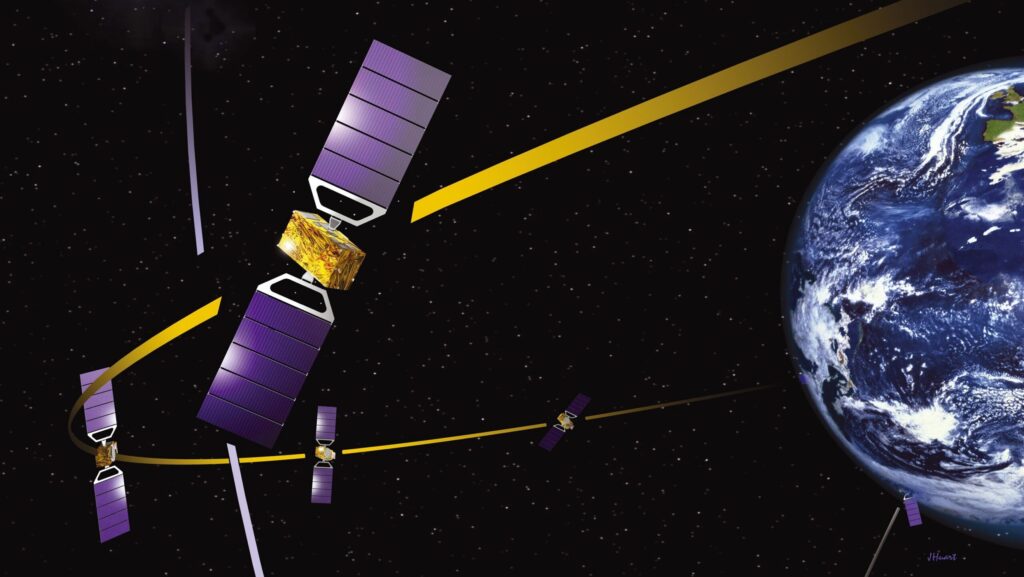
Moritz Novak, GATE Space CEO and co-founder, said in a post on LinkedIn that the satellite will be able to spot jamming and spoofing of position, navigation and timing constellations such as the US Global Positioning System and Europe’s Galileo, which are used by both military forces and civilians.
“These systems underpin aviation, autonomous mobility, critical infrastructure, and modern defense operations,” he said.
GATE Space, founded in 2022 with a focus on rocket propulsion systems, is backed by Austrian venture capital firm ROI Ventures and Boston-based Techstars.
GATE Space is serving as the prime for BEACONSAT, working with Danish satellite manufacturer Space Inventor and Austrian firm IGASPIN GmbH, which builds GNSS interference detection payloads, as well as a number of Austrian subcontractors.
As first reported by Payload Space, the company has not disclosed the total development costs for BEACONSAT, but the MoD is providing €1 million ($1.2M), and the European Space Agency (ESA) is kicking in €500,000.
ESA’s 23 member states in November approved a historic shift to allow the agency to finance dual-use capabilities that support both military and civil activities.
The Austrian MoD also is partnering with its Dutch counterpart to develop three demonstration satellites designed manoeuver between low Earth orbit (LEO) and very low Earth orbit (VLEO) and provide terrestrial imagery. LEO is defined as altitudes below 2,000 kilometers (about 1,243 miles), and VLEO is a subset typically defined as 100-450 kilometers where atmospheric drag is strong and thus satellites require additional propulsion to stay aloft.
The project is being funded by the two nations via the European Defence Fund, which last June signed a contract with prime contractor ISISPACE worth €10 million, according to a company press release.
“The LEO2VLEO satellites will provide proof of concept and in-orbit demonstration of defence applications, addressing Europe’s urgent need for sovereign, rapid-response space assets. Using Very Low Earth Orbit offers several strategic advantages, including improved communications, agility, and Earth observation capabilities, while minimising space debris risk,” the announcement said.
Those spacecraft are also set to follow BEACONSAT into orbit in 2027.