
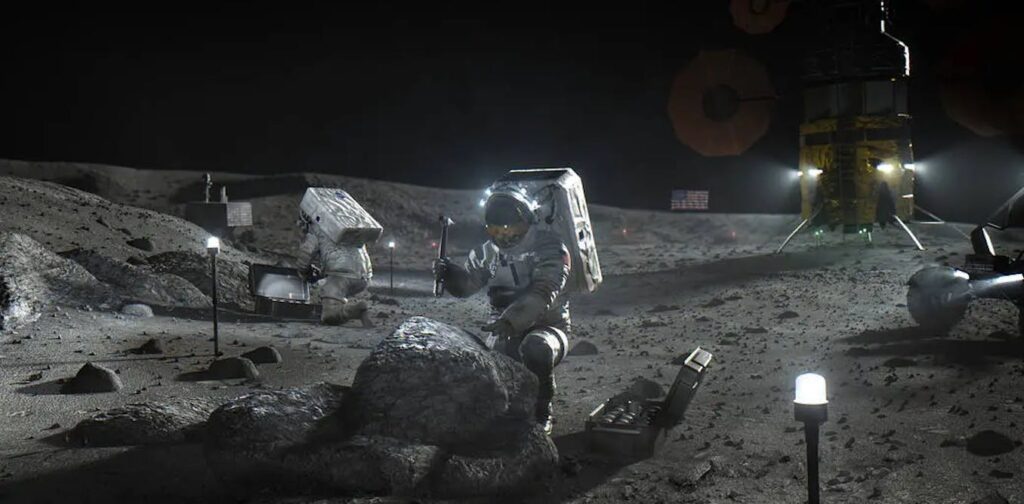
As we wait for the historic Artemis II mission — with Canadian astronaut Jeremy Hansen on board — NASA has announced major changes to the Artemis program.
The next mission, Artemis III, will now no longer land humans on the surface of the moon, but will instead feature a series of technology tests in Low Earth orbit. Artemis IV will then be the first human landing on the moon, sometime in 2028.
I am a professor, an explorer and a planetary geologist. I am a member of the Artemis III Science Team and have been supporting NASA in developing geology training for Artemis astronauts.
My research involves investigating Apollo samples and lunar meteorites to better understand the geology of the moon.

The Artemis II crew. NASA astronauts Reid Wiseman, commander; Victor Glover, pilot; Christina Koch, mission specialist; and Canadian Space Agency astronaut Jeremy Hansen, mission specialist are seen as they depart for a test in December 2025, at NASA’s Kennedy Space Center in Florida.
(NASA/Aubrey Gemignani)
Why the changes?
While it’s not impacted by last week’s NASA announcement, recent delays to the Artemis II mission are a symptom of the challenges that have faced the entire Artemis program for years.
Following an initial setback due to a liquid hydrogen leak encountered during a wet dress rehearsal on Feb. 3, further issues for Artemis II arose during the second wet dress rehearsal from Feb. 19 to 20. As a result, the earliest launch date is now April 1.
This would make it over three years since the first Artemis mission. Such long gaps between missions limit the ability to refine systems quickly and mean that the same issues (for example, fuel leaks) keep recurring. With the loss of more than 4,000 employees — approximately 20 per cent of its workforce — in 2025, NASA is also dealing with significant workforce challenges, causing further strain to the Artemis program.
These challenges appear to have been recognized by NASA’s new administrator, Jared Isaacman, who wrote in a recent social media post that “the days of NASA launching Moon rockets every 3 years are over.”
A big part of the plan involves standardizing the Space Launch System (SLS) rocket “upper stage” — this is the part of the rocket that propels the spacecraft from Low Earth orbit toward the moon.
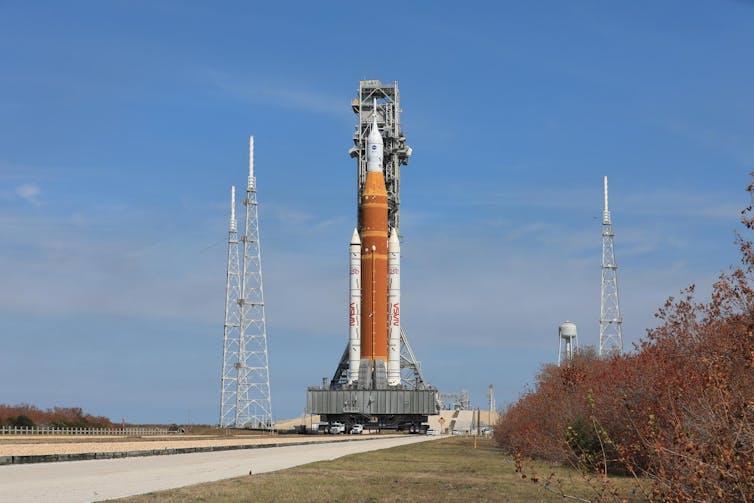
NASA’s crawler-transporter 2, carrying the Artemis II SLS (Space Launch System) rocket and Orion spacecraft, heads back to the vehicle assembly building at NASA’s Kennedy Space Center in Florida on Feb. 25, 2026.
(NASA/Kim Shiflett)
A reinvigorated Artemis program
There have been lots of news stories circulating since NASA’s announcement about the shake-up of the Artemis program, many of them referring to the “cancellation” of the Artemis III mission. This is not a fair or accurate representation of the new plans. Many people, including myself, think the new plans are not only more realistic, but also exciting in their own right.
It’s true that Artemis III will now not be the first human landing on the moon since Apollo 17 in 1972. Instead, the mission will launch the Orion crew capsule with astronauts on board into Low Earth orbit, where they will conduct in-space testing of critical technologies, including life support, propulsion and communications systems.
While in orbit, it’s also hoped that Orion will rendezvous and dock with one, or both, of the commercially developed lunar landers built by the companies SpaceX and Blue Origin. This makes sense as the original Artemis plan went from Artemis II straight to the surface without testing out these critical aspects of the mission.

The Artemis spacesuit prototype, the AxEMU, developed by Axiom Space.
(KBR/Axiom Space)
The crew may also test the new spacesuits designed by Axiom Space, which is important because these suits haven’t yet been worn for an actual space mission.
This new plan, therefore, actually reduces the risks and increases the likelihood of a successful human mission to the surface of the moon in 2028 — Artemis IV instead of Artemis III.
The most exciting, and surprising, part of the recent announcement was that NASA will try for not just one, but two moon landings in 2028, and then a mission every year thereafter. Suddenly, this is becoming much more like the Apollo program, which launched 11 crewed missions in four years.

A graphic illustrating NASA’s increased cadence of Artemis missions.
NASA
What about the Lunar Gateway?
There was a notable absence in last week’s announcement — a mention of the Lunar Gateway. This is the small space station that will orbit the moon as part of the Artemis program.
In the original plans, the second lunar landing, Artemis IV, was meant to go to the surface of the moon via the Lunar Gateway.
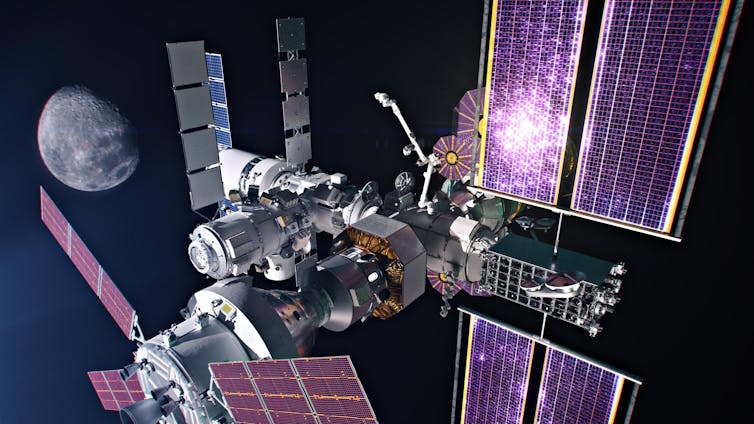
Artist’s concept of the full Gateway configuration.
(NASA)
Lunar Gateway is very important to Canada because it will be home to Canadarm3. As the name might suggest, Canadarm3 is Canada’s next-generation robotic arm and is a $2-billion contribution to the Artemis program.
It builds on Canada’s robotics heritage from Canadarm and Canadarm2, but is far more advanced, featuring artificial intelligence — which is necessary due to the distance it will operate from Earth. As NASA works out the plans for the second and subsequent lunar surface missions, I hope for the sake of the Canadian space program that the Lunar Gateway with its Canadarm3 will still be in the mix.