
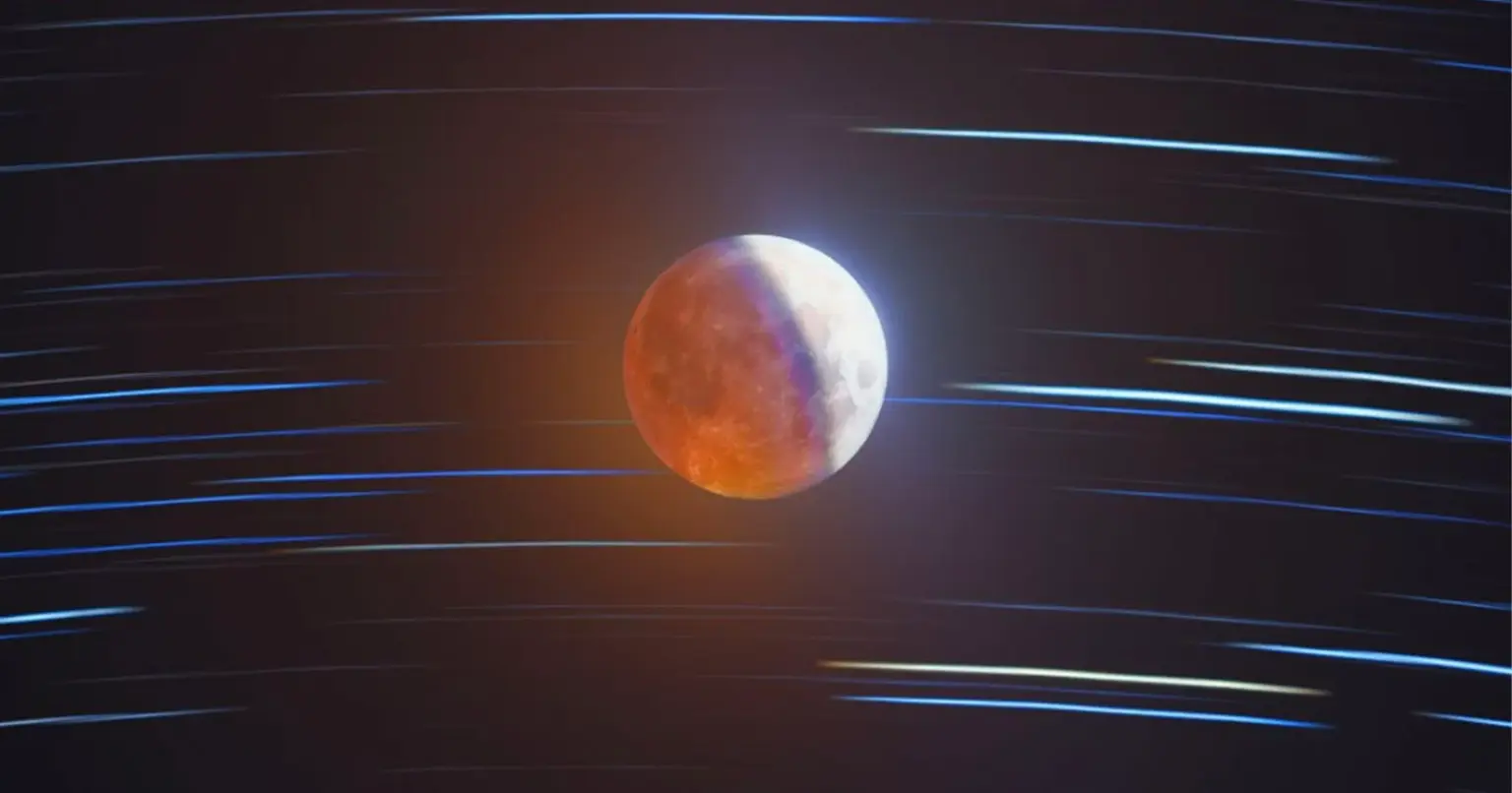
On March 3, residents of America, Asia, and Australia will witness a rather rare phenomenon: a total lunar eclipse, also known as a Blood Moon. Here is when it will start and where it can be viewed live.
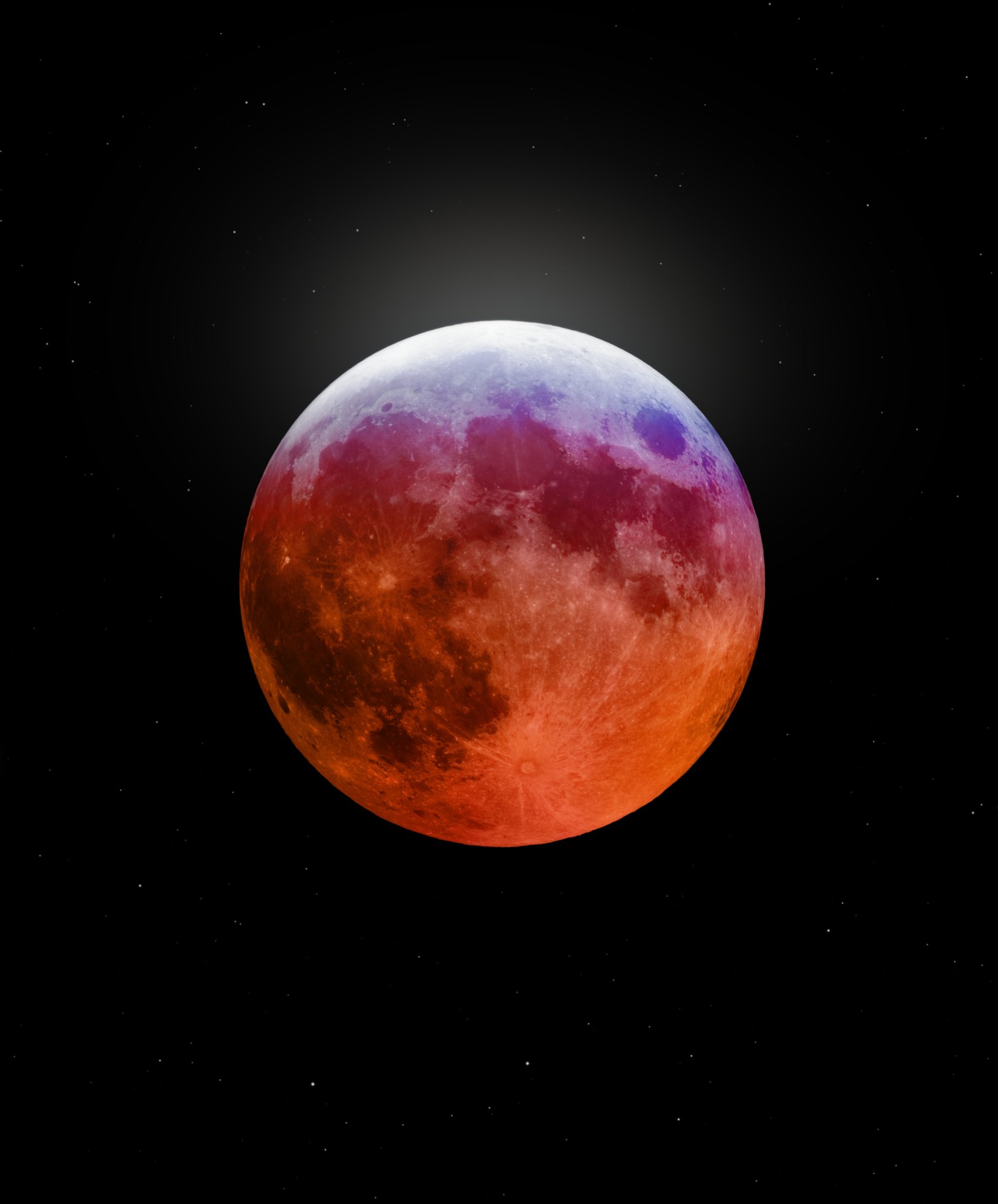 Total lunar eclipse. Source: Andrew Maccarthy
Why does the Moon turn red during an eclipse?
Lunar eclipses occur when the Moon passes through the shadow of our planet. At this moment, its disk turns a characteristic dark red color. This effect can be explained as follows. Although the Moon is in shadow, sunlight still reaches its surface, refracted by the Earth’s atmosphere. During this process, they are partially scattered. Since the Earth’s atmosphere is most transparent to rays in the red-orange part of the spectrum, it is these rays that reach the Moon’s surface to a greater extent. This is why it takes on this color during an eclipse.
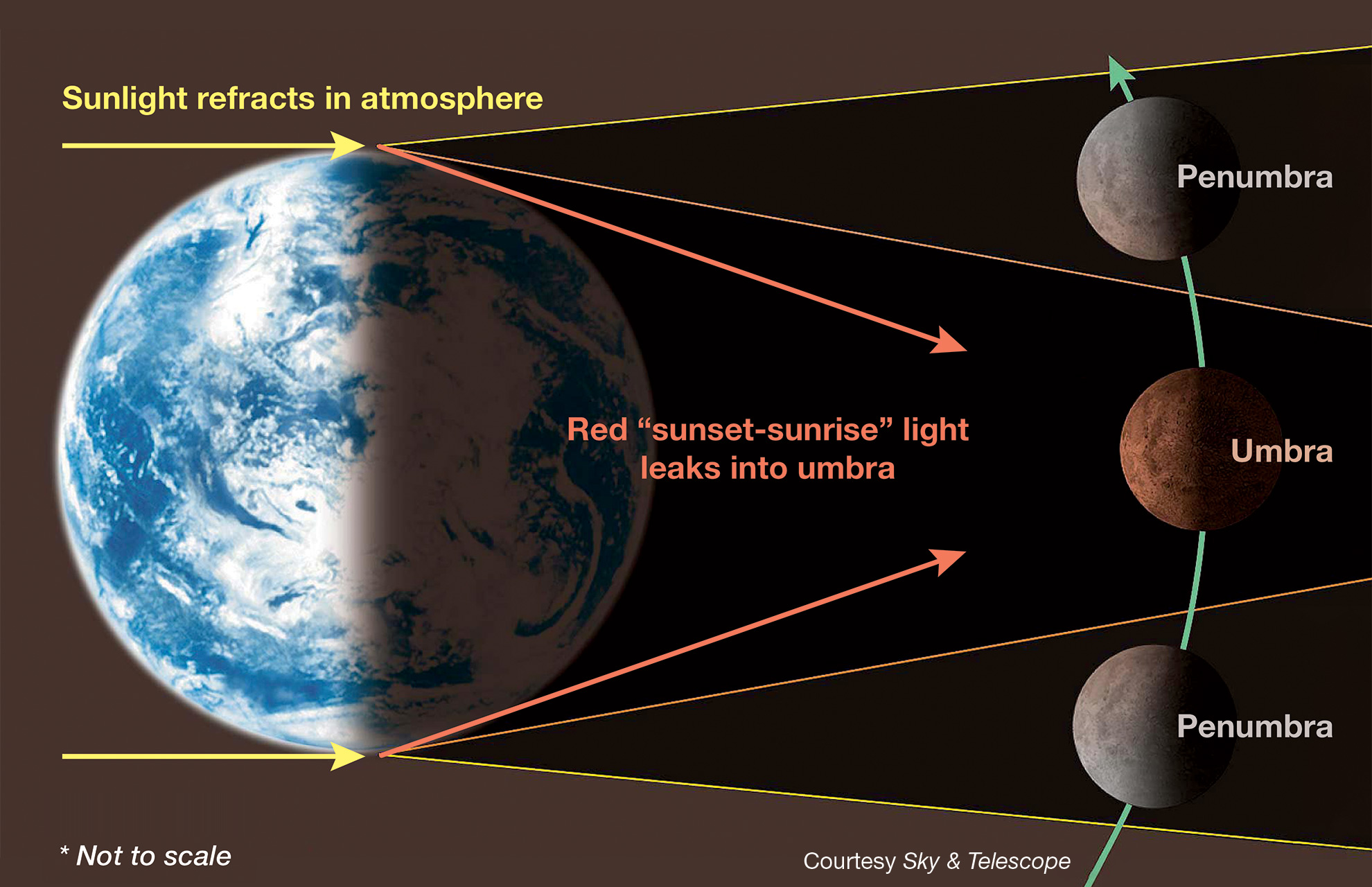 Diagram showing how sunlight refracts in the atmosphere, demonstrating why the Moon’s surface turns dark red during an eclipse. Source: Sky & Telescope
This phenomenon was captured by the Blue Ghost spacecraft, which transmitted images of the Moon’s surface turning red during the eclipse in March 2025.
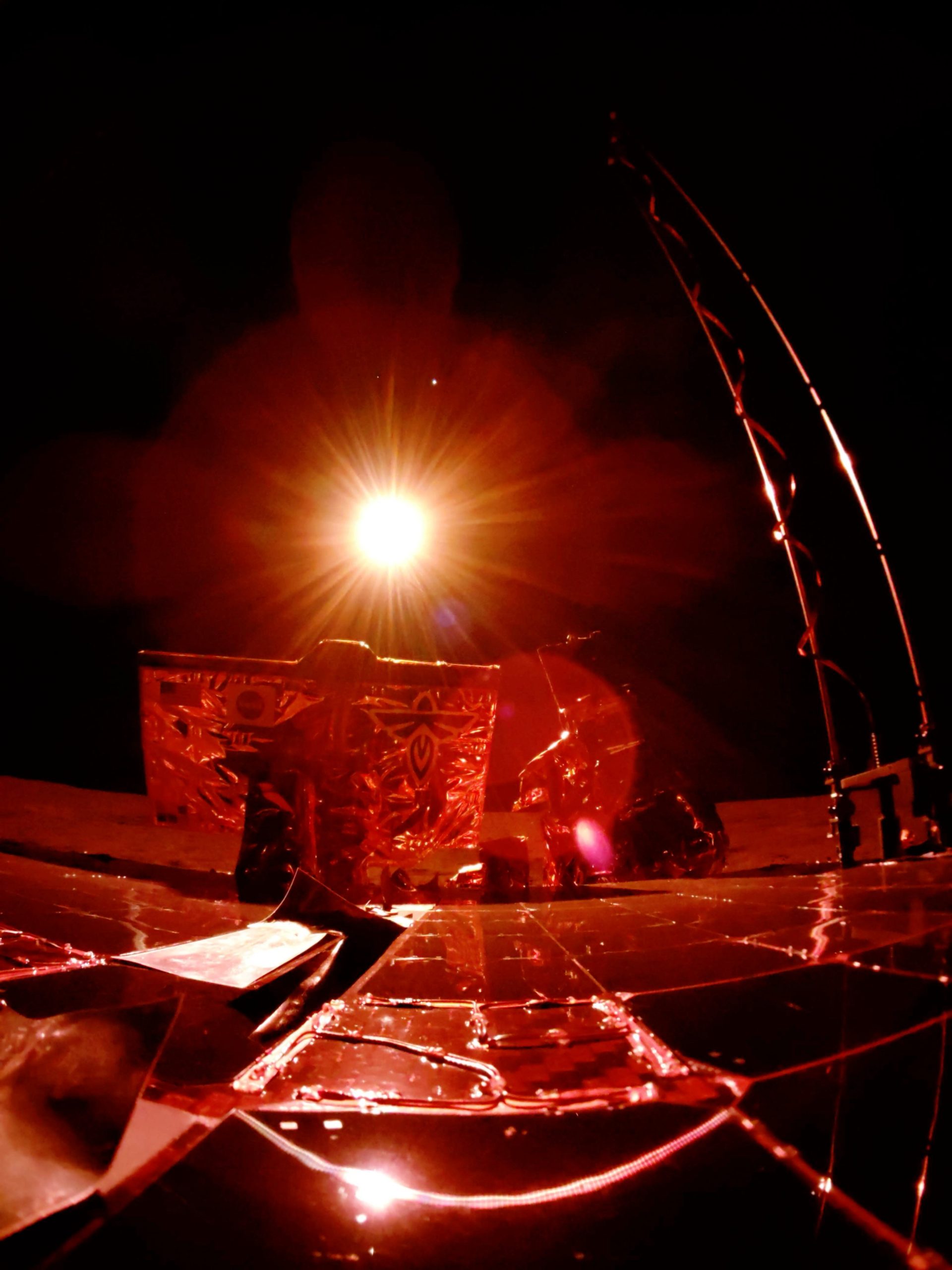 The Moon’s surface turned red during the eclipse in March 2025. The image was taken by the Blue Ghost camera. Source: Firefly Aerospace
Lunar eclipses can only be observed during full moons, when the Sun, Earth, and Moon are aligned. However, they do not occur during every full moon. This is because the Moon’s orbit is tilted at an angle of 5.14° to the ecliptic. Therefore, in most cases, during a full moon, it is either above or below the Earth’s shadow.
Start time of the lunar eclipse
The chronology of the upcoming lunar eclipse in Universal Time Coordinated (UTC) is as follows:
08:44 UTC – start of the penumbral eclipse. At this stage, the Moon will enter the Earth’s penumbra, which will cause a slight darkening of its surface that will be difficult to see with the naked eye;
09:50 UTC – start of the partial eclipse. During this phase, the darkening of the Moon will be clearly visible to the naked eye;
11:04 UTC – start of total eclipse. At this moment, the Moon will be completely hidden in the Earth’s shadow and will turn dark red;
11:33 UTC – maximum phase of the eclipse;
12:02 UTC – end of total eclipse;
13:17 UTC – end of partial eclipse;
14:22 UTC – end of the penumbral eclipse.
In total, the eclipse will last 5 hours and 39 minutes. The duration of the total phase will be 58 minutes. At the moment of the eclipse, the Moon will be 384,000 km away from Earth.
Live broadcast of the lunar eclipse
The total phase of the lunar eclipse on March 3, 2026, will be visible to over 3 billion people living in North and South America, Australia, and much of Asia.
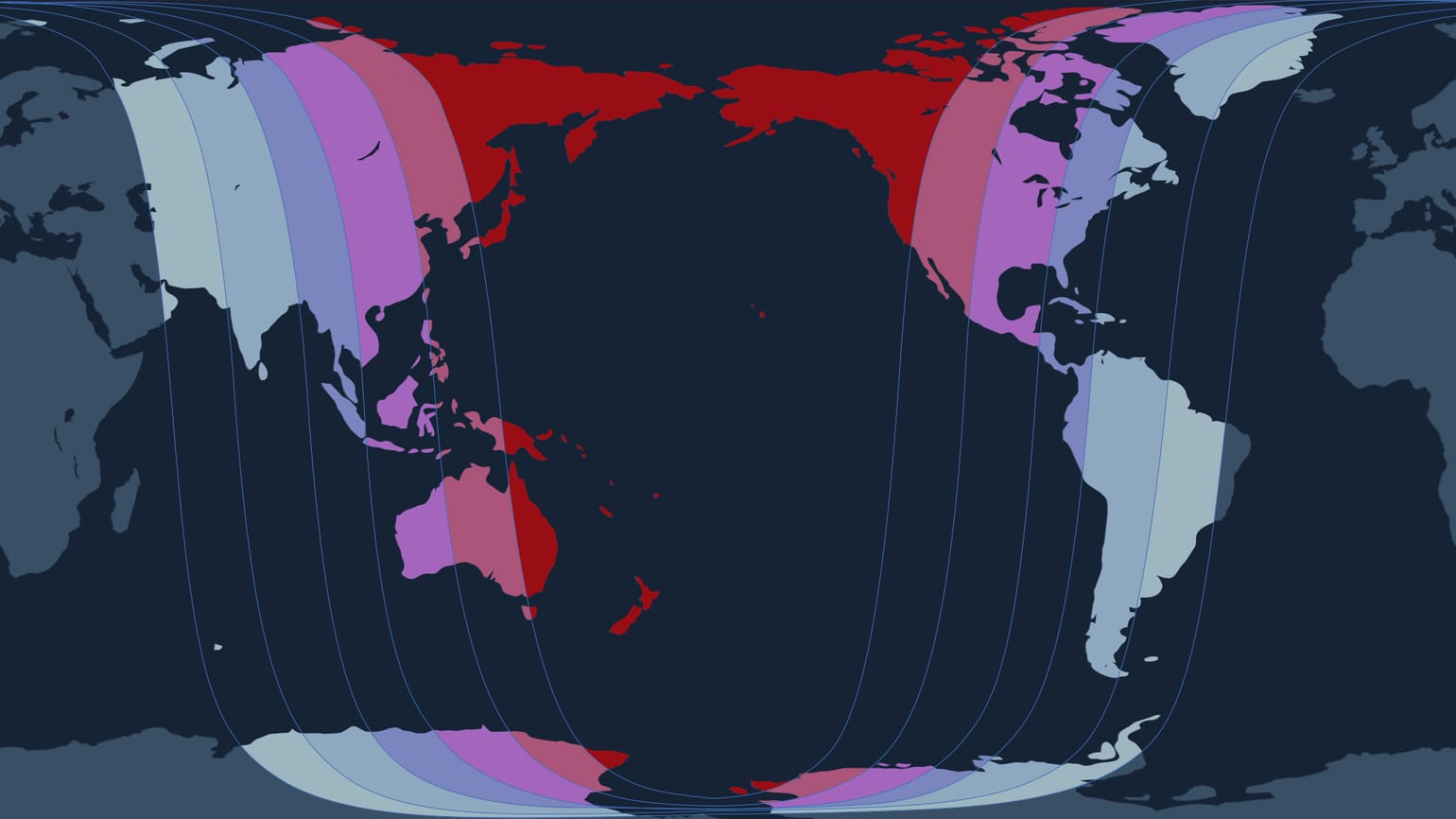 Visibility map of the lunar eclipse on March 3, 2026. Red areas show where the lunar eclipse will be visible from start to finish. Pink and purple areas indicate places where the total eclipse or its maximum phase will be visible, often low above the horizon. Light blue areas indicate regions where only a partial eclipse or penumbral phase will be visible, while dark areas without shading show locations where the eclipse will not be visible at all. Source: Vito Technology
However, residents of Europe, Africa, and the Middle East will not be able to see it live. But they can always use the World Wide Web as an alternative. The eclipse will be broadcast live on YouTube.
As for the next lunar eclipse in 2026, it will take place on August 28, 2026. On this day, the Moon will cover 93% of the Earth’s disk. The eclipse will be fully visible in North and South America, and its individual phases will be observed in Europe and Africa. Residents of Ukraine will be able to see the beginning of the eclipse. By the time it reaches its maximum phase, the Moon will already have disappeared below the horizon.
The following year, 2027, will be even more “modest” – all three of its lunar eclipses will be penumbral. During such eclipses, only one edge of the lunar disk darkens, which is barely noticeable to the naked eye.