
Martian soil contains something that prevents Earth bacteria from surviving in it, and therefore also prevents agriculture. Recently, scientists have discovered that this is possible using tardigrades — tiny living creatures renowned for their endurance.
 Tardigrades. Source: phys.org
Harmful effects of Martian soil
Tardigrades, better known as water bears, may offer a real-world glimpse into how humans could adapt extraterrestrial resources to support space exploration, as well as how such resources could help protect against Earth-based contaminants that humans may carry.
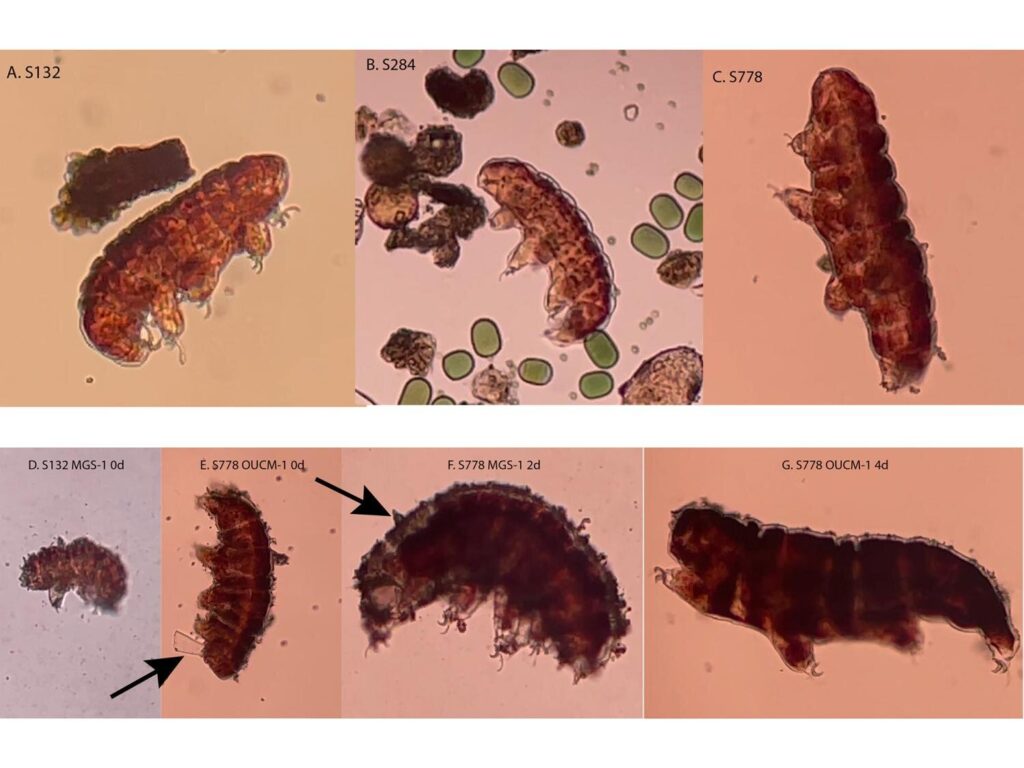
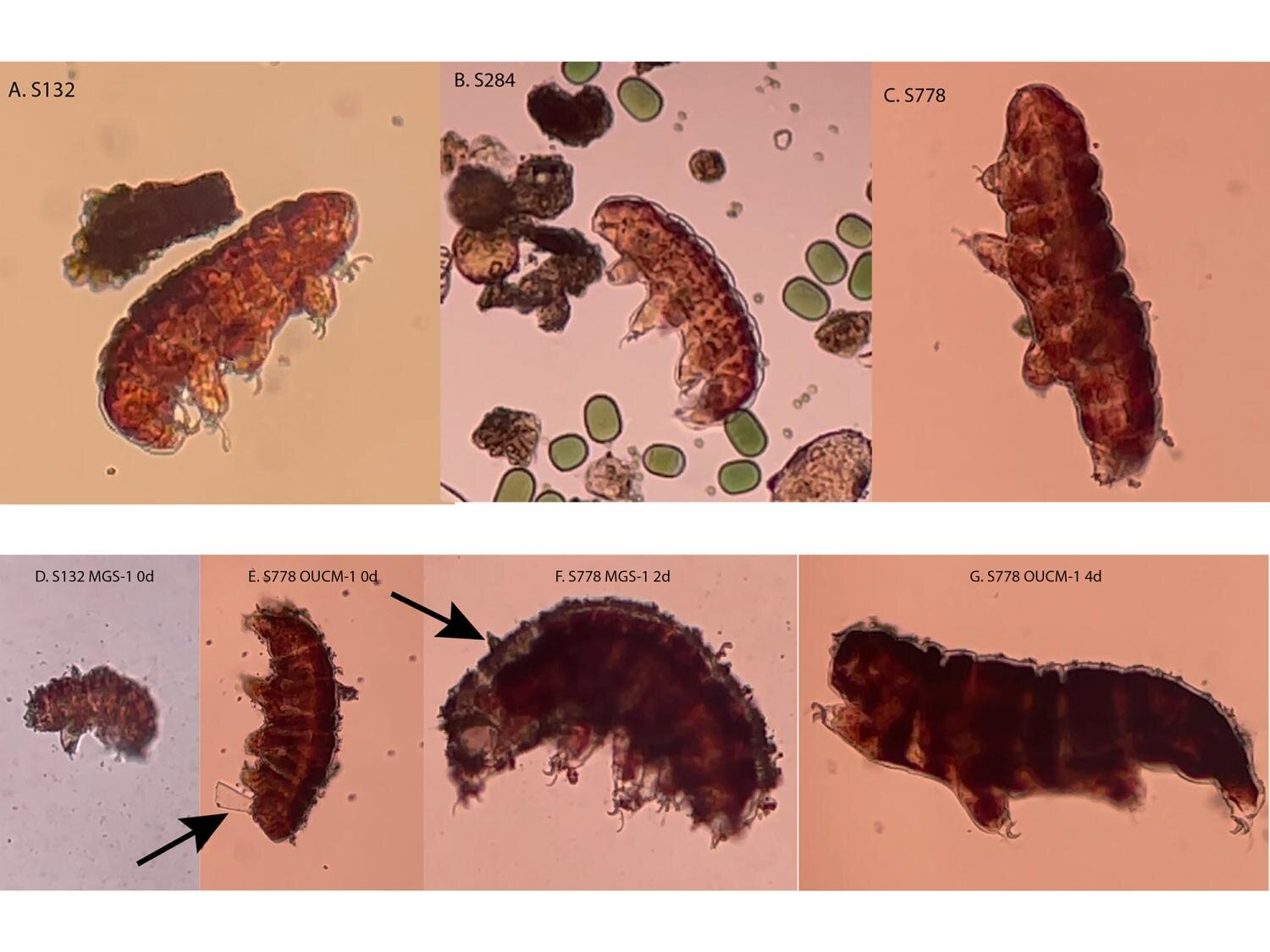
An international team of researchers led by Corien Bakermans, professor of microbiology at Pennsylvania State University in Altoona, recently discovered that the activity of tardigrades — a key indicator of their health — decreased significantly when they were placed in simulated Martian regolith. These are loose mineral deposits covering the bedrock of a planet or moon, similar to soil on Earth. However, simply rinsing the regolith with water before introducing the tardigrades, as it turned out, removed some harmful elements and largely mitigated the impact on their activity.
Bakermans, who coordinates the biological program at Pennsylvania State University in Altoona, says that Martian regolith is not only being considered as a potential resource for growing plants as part of creating a healthy community, but is also being studied as something that may contain inherent harmful conditions that could help protect against contamination.
Why protecting other planets is important
Protecting the planet means protecting extraterrestrial bodies from pollution from Earth and vice versa. It also aims to ensure that scientific research conducted during space expeditions, both by humans and robots, is as free from contamination as possible. This practice has been agreed upon by many countries and is regulated by several space agencies, including NASA.
According to Bakermans, if a planet has its own protective mechanism against extraterrestrial invaders in the regolith covering its surface, this may be one factor that those planning space missions need not worry about. However, such a mechanism would likely mean that people hoping to establish a base would be unable to adapt the regolith for their needs, such as growing food. If the protection is strong enough, it can directly harm people.
“We know a lot about bacteria and fungi in simulated regolith, but very little about how they impact animals—even microscopic animals, like tardigrades,” Bakermans said, explaining that simulated regolith is designed to accurately reproduce the mineral and chemical composition of the Martian surface. “We investigated the specific, isolated impact of the regolith on tardigrades.”
How did Martian soil affect tardigrades?
The researchers used two simulants of Martian regolith, both of which mimic the regolith that NASA’s Curiosity Rover collected from the Rocknest deposit in Gale Crater, south of the planet’s equator. One simulator, MGS-1, was originally developed for use as a “global” regolith representing the surface of the planet as a whole. Another, OUCM-1, was developed later to more accurately mimic a specific sampling area, with a focus on chemical composition in addition to mineral composition.
Bakermans mixed the active slow-movers with samples of each regolith simulator and used a microscope to check their activity levels over several days.
“For the MGS-1 simulant, we saw significant inhibition—reduced activity—within two days,” Bakermans said. “It was very damaging compared to OUCM-1, which was still inhibitory but much less so.”
Trematodes have two states: active and dormant. In an inactive state, usually achieved through severe dehydration, they can survive in the vacuum of space, the depths of the ocean, and almost any other environment. When they become active due to rehydration, tardigrades become more sensitive, but are still able to remain active in low temperatures, changes in food availability, and other challenging conditions. However, tardigrades exposed to MGS-1 showed no activity two days after exposure.
What did the regolith washing reveal?
Scientists were surprised by how harmful the MGS-1 simulator turned out to be. They hypothesized that there might be something specific in it that could be washed away. The researchers washed MGS-1 with water and mixed it with fresh tardigrades. These tardigrades showed almost no loss of activity.
“It seems that there’s something very damaging in MGS-1 that can dissolve in water—maybe salts or some other compound,” Bakermans said, noting that the team is continuing its research. “That was unexpected, but it’s good in a sense, because it means that the regolith’s defense mechanism could stop contaminants. At the same time, it can be washed to help support plant growth or prevent damage to humans who come in contact with it.”
Water is scarce in space, so washing away regolith is not an ideal solution, but Bakermans said that understanding that the harmful component can be washed away is useful for building a knowledge base.
Other factors affecting living organisms on Mars
In addition to studying the influence of specific regolith components, researchers are investigating additional conditions, such as atmospheric pressure and temperature fluctuations, that may affect activity.
“Regolith isn’t the only component, of course,” Bakermans said. “But we’re beginning to tease apart components of this overall system where any single piece could be a drawback or benefit the larger understanding of planetary protection.”
According to phys.org