
After nearly 20 years of continuous operation at an altitude of 5 km in Chile’s Atacama Desert, the Atacama Cosmology Telescope (ACT) has finally completed its scientific mission. But its final “gift” to humanity — the last and most accurate data package — is prompting scientists around the world to seek new answers to old questions. The results are published in articles in the Journal of Cosmology and Astroparticle Physics.
The main object of ACT’s research was the relic cosmic microwave background (CMB) — a kind of “radio echo” of the Big Bang, which allows us to look back to a time when our Universe was only 380,000 years old. While ESA’s Planck telescope had previously created a general map of the temperature of this light, ACT achieved the impossible: it discerned its polarization with unprecedented clarity.
“It’s like wiping dusty glasses,” jokes cosmologist Erminia Calabrese from Cardiff University. Thanks to the six-meter mirror, the new images of polarized light turned out to be much more detailed than ever before. This allows scientists not only to see, but also to understand the physical processes that took place in the early stages of our Universe.
Space scandal continues
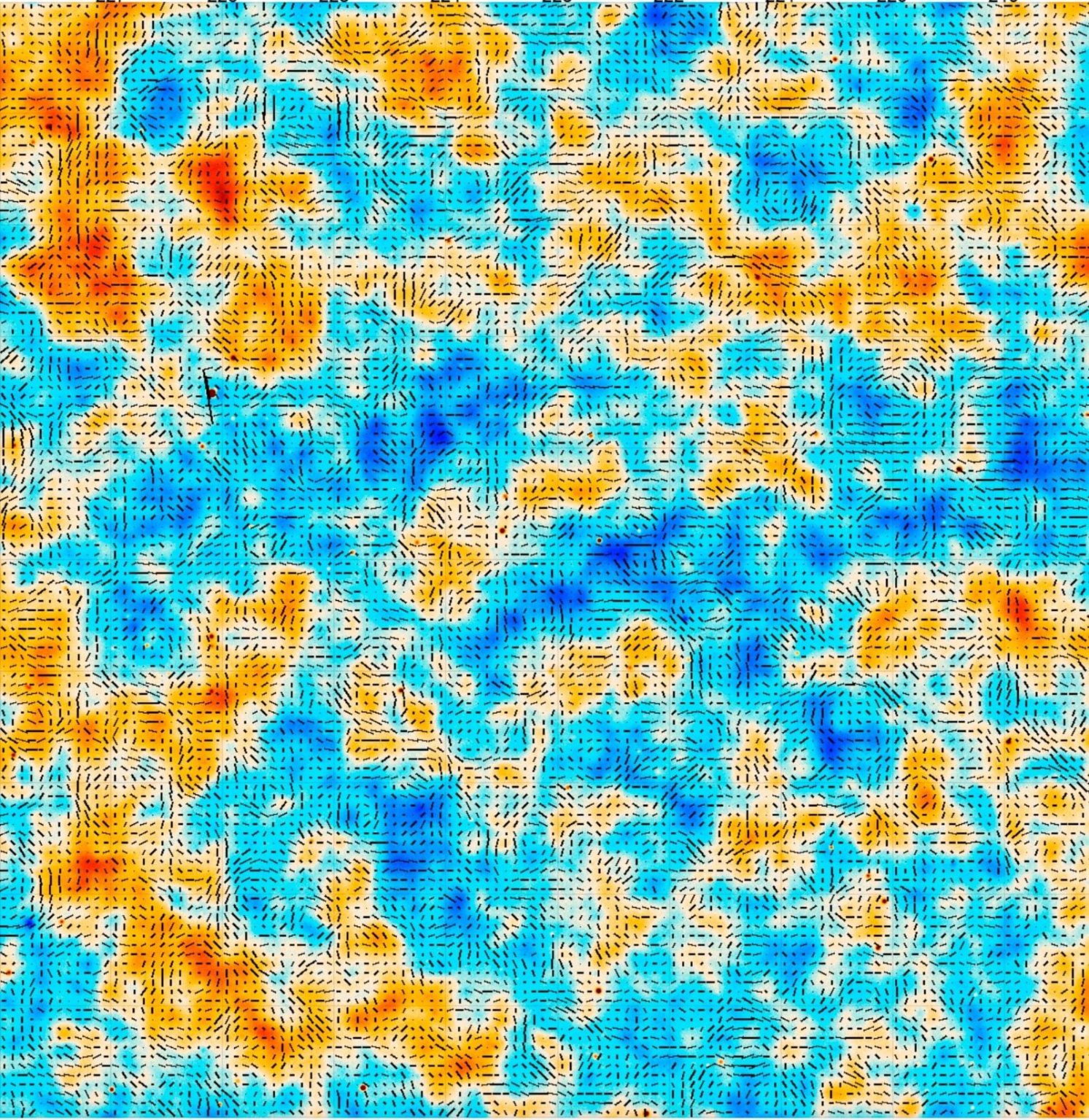 Polarization vectors on the intensity map. Data taken from the co-registered ACT DR6+Planck f090+f150 map to maximize signal-to-noise ratio, with ACT dominating the polarization. The TE correlation is low and changes sign depending on the scale, so no clear correspondence between intensity and polarization is expected. Authorship: ACT Collaboration
The biggest headache for cosmologists is the so-called “Hubble tension.” The essence of the problem is simple, but the data differs: scientists cannot accurately determine the rate at which the Universe is expanding.
The first method looks at relic radiation and calculates the expansion rate for the early Universe.
The second method measures distances to modern galaxies and supernovae.
The problem is that these two “speedometer” readings show different speeds. The ACT data not only confirmed this discrepancy, it made it even more obvious. The Hubble constant derived from ACT polarization data perfectly matches Planck data, but categorically refuses to align with measurements of the local Universe. This means that either we are mistaken in our calculations of the distances to neighboring galaxies, or, more interestingly, our theory of space-time needs a serious update.
The funeral of alternative theories
Of course, scientists did not sit idly by and proposed dozens of “extended” models that were supposed to reconcile these two dimensions. They attempted to add new particles, alter the properties of dark energy or gravity.
However, the ACT team put these theories through a real crash test. They tested about 30 different models based on new data. The result was devastating.
“They’re goned,” Calabrese states. “We weren’t trying to knock them down, only to study them. And the result is clear: the new observations, at new scales and in polarization, have virtually removed the scope for this kind of exercise.”
What next?
The ACT campaign is complete, but the telescope’s scientific life is just beginning. Scientists deliberately released all the data so that the cosmological community could study it from different angles.
“We’ve provided the first interpretation; now it is up to others to respond,” conclude the authors of the study. And who knows, perhaps it is precisely the analysis of these latest “photographs” of the Universe’s childhood that will help find a crack in the Standard Model and open the door to new physics.
Earlier, we reported on how distorted galaxies brought us closer to the mystery of the expansion of the Universe.
According scitechdaily.com