
 Credit: MaiaSpace
During an event at the Guiana Space Centre on 24 February, ArianeGroup subsidiary MaiaSpace announced that the inaugural flight of its two-stage Maia rocket will take place in 2027, slipping from a previously expected late-2026 launch.
Founded in 2022, MaiaSpace is developing a two-stage partially reusable rocket that will be capable of delivering up to 1,500 kilograms into low Earth orbit when launched in a fully expendable configuration. The company is also developing a kick stage that is expected to add as much as 1,000 kilograms to the rocket’s performance.
In January, MaiaSpace confirmed that it was targeting an initial suborbital demonstration flight of its Maia rocket in late 2026. While the launch will use a full two-stage configuration of the rocket, it will carry a reduced propellant load to reach a minimum altitude of 100 kilometres, the generally accepted boundary between Earth’s atmosphere and space known as the Kármán line. The company told European Spaceflight at the time that the vehicle represented “a minimum viable product designed to test critical phases.”
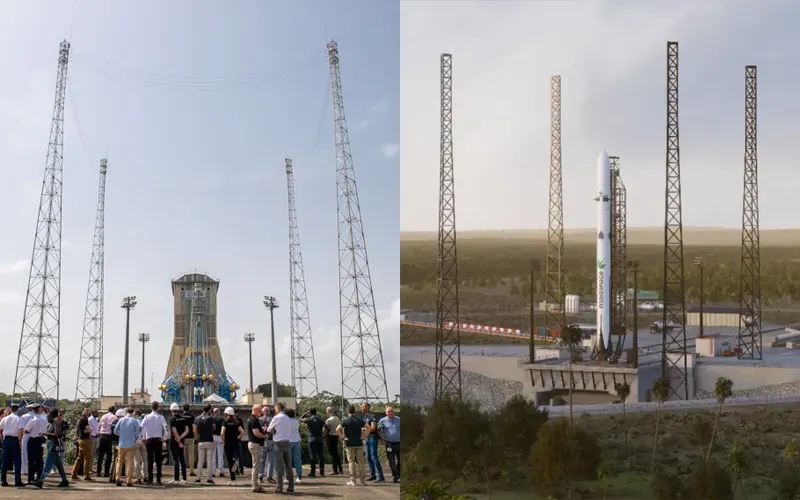
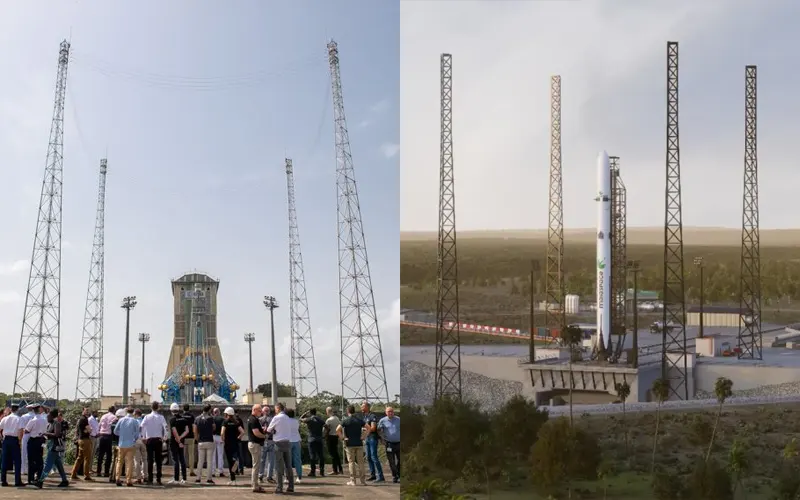
On 24 February, representatives from MaiaSpace, local authorities in Kourou, and the French space agency CNES gathered at the site of the former Soyuz launch facility at the Guiana Space Centre to sign a Temporary Public Domain Occupancy Agreement. This allows MaiaSpace to begin dismantling Soyuz-specific infrastructure that will no longer be required before starting construction of the modifications needed to launch Maia rockets from the site.
During the event, Maia officials revealed that they expected to host the inaugural flight of Maia from the facility in 2027. When asked for comment by European Spaceflight, a representative explained that the company remained committed to launching its first rocket less than five years after the company’s creation.
“We remain committed to our goal of achieving a first launch less than five years after the company’s creation i.e., April 2027. Our internal objective is even more ambitious: to have a launcher vertically mounted on the launch pad before the end of 2026 in order to conduct combined tests prior to our first flight. Maintaining this roadmap will not be without challenges and difficulties, but it is inherent to our iterative learning method, which places ground and flight testing at the heart of the development process to go faster.”
The Soyuz launch facility in French Guiana has been abandoned since 2022 after the European Space Agency cut ties with Russia following its invasion of Ukraine. In April 2024, CNES published an opportunity for a commercial operator to take over the site, and MaiaSpace was awarded the right to redevelop the facility in September 2024.
According to MaiaSpace, the company began work on the site’s adaptation last year. The company expects to reuse up to 80% of the existing infrastructure, including the integration building, railway, liquid oxygen storage and refueling facilities, and the flame trench. Speaking to European Spaceflight, the MaiaSpace representative explained that this approach would allow the company to move quickly and limit its total investment into the site to “a few tens of million euros.” This is intended to “ensure economic viability, and to limit our environmental impact.”
Keep European Spaceflight Independent
Your donation will help European Spaceflight to continue digging into the stories others miss. Every euro keeps our reporting alive.