
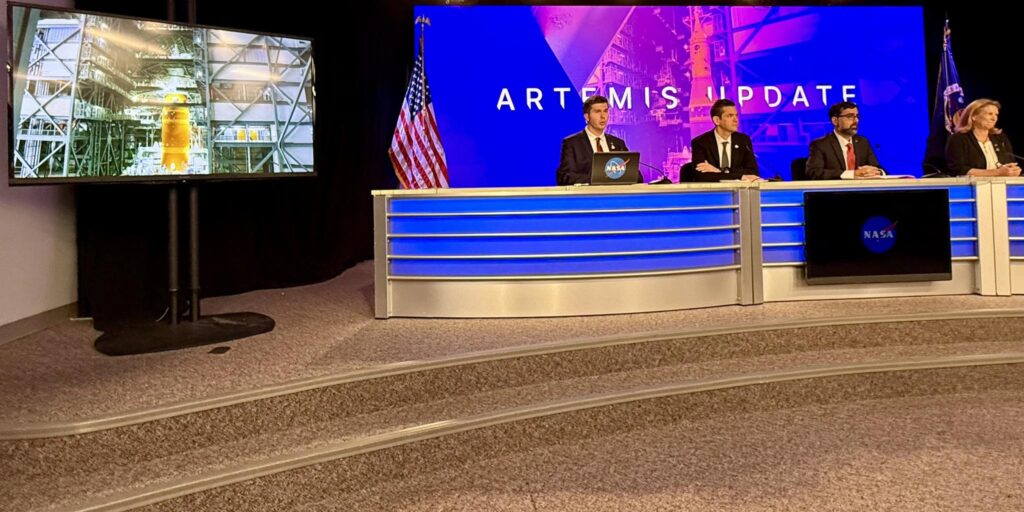
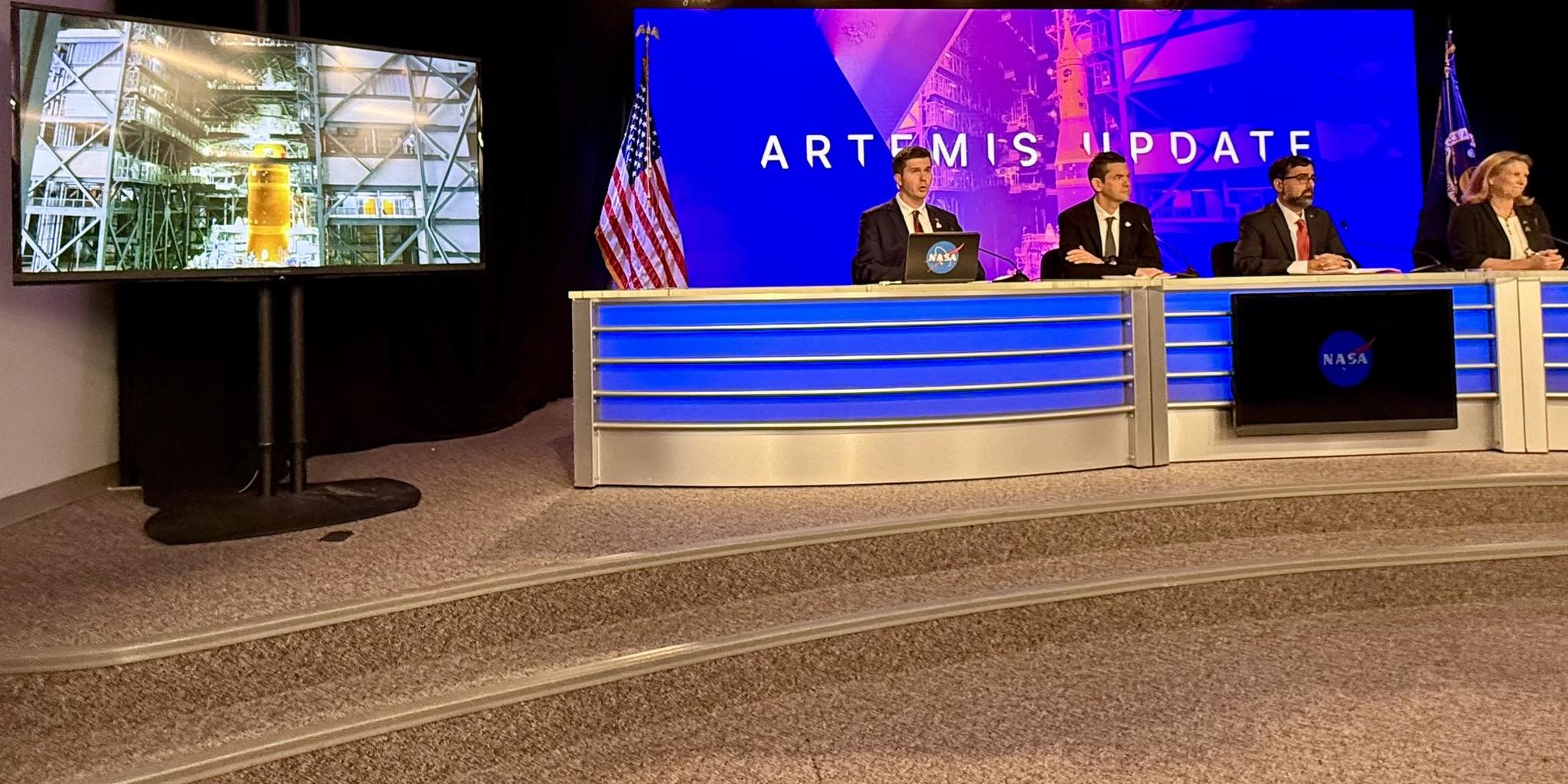
 NASA Artemis News Conference video streamed live on Feb 27, 2026 from Kennedy Space Center Press Site in Florida. Credit: Ken Kremer
At a news conference at the Kennedy Space Center press site held on February 27, 2026, NASA Administrator Jared Isaacman announced sweeping changes to Project Artemis – increasing the flight cadence for the SLS and Orion moon rocket by adding another test flight to improve resiliency and reliability, as well as changing the goals of future missions. Artemis III will have a different goal, while NASA is changing the mission order to insert the additional hardware test flight.
Artemis III will now be conducted similar to Apollo 9 – a test flight to rendezvous and dock with a commercial human lunar lander in Earth orbit – from either SpaceX and/or Blue Origin in mid to late 2027, whichever is ready for rendezvous and docking with the Orion crew capsule.
Ideally both would be available during the same Orion test flight with a crew of astronauts yet to be named.
Lunar landers supplied by Blue Origin and/or SpaceX will not take crews to the Moon’s surface until Artemis IV and V in 2028 and beyond.
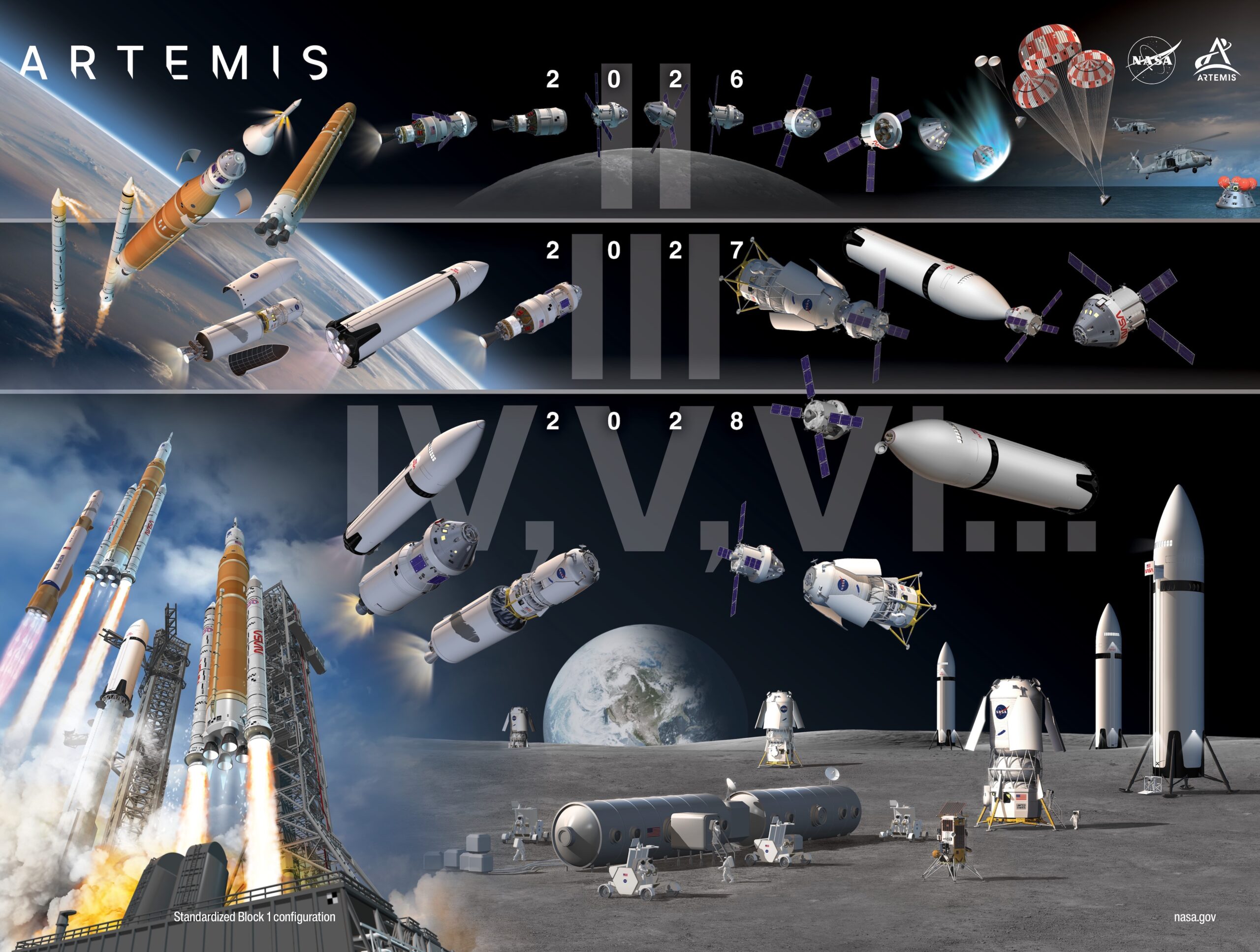 A graphic illustrating NASA’s increased cadence of Artemis missions. Credit: NASA
Isaacman hopes to increase the Artemis SLS Orion flight rate to at least once per year vs a single launch every 3.5 years as is currently – so that teams stay focused, active, primed and ready, and so that learned skills don’t atrophy.
By launching annually, NASA hopes to rebuild core competencies in the civil servant workforce including more in-house and side-by-side development work with the agency’s Artemis partners, enabling a safer, more reliable, and faster launch cadence.
SLS and Orion will be standardized into a near Block 1 configuration so that each is not a ‘work of art’ as Isaacman stated to make them more reliable and robust.
NASA will forgo improvements to Block 1B and Block 2 configuration and is apparently cancelling the much more powerful Boeing EUS or Exploration upper stage – at last for now.
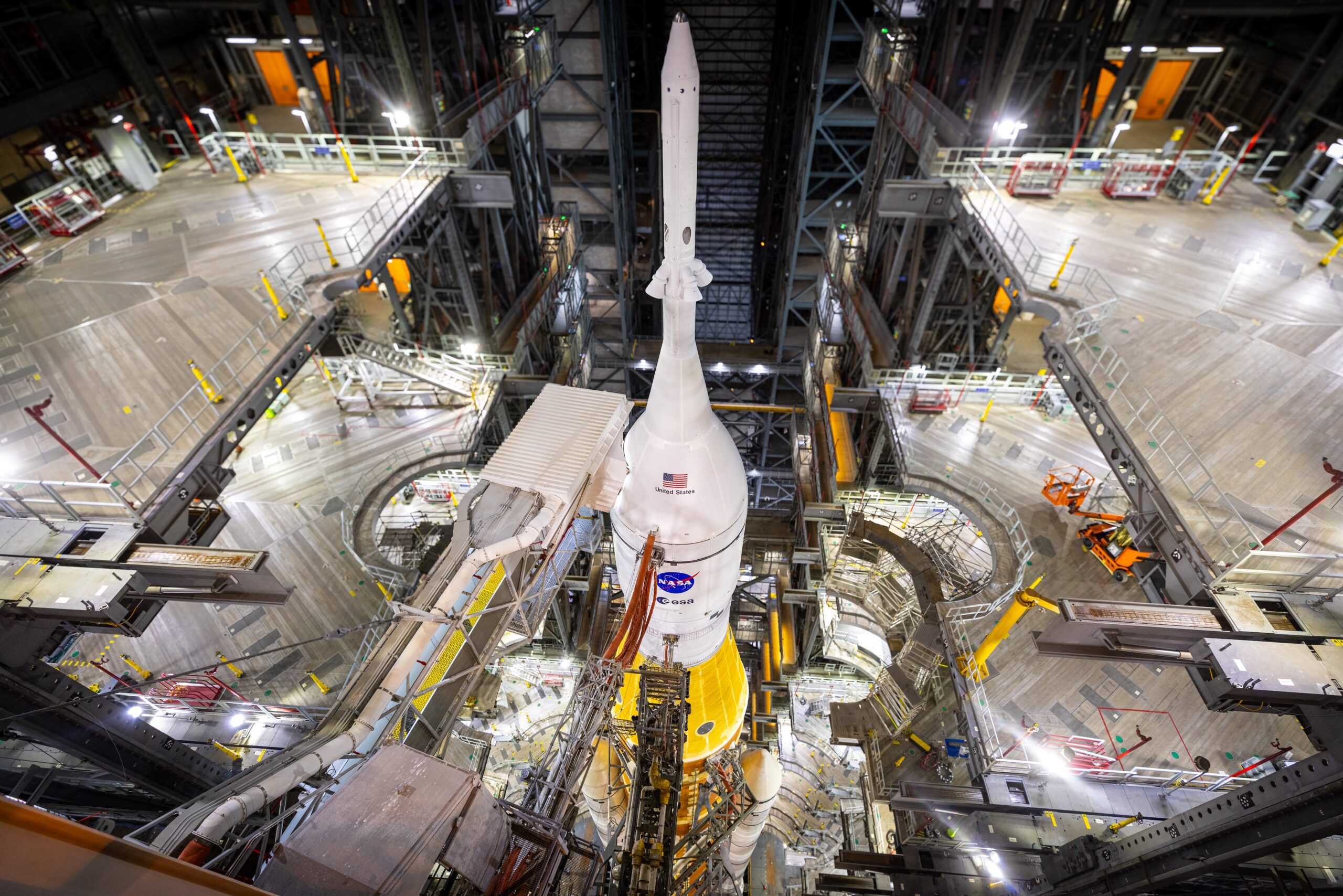 In this view looking down in High Bay 3 inside the Vehicle Assembly Building on Jan. 17, 2026, the work platforms are retracted around NASA’s Artemis II SLS rocket and Orion spacecraft in preparation for rollout to the launchpad. The same rocket architecture will be used in future missions as well. Credit: NASA/Frank Michaux
“After successful completion of the Artemis I flight test, the upcoming Artemis II flight test, and the new, more robust test approach to Artemis III, it is needlessly complicated to alter the configuration of the SLS and Orion stack to undertake subsequent Artemis missions,” said NASA Associate Administrator Amit Kshatriya. “There is too much learning left on the table and too much development and production risk in front of us. Instead, we want to keep testing like we fly and have flown. We are looking back to the wisdom of the folks that designed Apollo. Therefore, we want to fly the landing missions in as close to the same Earth ascent configuration as possible – this means using an upper stage and pad systems in as close to the ‘Block 1’ configuration as possible.”
The once-planned Gateway which was slated to be the first space station orbiting the Moon, seems to be on hold for now to focus on the lunar landings and to establish a lunar base.
This article originally appeared on Space UpClose. It has been edited for our use.

Dr. Ken Kremer is a speaker, freelance science journalist, scientist and photographer (Princeton, NJ) whose articles and space exploration images have appeared on TV, magazines, books and on websites. Ken has presented at numerous educational institutions, civic & religious organizations, museums, conventions and astronomy clubs. Ken lectures on both Human and Robotic spaceflight. Ken has a PhD in Organic Chemistry and over 25 years of Research & Development and Manufacturing experience in the US, Europe & South America. Ken has written over 600 articles. He has 3 dozen scientific publications including 17 US Patents. He has witnessed about 3 dozen Space Shuttle & rocket launches. Ken has been a science & space consultant to NASA, JPL and various news organizations across the US, Europe and Asia.