
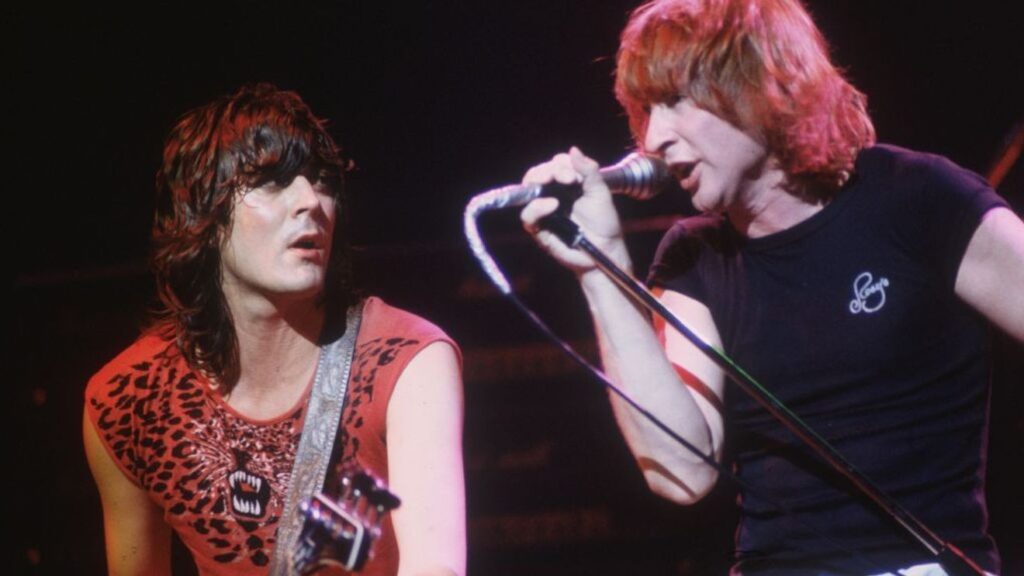
It’s easy to call UFO’s 1981 album The Wild, The Willing and The Innocent a classic, but numbers and time back it up.
Originally released on January 16, 1981, the band’s ninth studio LP climbed to No. 77 on the Billboard 200 and #19 on the UK Albums Chart, a solid showing amid a crowded hard rock landscape. Its single “Lonely Heart” broke into the UK Top 50 at No. 41, giving the postMichael Schenker era some mainstream traction.
Now, 45 years later, the album gets a deluxe reissue, remastered and expanded with a previously unreleased live set from London’s Hammersmith Odeon.
Ahead of the May 1 release, I caught up with lead singer Phil Mogg to talk about the making of the record, the band’s evolution, and why it still resonates today.
Making The Wild, The Willing and The InnocentWe came off the back of doing No Place to Run I think we were a bit restless in terms of going into the studio with a producer and using the same format we’d used before,” Mogg remembers. “So we managed to twist Chrysalis’ arm, bless them, and say, can we go and do this album our own way, with an engineer and no producer. And they said yes.
The result, he says, was one of the most enjoyable experiences of the band’s career. “Out of most of the albums we’ve done, I’d say that comes up as the most fun in terms of getting it together and doing it. It was a really enjoyable record.”
That freedom gave UFO room to experiment. “Yeah, well, let’s use the word ‘control’ loosely,” Mogg laughs. “But we managed to retain the party atmosphere.” Strings, keyboards, and layered arrangements pushed the band beyond straight-ahead hard rock. “It was more cinematic than it might have been. Rather than just cut-and-dry numbers. It was like, well, let’s try it. If it goes wrong, I’ll blame you.”
A band forged in fire
Formed in London in 1969, UFO began as a blues-tinged hard-rock outfit led by Mogg alongside guitarist Mick Bolton and bassist Pete Way. Early albums UFO 1 (1970) and UFO 2: Flying (1971) built a cult following, but it wasn’t until German guitar prodigy Michael Schenker joined in 1973 for Phenomenon that the band’s identity fully locked in.
Schenker’s razor-sharp guitar work and Mogg’s melodic snarl powered a run of classics including Force It (1975) and No Heavy Petting (1976). The 1977 live album Strangers in the Night captured UFO at their creative and commercial peak, cementing their reputation as one of hard rock’s most formidable live acts.
Schenker’s departure in 1978 marked the end of an era. Guitarist Paul Chapman stepped in, while keyboardist/guitarist Paul Raymond eventually exited, making room for multi-instrumentalist Neil Carter. Through lineup changes and shifting trends, songs like “Doctor Doctor,” “Only You Can Rock Me,” and “Lights Out” endured , proof of UFO’s knack for marrying melody with muscle.
A new energy
Carter’s arrival proved crucial to The Wild, The Willing and The Innocent. “He was like a breath of fresh air,” Mogg says. “Funny, easy to get along with, and he could play everything and sing. You’d say, ‘Can you play that on sax?’ and he’d go, ‘Yeah,’ and do it really well.”
Carter’s versatility broadened the band’s sonic palette and helped define the album’s more expansive feel. “He was a great plus,” Mogg adds. “And I’m still playing with him to this day, so we’ve remained friends all this time.”
Lyrically, tracks like “Profession of Violence” reflected Mogg’s fascination with crime and history. “There were a few books back then — one called Profession of Violence about the Kray twins in the East End in the ’50s,” he says. “That was the root, the seed of writing the lyric.”
Revisiting the classics
The reissue doesn’t just polish the original album. It expands the picture. A newly mixed Live at Hammersmith Odeon, recorded January 29, 1981, captures UFO at full throttle.
I think we were firing on all six by the time we got to Hammersmith,” Mogg says. “So it should be pretty tight.
Looking back, he views The Wild, The Willing and The Innocent as a creative high point for the post-Schenker lineup. “Michael would end Strangers in the Night and this would come up as our pinnacle with Paul,” he says. “He’d have a few drinks and say, ‘Let’s do this.’ It’s remarkable what you can do with a bottle of Jack Daniel’s and a guitar. He was a shining light.”
Experimentation defined the sessions. “The stripped-down, raw stuff we’d done before. We were looking for something different,” Mogg says. “We were just screwing around trying to find another way to go. And that was Wild and the Willing. You’ve got time in the studio, so you play around. If it worked, it worked. If it didn’t, it didn’t. That freedom was everything.”
Legacy and impact
At the time, The Wild, The Willing and The Innocent received mixed reviews, with some critics unsure of its more polished direction. In hindsight, tracks like “Couldn’t Get It Right,” “Lonely Heart,” and “Long Gone” are often cited as underrated highlights, songs that reveal a band evolving without losing its edge.
For Mogg, the album’s endurance comes down to instinct.
Rock music. If it hooks you, you know,” he says. “Like when you’re a kid and you find something and go, ‘Ah, this is it.’ And it doesn’t leave you.
The deluxe reissue from Chrysalis Records includes remastered audio across 3LP 180-gram vinyl and a 2CD Digipak, original 7-inch edits, alternate mixes, and the full Hammersmith live set, alongside new liner notes by Michael Hann and previously unseen photographs, making it essential listening for longtime fans and a compelling entry point for newcomers.
CLICK HERE to pre-order.