
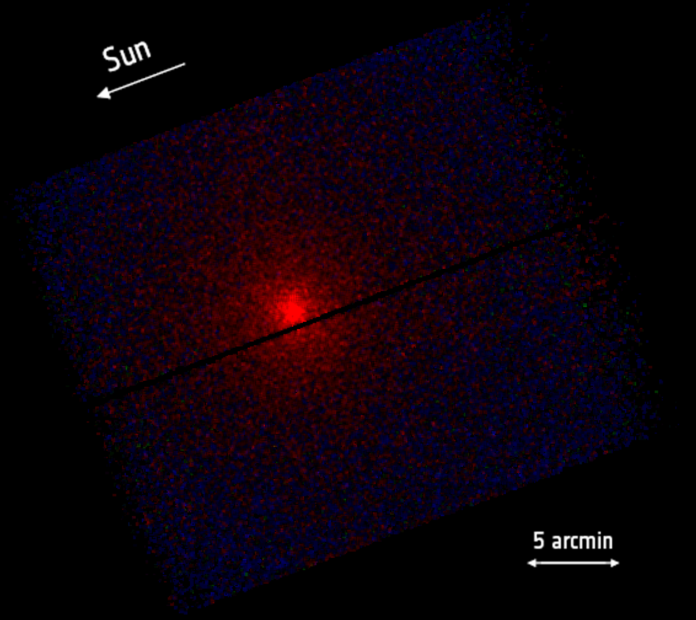
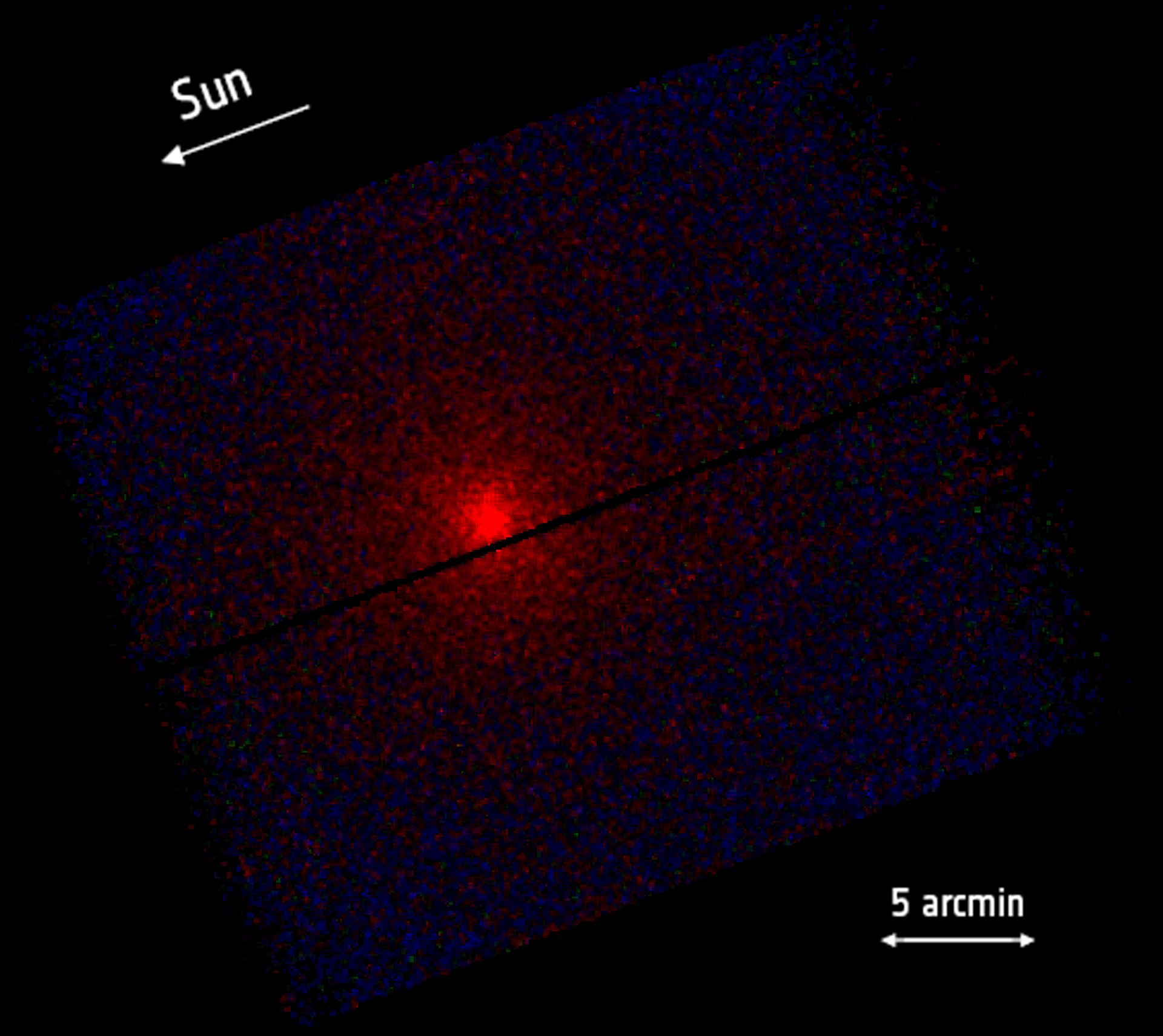
 Image credit: European Space Agency (ESA) / XMM-Newton. Used for editorial reporting purposes under 17 U.S.C. §107 (Fair Use).
In December 2025, the European Space Agency’s XMM-Newton observatory captured a 20-hour X-ray exposure of interstellar object 3I/ATLAS while it was roughly 282–285 million kilometers away. At the time, the image was published with straightforward scientific context: a comet interacting with the solar wind, producing expected low-energy X-ray emissions.
But fewer than 60 days later, advances in publicly accessible forensic image analysis tools — combined with interdisciplinary analytical frameworks drawn from both astrophysics and legal evidentiary standards — have reopened scrutiny of that exposure.
The question is no longer just what ESA saw.
It is whether we have fully interpreted what it means.
The Timeline
On 3 December 2025, ESA’s XMM-Newton spacecraft observed 3I/ATLAS using its EPIC-pn camera, the observatory’s most sensitive X-ray detector. The resulting image showed a bright red X-ray core surrounded by gradients of purple and blue. ESA explained the glow as solar wind charge exchange — a well-known phenomenon when solar particles collide with cometary gases such as water vapor, carbon dioxide, or carbon monoxide.
Scientists noted that X-ray analysis is uniquely sensitive to gases like hydrogen (H₂) and nitrogen (N₂), materials that optical and ultraviolet telescopes struggle to detect.
The release was scientifically sound. No controversy followed.
Until now.
What Changed
Forensic imaging software available in early 2026 allows deeper pixel-level interrogation than what was publicly applied in December. Advanced rotational gradient filtering, spectral density mapping, and anomaly clustering algorithms — commonly used in satellite intelligence and digital evidence authentication — have now been applied independently by analysts reviewing the XMM-Newton dataset.
While the underlying ESA data remains unchanged, the interpretive tools have matured.
That distinction matters.
In criminal forensics, a photograph is not static evidence. It is a dataset. Contextual enhancement, pixel differentiation, artifact separation, and noise discrimination can reveal patterns not initially recognized.
The same principle applies here.
The Anomalies Under Review
Using high-resolution contrast amplification and vector gradient modeling, several unusual characteristics in the 3I/ATLAS X-ray emission pattern warrant further examination:
First, the red X-ray concentration appears asymmetrically elongated relative to expected isotropic solar wind interactions at that heliocentric distance.
Second, intensity dispersion gradients show micro-variability inconsistent with uniform outgassing models. While solar wind flux can vary, clustering appears structured rather than random.
Third, the detector gap — the thin horizontal line dividing the rectangular frame — reveals subtle continuity across the gap region that suggests emission persistence rather than instrumental artifact.
None of these observations establish extraordinary conclusions.
But they complicate simple ones.
The Scientific Context
X-ray emission in comets occurs when highly charged solar wind ions strip electrons from neutral gases escaping the nucleus. The resulting charge exchange produces soft X-rays detectable by instruments like XMM-Newton’s EPIC-pn camera.
3I/ATLAS has already shown signs of containing volatile compounds, including water vapor and carbon-bearing molecules, consistent with cometary composition.
However, X-ray sensitivity to hydrogen and nitrogen has renewed comparisons to theoretical models proposed after 1I/ʻOumuamua’s 2017 passage — including hypotheses suggesting exotic ice compositions.
While no mainstream institution has suggested artificial origin or technological structure, the renewed forensic analysis underscores something more subtle:
We may not yet fully understand the compositional heterogeneity of interstellar bodies entering our solar system.
The Core Question
Is this: