
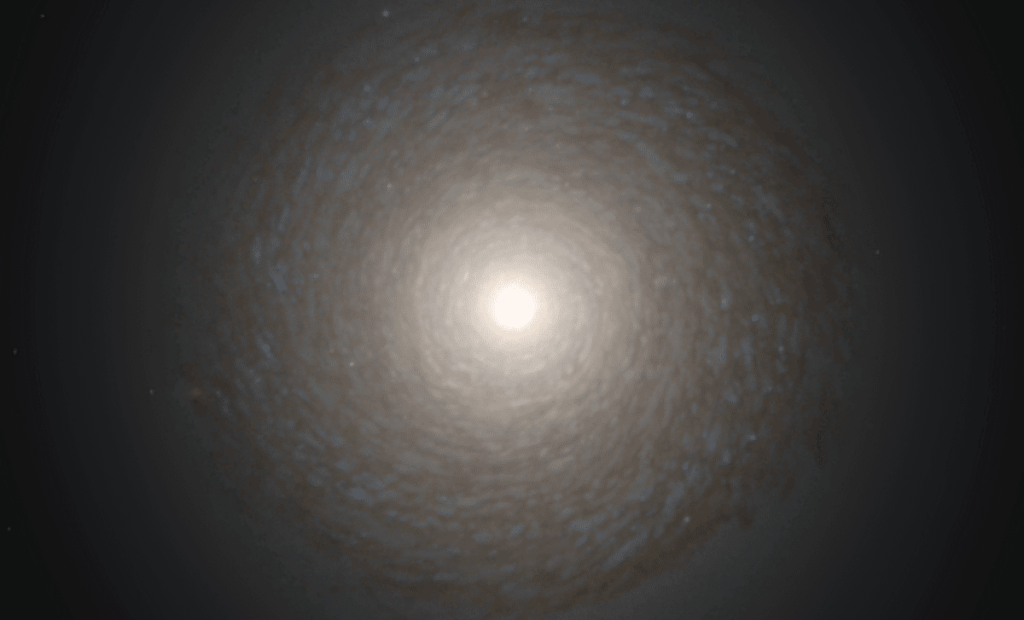
Molecular gas is a key component in the evolution of galaxies, influencing both their star formation and overall structure. Giant molecular clouds (GMCs), composed primarily of molecular hydrogen, are the regions where new stars are born. A detailed study of NGC 1387, an early-type lenticular galaxy in the Fornax Cluster, used ALMA to examine the properties of its molecular clouds. This research, published in the Monthly Notices of the Royal Astronomical Society, provides new insights into the molecular gas content of the galaxy, enhancing our understanding of how these clouds interact with the galaxy’s dynamics and star formation processes.
NGC 1387: A Galaxy Worth Studying
NGC 1387 is an early-type lenticular galaxy with a size of about 60,000 light years and a mass of approximately 50 billion solar masses. Unlike spiral galaxies, early-type galaxies like NGC 1387 have a smoother, more symmetric structure, making them an intriguing subject for astronomers. Previous studies have shown that this galaxy contains roughly 320 million solar masses of molecular gas. In addition, its molecular gas disk exhibits a regular, smooth rotation pattern, which is a key feature in understanding the galaxy’s overall dynamics.
One of the most fascinating discoveries from the new study is that the molecular gas and stars in NGC 1387 appear to co-rotate, meaning that the molecular gas is tightly integrated into the galaxy’s rotational motion. This observation is essential for understanding the galaxy’s star formation rate and the role of gas in regulating it. The star formation rate in NGC 1387 has been estimated to range from 0.008 to 0.082 solar masses per year, a relatively low rate compared to more actively forming galaxies. However, it is still significant in understanding the processes that govern star formation in galaxies with low activity.
ALMA’s High-Resolution Observations Reveal Surprising Details
The research team utilized ALMA to obtain high-resolution observations of the molecular gas in NGC 1387, as part of the mm-Wave Interferometric Survey of Dark Object Masses (WISDOM) project. ALMA’s advanced capabilities allowed the astronomers to identify and analyze a large sample of 1,285 giant molecular clouds within the galaxy. These clouds have an average radius of approximately 65 light years and an average mass of 316,000 solar masses.
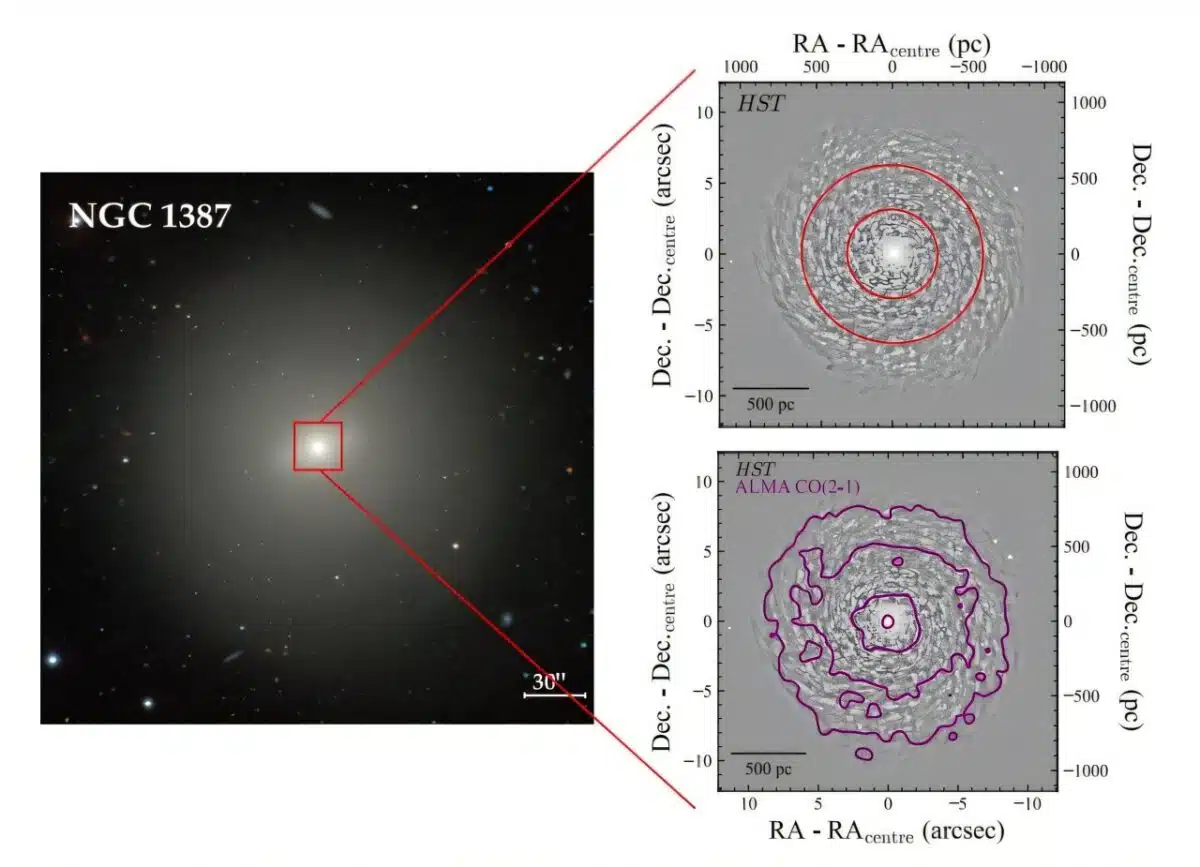 Overview of NGC 1387 and its molecular gas content. Left: optical image from the CGS survey. Top-right: unsharp-masked HST ACS/WFC F475W image of the central region only, highlighting dust features. The red ellipses overlaid indicate the boundaries of the three regions. Bottom-right: the same unsharp-masked HST ACS/WFC F475W image, with the contours of the (smoothed) CO(2-1) total intensity map overlaid in purple. A scale bar is provided in each panel.
Credit: Liang et al., 2026.
What makes these results particularly significant is the level of detail ALMA provided, allowing for a more nuanced understanding of the structure and behavior of GMCs. By mapping the molecular gas distribution, the study was able to offer a detailed look at the spatial arrangement of these clouds and their relationship with the galaxy’s large-scale rotation. This insight is crucial in understanding how molecular clouds interact with their galactic environment and how their internal dynamics can influence star formation.
The Mass Spectrum of GMCs in NGC 1387
One of the key aspects of the study was the analysis of the mass spectrum of the GMCs in NGC 1387. The team found that the mass distribution of these clouds follows a slope of −1.8, which is similar to that observed in the Milky Way’s disk. This suggests that, although the GMCs in NGC 1387 have a different evolutionary context, their mass distribution behaves similarly to those in other spiral galaxies.
Moreover, the study, published in the Monthly Notices of the Royal Astronomical Society, highlighted a distinct cut-off mass of around 1.5 million solar masses, indicating a lack of extremely high-mass GMCs in NGC 1387. This characteristic is notably similar to the GMCs observed in the outer regions of the Milky Way, offering valuable clues about the conditions under which these clouds form and evolve. The absence of massive GMCs could also suggest differences in the processes that govern cloud formation in early-type galaxies compared to more active star-forming galaxies.
Internal Rotation of GMCs and Galactic Dynamics
An intriguing aspect of the study is its finding regarding the internal rotation of GMCs in NGC 1387. The study showed that the internal rotation of these clouds does not appear to be driven by the large-scale galactic rotation. Instead, the clouds seem to follow their own dynamics. However, it was noted that the larger and more massive GMCs, particularly those closer to the galaxy’s center, are more strongly influenced by the galaxy’s rotation. This suggests that the interaction between GMCs and the galactic potential could be more complex than previously thought.
The research also highlighted the importance of studying the interplay between the galaxy’s large-scale motion and the behavior of molecular clouds. Understanding this relationship is vital for unraveling the broader processes that govern star formation in galaxies. As a next step, the authors suggest expanding the study to include multi-molecule, multi-transition observations, which could provide even deeper insights into the cold molecular gas dynamics in early-type galaxies.