
I've been working on AstroBurst, a desktop application for processing astronomical FITS images. It's built with Rust + Tauri + WebGPU and focused on performance — batch-loading hundreds of FITS files with sub-second preview.
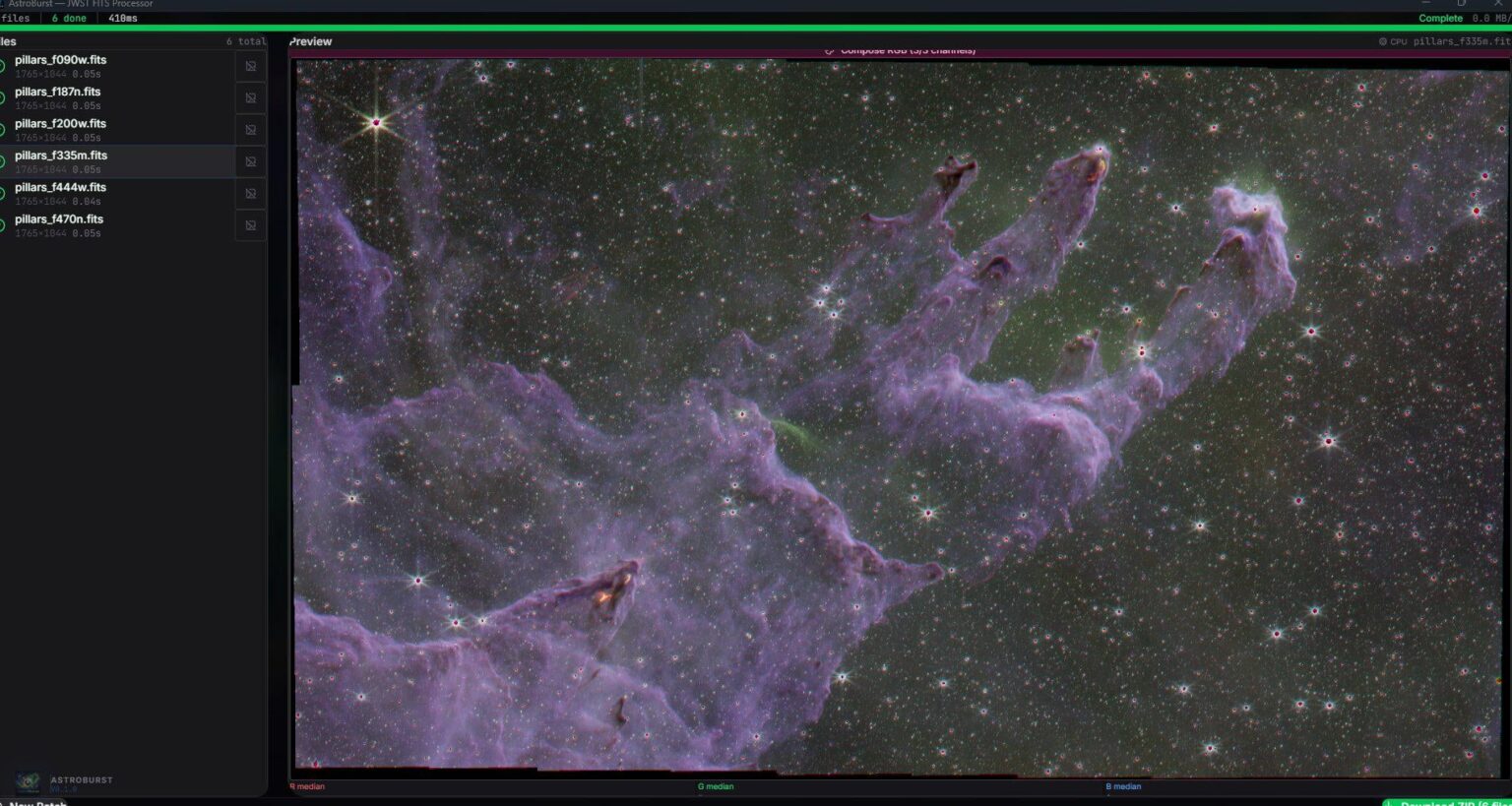
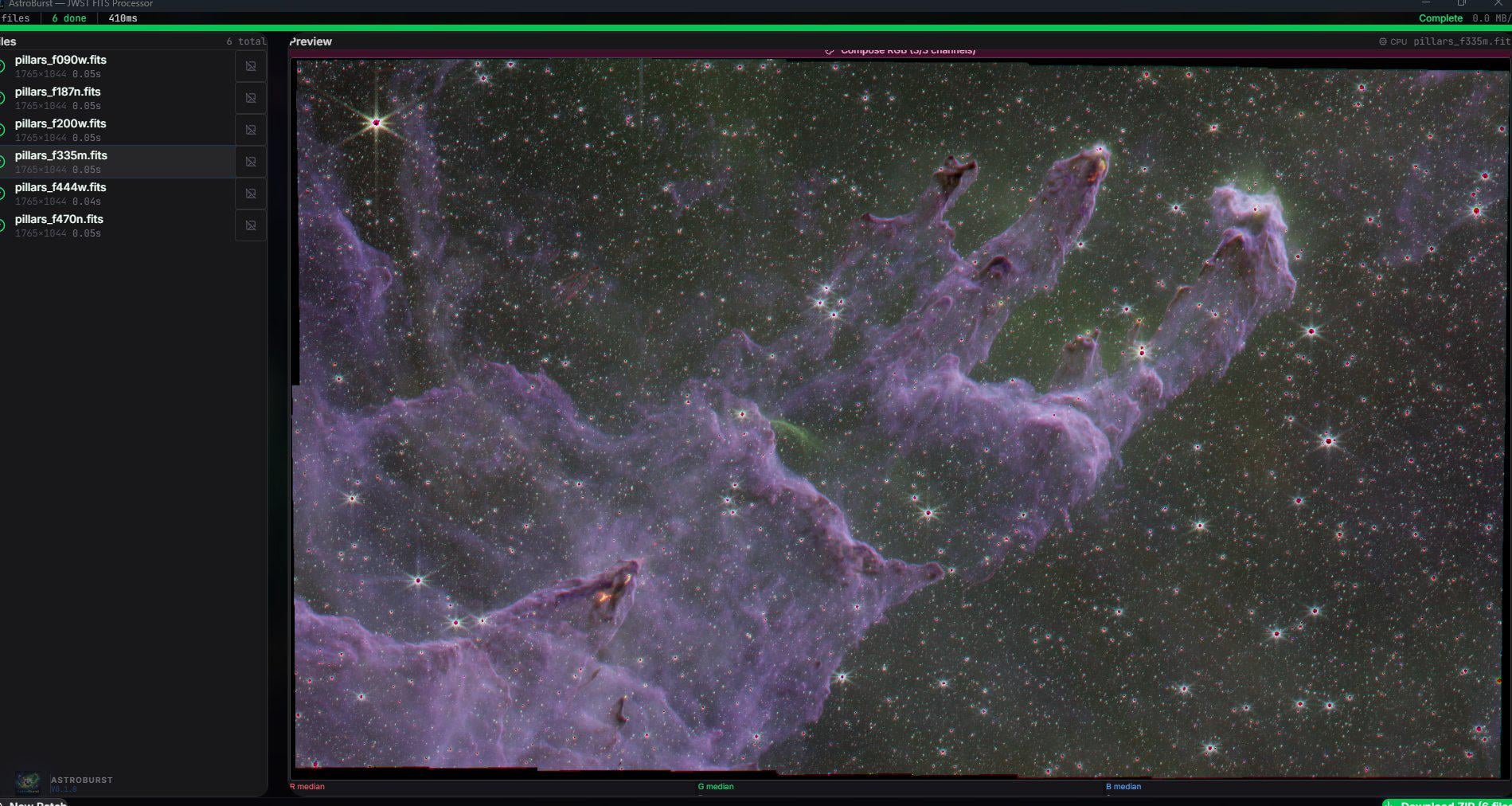
The image above is the Pillars of Creation (M16, Eagle Nebula) composed from JWST NIRCam long-wave data (Proposal 2739):
Red: F470N (4.70 μm)
Green: F444W (4.44 μm)
Blue: F335M (3.35 μm)
All 6 NIRCam filters (1765×1044 each, downsampled from 7865×4178 originals) loaded and composed in 410ms.
What AstroBurst does:
Opens single-HDU FITS with memmap (no full load into RAM)
Auto Screen Transfer Function (STF) with MAD-based stretch
RGB composition from separate narrowband/broadband filters
Asinh stretch, sigma-clipped stacking, drizzle integration
Histogram, FFT power spectrum, FITS header explorer
Star detection with PSF centroid fitting
WCS coordinate overlay and SCNR green noise removal
GPU-accelerated rendering via WebGPU compute shaders
I built this because PixInsight is $300 and Siril's UI makes me want to cry. AstroBurst is nowhere near their feature set yet, but for quick FITS inspection, RGB composition, and batch processing it's already usable. MEF support (for opening raw JWST/HST files directly without extraction) is coming in v0.2.0.
Tech stack: Rust 1.75+, Tauri v2, ndarray, Rayon, memmap2, rustfft, WebGPU/WGSL, React 19, TypeScript
Download: https://github.com/samuelkriegerbonini-dev/AstroBurst
MIT licensed. Works on Windows, macOS, and Linux.
Feedback, issues, and PRs welcome.
by Jazzlike_Wash6755
1 Comment
Bookmarked this post. Will give it a try.
Just download and install?
Will try stacked fits from Siril