
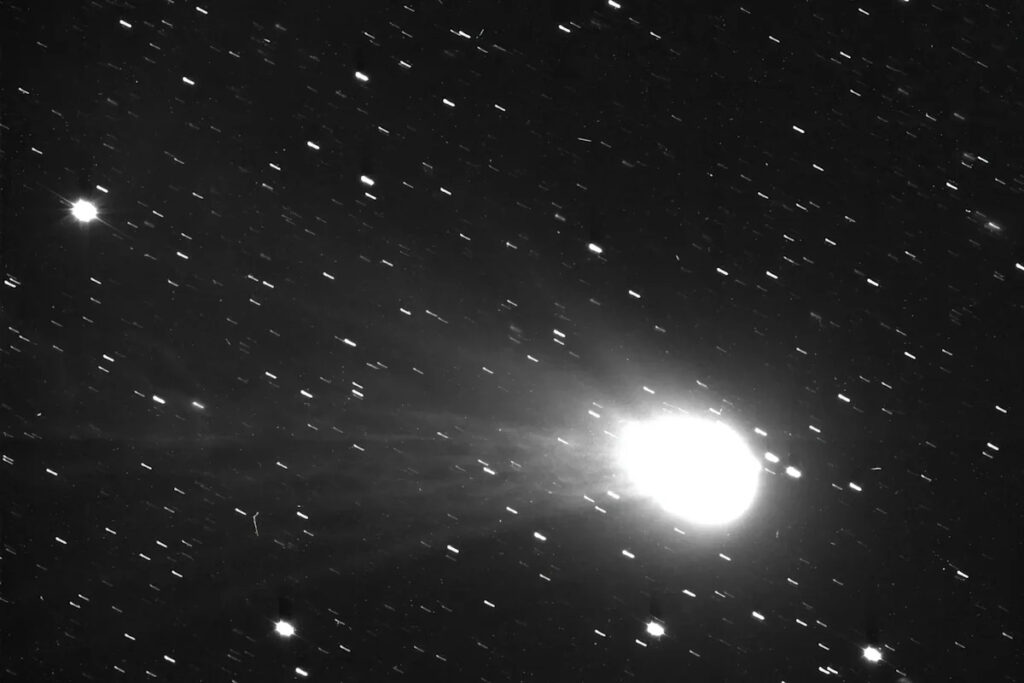
In late 2025 a mysterious comet flew between the orbits of Earth and Mars and reached a speed of more than 150,000 miles per hour during its closest approach to the sun. The rare interstellar guest to our solar system captured astronomers’ attention, and many trained their observations onto it in a bid to understand what exactly it is, why it is here and where it might be going.
Every new piece of data offers a glimpse at the space beyond our solar system. And as the comet, called 3I/ATLAS, speeds through our cosmic neighborhood, space agencies have coopted spacecraft to observe it as it goes. The European Space Agency’s Jupiter-bound spacecraft is no exception: a new image of the comet captured last November by the Jupiter Icy Moons Explorer, or JUICE, reveals it to be almost egg-shaped, with a cloud of gas veiling its central core, or nucleus.
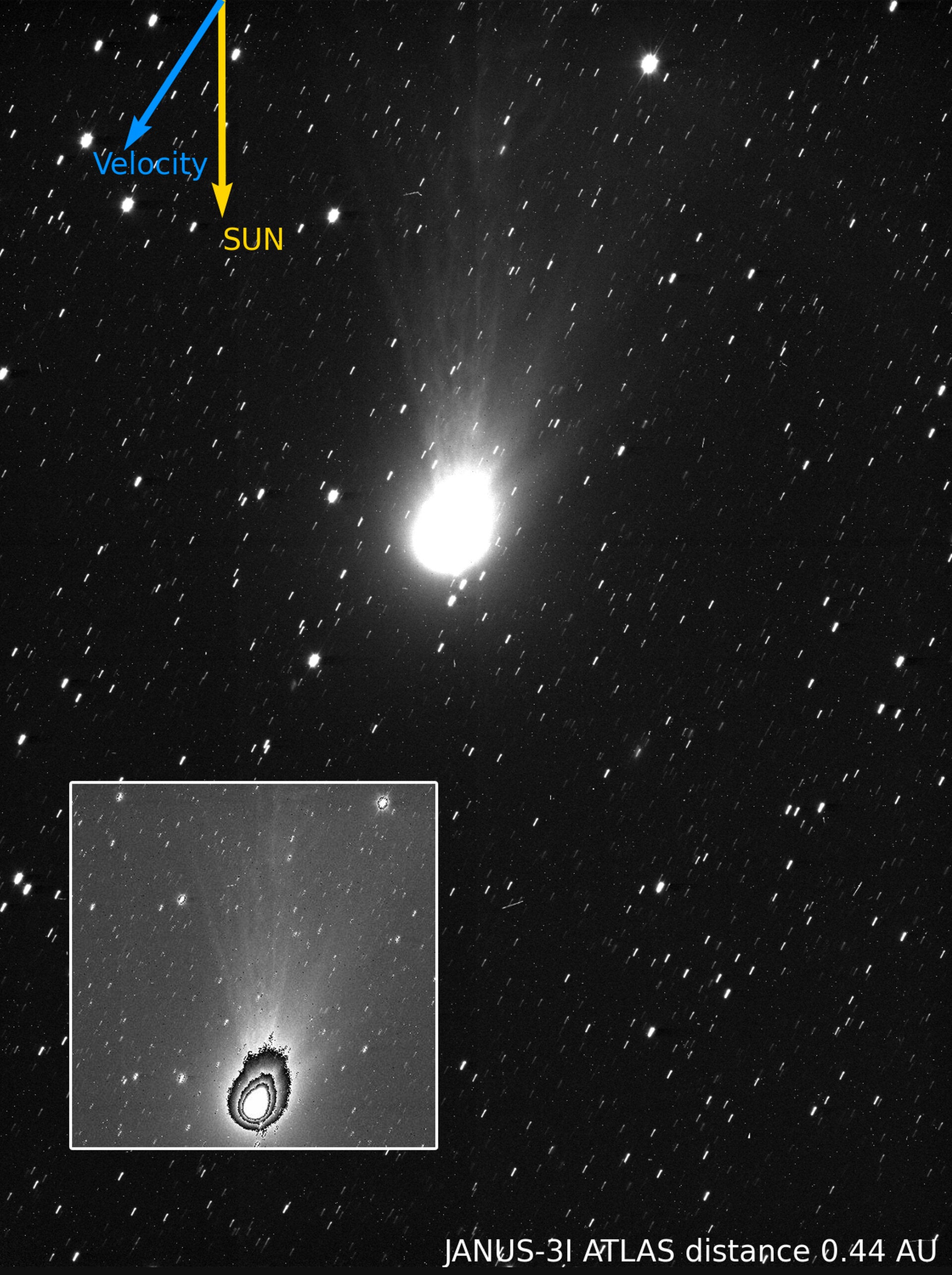
“While 3I/ATLAS is a visitor from interstellar space, travelling from outside the Solar System, its behaviour is completely in line with that expected from a ‘normal’ comet,” the agency said in a statement.
“No one knows where the comet came from,” said David Jewitt, director of the Institute for Planets and Exoplanets at the University of California, Los Angeles, in a statement last year. “You can’t project that back with any accuracy to figure out where it started on its path.”
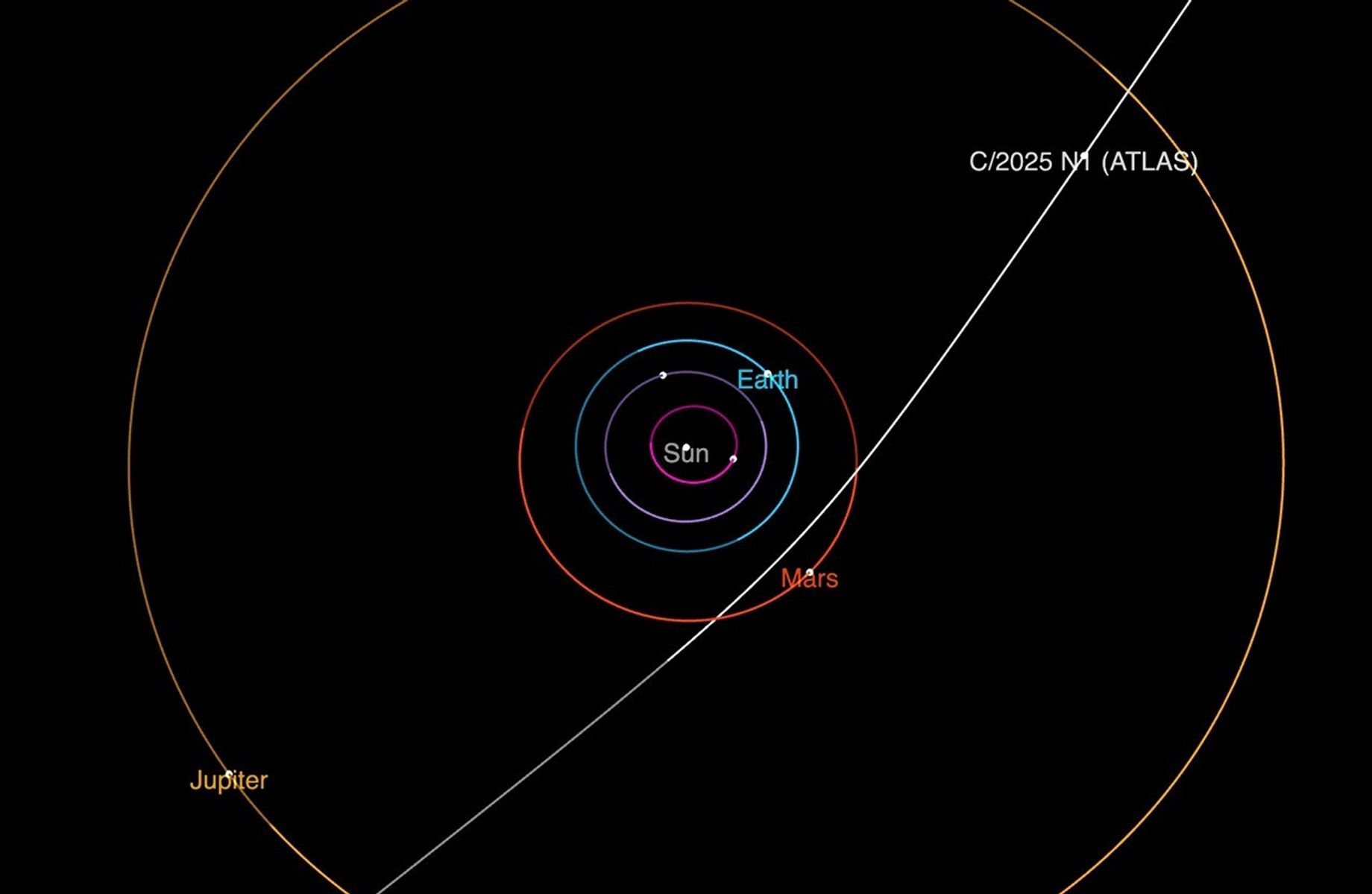
The trajectory of Comet 3I/ATLAS as it passes through the solar system.
Comet 3I/ATLAS has puzzled and excited scientists since it was first spotted in July 2025. Its extraordinary speed at the time—137,000 miles per hour—and strange trajectory indicated that it must been traveling through interstellar space for possibly billions of years, according to NASA. Just three interstellar objects have ever been discovered passing through our solar system. And despite the scramble to observe it as it goes, Comet 3I/ATLAS remains very much a mystery.
“It’s like glimpsing a rifle bullet for a thousandth of a second,” Jewitt said in the same statement.